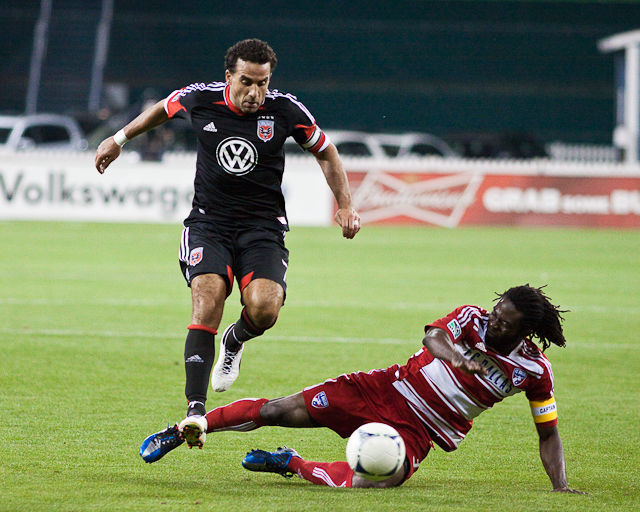
 D.C. United’s Dwayne De Rosario evades Dallas’ Ugo Ihemelu.
Yesterday, while snooping around Maryland Gov. Martin O’Malley’s proposed budget for the 2013 fiscal year, we found his proposal to spend $175,000 on studying the economic feasibility of moving D.C. United to a new stadium in Baltimore.
Only, when the article was originally published, I used a definite article in front of “D.C. United.” This apparently was in error, as suggested by the first comment on the post—”head explodes”—and later confirmed in an email from the team.
D.C. United should not be preceded by the word “the,” I was told, no matter how funny it sounds to my ears or anyone else’s. Other sports teams take a definite article when we write and speak about them. For example, we talk about the Redskins’ latest blunder, not Redskins’ latest blunder.
If other teams’ combination of a geographic location and nickname—two proper nouns—demand the use of a definite article, shouldn’t “The D.C. United” read and sound more correct than simply “D.C. United”? After all, there are other Major League Soccer teams for which using “the” is appropriate: The New England Revolution, the San Jose Earthquakes, the New York Red Bulls.
I had long operated under the assumption that United were akin to sports franchises that use singular nouns as nicknames—the Miami Heat or Utah Jazz, for example. Except “United” isn’t a nickname, team spokesman Kyle Sheldon told me in an email. It’s an adjective that describes the communal effect the team hopes to have on its fan base.
“The club unites people regardless of race, class, culture—and also unites D.C., Virginia and Maryland,” Sheldon said.
Moreover, it’s and old-timey soccer thing. Many, if not most high-level European teams go simply by their cities or boroughs perhaps accompanied by a few non-nickname modifiers. Arsenal F.C., to name one, is simply that: A football club that originated with workers at a 19th-century arsenal in southeast London. No nickname there, and saying “the Arsenal” in reference to a soccer team instead of a munitions store would just sound dumb. Same goes for Aston Villa, Tottenham Hotspur and, obviously, Manchester United.
Some teams in Britain’sEngland’s Premier League do have nicknames, such as the Blackburn Rovers or Wolverhampton Wanderers, though over there you won’t hear fans use the definite article in talking about those squads. That’s a bit murkier to explain. Is it in keeping with the British convention of dropping the definite article before institutional nouns—”He is in university to study philosophy”—or to match the way non-nicknamed teams are addressed? In 2009, the U.S.-based soccer blog The Run of Play pondered the anomaly posed by (the) Blackburn Rovers:
To American ears, using the nickname without the article suggests an unknown or undifferentiated quantity: if you saw zombies swarming up the front lawn, you would cry, “Zombies are swarming up the front lawn!” in the same way that you might cry “Rovers are swarming toward our six-yard box!” But then, assuming there was only one group of zombies, you would quickly start adding the article (“My God, the zombies are eating Fido!”), which never seems to happen for Blackburn.
Such is the case with several of D.C. United’s fellow MLS teams: Real Salt Lake, Toronto F.C., and the clumsily named Sporting Kansas City lack proper nicknames. If you want to haggle with Real Salt Lake, ask team owner Dave Checketts where he gets off suggesting his Utah-based team holds a royal warrant from the Spanish crown. (The soccer team in Spain’s capital city has one, hence, Real Madrid.)
But I’ve learned my lesson with respect to D.C. United. The definite article is neither needed nor appropriate when naming the soccer team that plays at Robert F. Kennedy Stadium. Now if that still makes you feel like your head is about to explode, please, get yourself to hospital.