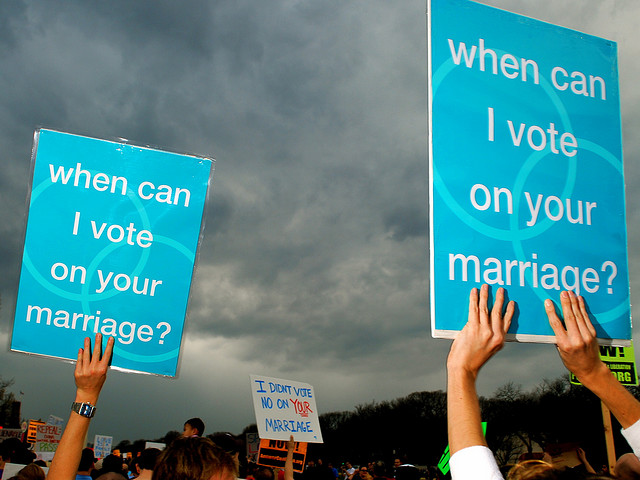
 Photo by M.V. Jantzen
While several area elected officials were quick to dole out their appreciation of President Obama’s newfound support for same-sex marriage, the news of the president’s stance was quickly followed by a very obvious question: What will be the political fallout?
In Virginia and Maryland, there could be quite a bit, some pundits expect. Maryland’s recent legalization of same-sex marriage is facing a ballot challenge in November, and already the law’s supporters and detractors say Obama’s embrace of marriage rights for all will help their cause. The Maryland Marriage Alliance, which sponsored the initiative to overturn the marriage equality law (which does not take effect until next January 1), said it does not think Obama’s statement yesterday will negatively impact its chances, according to the Associated Press.
“We feel that this will have little to no effect on the voters on the state of Maryland as well as the voters around the country,” Derek McCoy, the group’s executive director, told the AP.
Meanwhile, some African-American pastors who were part of the anti-gay-marriage drive are urging their congregants to vote to repeal the new marriage statute but not against the president’s re-election campaign.
In Virginia, where voters in 2006 adopted a referendum banning same-sex marriage, observers of the U.S. Senate race between Democrat Tim Kaine and former Republican George Allen are saying marriage equality could become a campaign issue this year. Kaine, who was governor when voters chose to restrict marriage rights, opposed that referendum and has said he supports the repeal of the military’s “Don’t Ask, Don’t Tell” policy, said little after Obama’s announcement yesterday.
“Governor Kaine believes in equal treatment under the law,” a Kaine spokesperson told the Richmond Times-Dispatch. “While he does not believe government should tell faith congregations what unions to recognize for religious purposes, he does believe that all committed couples, regardless of sexual orientation, should have the same legal rights and responsibilities.” Allen, meanwhile, reiterated his belief that marriage should be limited to one man and one woman.
The 2006 referendum passed 57 percent to 43 percent, but today, its support has dipped to just 52 percent, the Times-Dispatch reported. Nationally, 49 percent of voters support same-sex marriage with 40 percent opposed, according to a March poll conducted by The Wall Street Journal and NBC News.
But while Kaine, who was Obama’s pick in 2009 to head the Democratic National Committee, might get some pressure to clarify his own stance on same-sex marriage, it might not weigh on him as heavily as it did on the president. “What are liberals going to do, vote for George Allen?” Larry Sabato, the University of Virginia political scientist, asked the Times-Dispatch.