DCist’s subjective and incomplete guide to the finest in digital and occasionally celluloid entertainment coming to town in the next week.
—
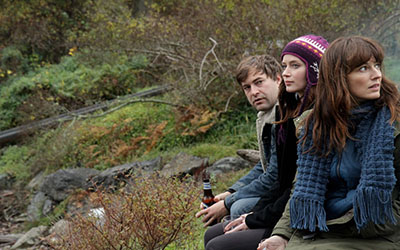 From left: Mark Duplass, Emily Blunt, and Rosemarie DeWitt. (Steven Schardt/IFC Films)
 Jack (Mark Duplass) is an unemployed Seattle slacker, emotionally challenged at the best of times and still smarting over the death of his brother a year ago. His best friend Iris (Emily Blunt) invites him to stay at her family cabin to clear his head and detox. But instead of time alone he finds Iris’s sister Hanna (Rosemarie DeWitt). They get off to a bad start but lay waste to a bottle of tequila, and the film seems like it’s going to be a compelling two-hander. But Emily Blunt gets top billing, and she makes it a chamber piece in a very different cabin in the woods.The set-up is dangerously close to sitcom territory but the writing is frank and the actors have a tense chemistry that makes it hard to look away. There’s a glaring bit of exposition to explain why Iris has a British accent and Hannah doesn’t, but apart from that minor misstep the dialogue and relationships are real, the sit-com framework filled in with characters you can’t stop watching. The fourth feature by Humpday writer-director Lynne Shelton, Your Sister’s Sister is an intimate drama of humor and tension that recalls early Polanski and Bergman, but with a indie-folk soundtrack and Pacific Northwest setting that marks it as distinctly American. Blunt may be the money maker on this marquee, but Duplass, his humor masking a self-loathing rage, owns this movie.
View the trailer
Opens tomorrow at E Street and Bethesda Row
—
 Gerhard Richter working on “Abstract painting (911-4)” (Kino Lorber)
German painter Gerhard Richter is one of the greatest living artists. He was the subject of an essential retrospective that came to the Hirshhorn in 2003, and one of his massive abstracts is currently on view at the National Gallery of Art’s East Building. But would you want to watch him paint? Corinna Belz is not the first filmmaker to focus on the creation of a canvas—Victor Erice’s The Quince Tree spent more than two hours with painter Antonio López García in a more rewarding film. Richter tells Belz that he can’t paint while being watched. So much of the footage comes from a camera left on a tripod to observe the broad strokes and squeegees that go into two late abstractions. This studio footage is cut with interviews dating back to the 1960s and shots of miniature reproductions of his work, as well as mockups of various exhibitions. What tension there is comes from the non-chronological decision to save his most powerful work for the final reel: the fifteen-painting cycle called October 18, 1977. This series of works based on newspaper reports of the Baader-Meinhof case are among Richter’s most enduring canvasses, but the film assumes the viewer is familiar with the cycle and its political context (cf. The Baader Meinhoff Complex). Fans of the artist will find this a must-see, but the PBS-style politeness (complete with a closing credits that play over, surprise, Bach) won’t make any converts. For a truly illuminating art documentary (thanks in part to a life that is as compelling than the work), don’t miss Ai Weiwei: Never Sorry, coming to Silverdocs next and E Street in July.
View the trailer.
Opens tomorrow at E Street.
—
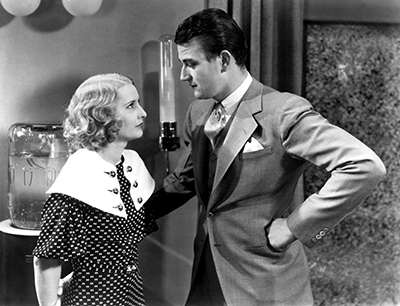 Barbara Stanwyck and John Wayne in Baby Face
 The Hirshhorn’s summer film series moves away from campy monster movies this year to survey another powerful creature: the baby. None of the titles in Baby Kamp, which will be introduced by film scholar Dr. David Wilt, features a literal baby, but play on the tension between innocence and experience. Tonight the series opens with Baby Face, a sensational pre-code vehicle for Barbara Stanwyck who stars as a woman who looks innocent enough but sleeps her way to the top. Maybe we can petition the Washington Psychotronic Film Society to counter-program Larry Cohen’s It’s Alive series and the disturbing 1973 adult baby horror movie.
View the trailer for Baby Face.
Tonight at the Hirshhorn at 8:00 pm. Free.
—
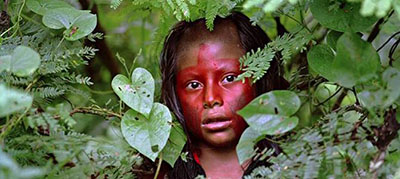 Baraka
“A film festival for heart & mind,” this year’s edition of BuddhaFest is again hosted by the Artisphere. The opening night film is director Tiffany Shlain’s Connected (Thursday, June 14 at 7:30pm) , a “warm and exhilarating journey of self-discovery.” But what may be the festival’s most intriguing program is already sold out. Meditation teachers Tara Brach (author of Radical Acceptance) and Jonathan Foust speak with Rep. Tim Ryan (D-OH) on “The Alchemy of Transformation: Awakening Our Hearts, Healing Our World”, (Friday June 15 at 7pm) followed by the film Buddha’s Lost Children. Other film programs include Baraka (Saturday, June 16 at noon) cinematographer Ron Fricke’s heavy-handed follow-up to the 1982 time-lapse footage classic Koyaanisqatsi; Ram Dass: Fierce Grace (Sunday, June 17 at 7 pm), a documentary about the 1960s guru and Timothy Leary acolyte, followed by a Skype discussion with Ram Dass; and Bodhisattva: The Journey of the Seventeenth Gyalwa Karmapa (Sunday, June 16 at 2:45 pm), the East Coast premiere of a film about a man whom many see as the natural successor to the Dalai Lama.
View the trailer for Bodhisattva.
Thursday, June 14—Sunday, June 17 at the Artisphere. See the festival website for details.
—
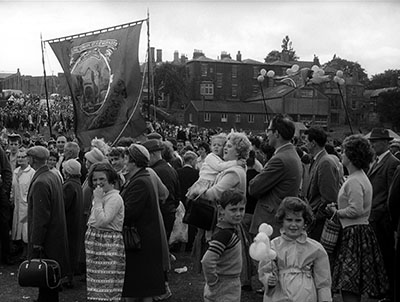 The Miners’ Hymns (Icarus Films)
Early motion pictures were printed on volatile nitrate stock that was highly combustible. For his experimental film Decasia: The State of Decay (2002), filmmaker Bill Morrison assembled decomposed nitrate reels, and the result was a sequence of images that was barely recognizable but marked by an intense visual poetry. The director’s recent work continues to tap archival footage in the state of decay or simply age. The Miners’ Hymns (Saturday, June 16 at 2:30 pm), takes material from the British Film Institute archives and sets it to music by atmospheric (is there any other kind?) Icelandic composer Jóhann Jóhannsson. Morrison’s latest project, Tributes-Pulse (Saturday, June 16 at 4:30pm) marks a return to the poetry of decaying nitrate. The film will be presented with live musical accompaniment by Peter Navarro-Alonso and Simon Christensen. Tributes-Pulse was conceived as a tribute to a diverse set of American musicians: Charles Ives, Conlon Nancarrow, Steve Reich, and Trent Reznor. For Spark of Being (Sunday, June 17 at 4:00p m), Morrison collaborated with New York-bred jazz trumpet player and composer Dave Douglas in an avant-garde interpretation of Mary Shelley’s Frankenstein.
View the trailer for Spark of Being.
Saturday, June 16 and Sunday, June 17 at the National Gallery of Art. Free.
—
Also opening this week, the 80s returns in an all-star film adaptation of the Broadway musical Rock of Ages; and in Adam Sandler’s latest atrocity That’s My Boy. We’ll have full reviews tomorrow. And stay tuned for DCist’s coverage of Silverdocs, which opens next week.