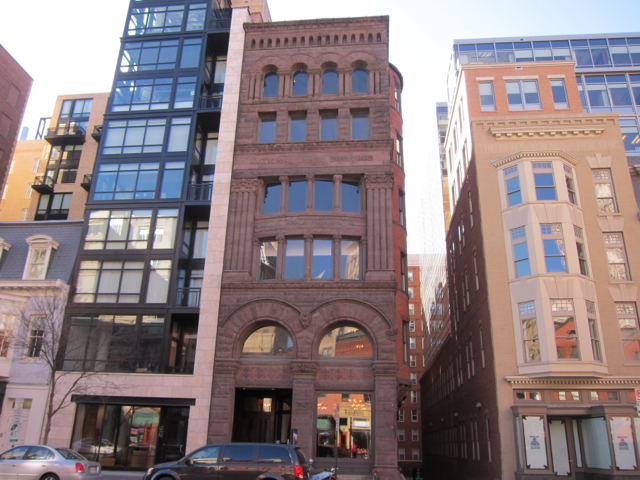
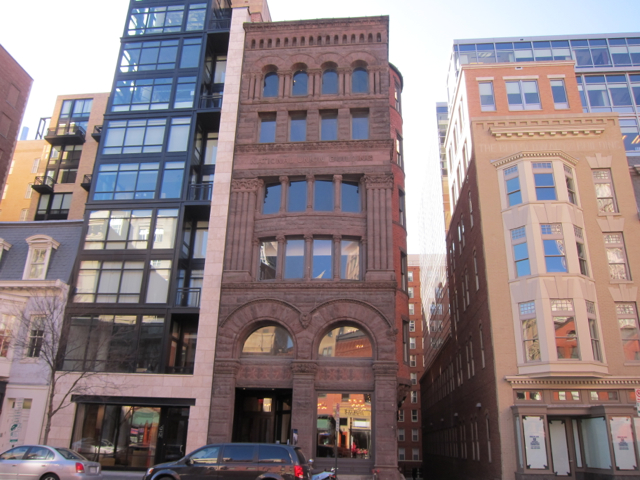
 One of LivingSocial’s six D.C. offices, located at 918 F Street NW. (Photo by Benjamin R. Freed)
Mayor Vince Gray’s proposal to grant generous tax breaks to LivingSocial in order to keep the expanding daily deals website based in the District is up for a vote in the D.C. Council today, but the deal as originally arranged might be lacking.
That’s the position of the D.C. Fiscal Policy Institute, which last week suggested a menu of amendments to the tax deal that might make it more beneficial to District residents.
“We’re concerned the city is giving a lot without getting much in return,” says DCFPI head Ed Lazere.
The LivingSocial deal, when it was first proposed in April, would decrease the company’s tax burden by $32.5 million over a five-year period beginning in 2016. In return, LivingSocial would agree to remain headquartered in D.C. and guarantee that at least half its new hires are District residents.
But that’s a bit too vague for DCFPI. Lazere says that simply requiring half of its new employees to live in D.C. could allow LivingSocial to maintain its current staffing level of about 1,000 local denizens.
“A new hire could include someone who is hired to replace someone who is leaving,” he says.
The institute doesn’t oppose the subsidy program on balance, though. Lazere concedes that LivingSocial has grown large enough since its founding in 2007 that “there is clear interest in keeping them here.” But as the mayor’s proposal is written, DCFPI doesn’t see LivingSocial as committed to the District as it could be. Once LivingSocial satisfies the bare minimum of requirements, Lazere says it could still decamp from the District.
“So what we’ve argued is ‘fine, let’s offer a subsidy,’ ” he says. “But expect to get something in return.”
In the DCFPI proposal, the deal would include repayment penalties, or “clawbacks,” if LivingSocial fails to make good on its promises to D.C. The company has been seeking the space to build a 350,000-square-foot headquarters to consolidate the half-dozen offices its hometown staff is currently spread out across. Should the company wind up finding that bigger office space in, say, Virginia, after the tax abatement runs its course, DCFPI argues that LivingSocial should repay the sum. Same goes if the company does not meet its promise of eventually expanding its D.C. workforce to 2,000.
In the D.C. Council today, several members offered statements about keeping tabs on LivingSocial’s new hires. Yvette Alexander (D-Ward 7) asked what oversight would be conducted to ensure that half of the company’s new employees are, in fact, D.C. residents. Tommy Wells (D-Ward 6) said that in his conversations with the company he was told that LivingSocial is remaining tied to the District because “this is where the workers are now moving.”
Councilmember David Catania (I-At Large) spoke more leniently toward the company, noting that in five years of operation, it’s still looking for its first positive balance sheet. “LivingSocial still needs to tend its own garden and become profitable,” he said. Catania also said that LivingSocial provides D.C. businesses with a multiplier effect by advertising local merchandise and services in its daily coupons.
But where there seemed to be broad agreement from the Council with what DCFPI is proposing is a more defined community benefits partnership between the District and LivingSocial. Right now, the deal “has nothing about training D.C. residents” for jobs with the company, Lazere says. He proposes that LivingSocial invest itself at the University of the District of Columbia and McKinley Technological High School, where many students are enrolled in software and Internet programming courses.
The Council approved the tax incentive package to be moved to a legislative session following today’s meeting of the Committee of the Whole, but agreed to revisit the benefits LivingSocial would offer to the community at large.