Martin Austermuhle
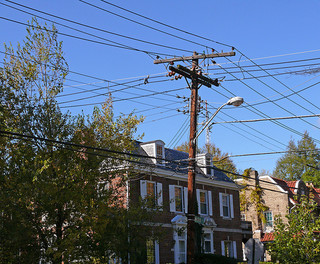 Photo by billadler
After the derecho storm that swept across the region knocked down power lines and left tens of thousands of D.C. households in the dark, residents again started asking an obvious question: why not just bury all the power lines and be done with it?
Councilmember Mary Cheh (D-Ward 3)—whose constituents experienced some of the most widespread blackouts after the storm—seems to wondering the same thing, and will introduce legislation that would do something about it.
As part of her proposal, a five-person Underground Conversion Assessment Commission would identify “Underground Utility Districts” where it would be easiest to bury power lines, based on factors such as ongoing construction projects, neighborhood aesthetics and whether burying the power lines would actually help stop power outages. After a period of review by the mayor and D.C. Council, those areas would be green-lighted for power lines to be buried.
Of course, then there’s the matter of cost, with Pepco arguing that burying power lines can be prohibitively expensive and others countering that Pepco is merely saying so to get out of actually doing it. (A 2010 D.C. report found that it could cost between $1.1 billion and $5.8 billion, depending on how many lines are buried.) The legislation addresses the price tag by creating a Underground Utility District Trust Fund, which will take in money from a four percent assessment on the sale of electricity in D.C. Only when there is enough money in the fund would work begin; the legislation wouldn’t preclude Pepco from burying power lines itself.
According to Cheh’s staff, the bill is mirrored on a similar program that started in Anaheim, Calif. in the mid-1990s and aimed to bury 100 miles worth of wires over 50 years. The cost there has been $3 to $4 million a mile, and has come out to roughly $24 per household annually.
The Post recently had a good rundown on the long-running debates over whether or not to bury D.C.’s power lines.