Martin Austermuhle
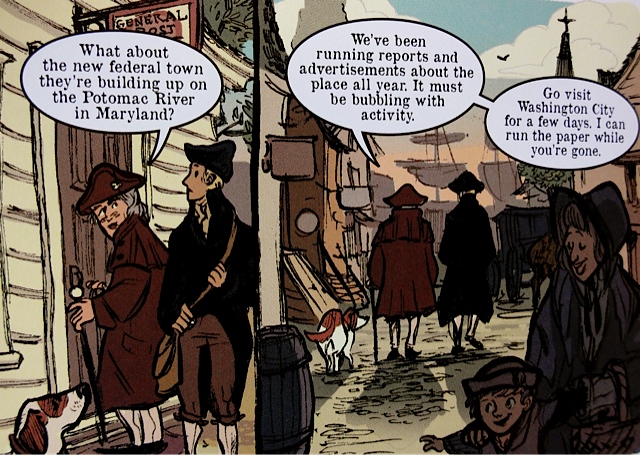 “Impartial? Washington’s First Newspaper” from “District Comics: An Unconventional History of Washington, D.C.”
It’s not a conventional history book. It’s also not a conventional comic book. Rather, it’s both—unconventionally.
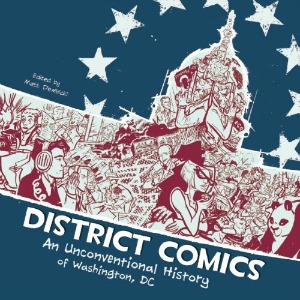 District Comics: An Unconventional History of Washington, D.C. is a 250-page-long comic book that traces the arc of the city’s history in 22 beautifully illustrated and vibrant comic strips. From the 1814 burning of Washington by the British and Walt Whitman’s visit to D.C. during the Civil War to why Bad Brains wrote the song “Banned in D.C.” and how a shoe-shiner helped bring down a Jim Crow-era law, the book and its talented illustrators seek to “uncover a city rich in history, offbeat tales, and unique personalities.”
The book is the brainchild of Matt Dembicki, a member of the D.C. Conspiracy, a comic creators collective. He answered some questions for us on how the project came together and why he chose comic strips as a means to recount the city’s history.
What’s your background, and how did you get involved in the project? What made you think, “Hey, I think a comic book about D.C. history is a cool idea?”
Matt Dembicki: About two years ago, local cartoonist Andrew Cohen and I did a 20-page minicomic about legendary D.C. brewer Christian Heurich and his mansion at Dupont Circle. It was very well received, especially by the Heurich family and the museum staff and board. That got me thinking about other cool D.C. stories that would convey well in a comics format.
How did you solicit ideas and submissions, and how did you connect with the different artists?
MB: I wanted the anthology to cover the history of D.C., from its beginnings to contemporary times. I personally know all the writers and artists on the projects—nearly all of whom live in D.C. or have lived in D.C.—and let them pitch me stories.
My job was to make sure we had stories that covered all the eras and that we didn’t have too many in one area. For example, we had about a dozen pitches for stories related to the Civil War period. For writers who were stumped, I had a cache of potential stories that they could go with or use as a springboard for their own ideas.
Are there any moments or parts of D.C. history you wish had made it in but didn’t?
MB: I would have liked to find a fitting story that was post War of 1812 but pre-Civil War. There wasn’t a whole lot going on during that period in D.C., but I would have loved to find a nugget in there.
In some ways, comics are a dying art form. What’s attractive to you about comics, and what do you think comics can bring to the table that other media might not be able to?
MB: I think of comics as another form of storytelling. Personally, I enjoy balancing text and art, and tackling the challenges that it poses. In my mind, comics vary from other media in the different artistic styles that they can represent. In comics, I’m first drawn to the art and then I read the story if the art grabs me.
Hopefully, there’s good chemistry between the art and story. I think comics allow you to absorb both at your own speed. You can stop and fully absorb an image, if you want to. You can’t really do that with movies. And with prose books, you don’t have the visual to enjoy.
Do you have any favorite parts of the book?
MB: I enjoyed the contemporary stories a little more. Perhaps because I’m fairly well versed in history up to and including the Civil War. Schools seem to focus on those time periods the most. I think we generally forget that history comes up to the edge of current times.
The book is available at local bookstores—I bought my copy at Politics & Prose—and Dembicki will be exhibiting at the Baltimore Comics Convention on September 8-9 and at the Small Press Expo in Bethesda on September 15-16.