
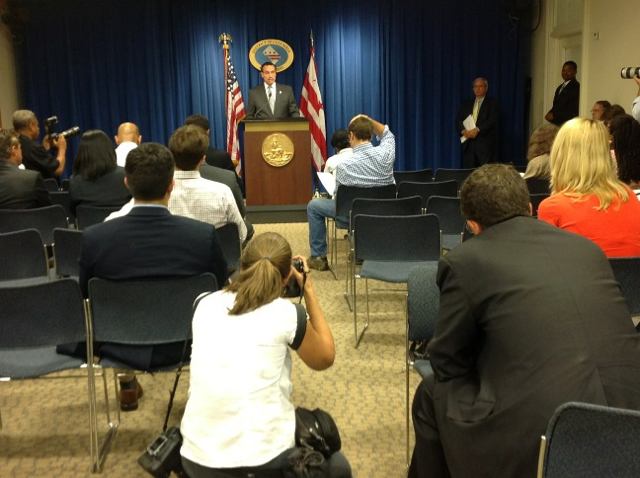
 Photo by @mayorvincegray
Mayor Vince Gray and D.C. Attorney General Irv Nathan introduced today new legislation they hope will bring a new sheen of legitimacy to a local political scene often confounded by scandal-laden campaigns.
At a press conference Tuesday afternoon at the John A. Wilson Building, Gray and Nathan said the proposed reforms would by ending a “pay-to-play” culture by restricting many D.C. government contractors from contributing to candidates for offices with purview over their contracts.
The bill would also prohibit registered lobbyists from acting as campaign bundlers—individuals who corral contributions from numerous donors—and strengthen disclosure rules for organizations that act on the behalf of a candidate. And, in a proposal that is sure to remind D.C. political observers of the fundraising network led by former Medicaid contractor Jeff Thompson, money order contributions would be subjected to the same $25 limit as cash donations.
“This is one of the most important issues our city faces,” Gray said at the news conference. “I’m going to do everything I can to see it’s adopted.”
Of course, the draft legislation is having its debut amid an ongoing federal investigation into Gray’s 2010 mayoral campaign, an inquiry that has revealed that several of his close allies operated an off-the-books “shadow campaign” largely backed by a $653,000 contribution from Thompson. Gray, who has not been accused of any wrongdoing, raised reforming the District’s campaign rules in late June. Around that time, Gray’s political circle was rocked by guilty pleas by several of his 2010 aides that revealed the nature of the shadow campaign.
The new legislation, if passed in its current form, would prohibit contractors who hold or are pursuing government contracts valued at more than $250,000 from donating to the officials who hold sway over those contracts. However, there would be a $300 exemption for family members, and donation restrictions would not begin until contract bids are solicited, Nathan said.
“The goal is to seek to combat even the appearance of favoritism,” he told reporters.
The proposed legislation is set to go before the D.C. Council when legislators reconvene next month, following a public comment period. And while it seeks to considerably limit the way campaigns in D.C. operate, it does not go nearly as far as some reformers would like.
“Being supportive, I think it’s a great first step,” says Bryan Weaver, the Ward 1 activist who led D.C. Public Trust’s unsuccessful effort to get a ballot initiative proposing the banning of corporate contributions. Gray’s and Nathan’s bill would not do that, but instead require corporate donations to be “attributed to the controlling shareholder and any affiliates of the entity so that maximum contribution limits cannot be evaded.”
But while Weaver, who attended the press conference, is pleased the mayor and attorney general are making this effort, he is unsure about the bill’s prospects once it reaches councilmembers.
“My concern is it many the things he’s propsing is things the council voted down last year, overwhelmingly,” Weaver says. “I don’t know if there’s a stomach for it on the council.”
More troubling to Weaver, however, is the fact that the bill, as written, does not contain language authorizing additional funding to the Office of Campaign Finance, which presumably would need added resources to enforce new regulations. Nathan said as much in his answers at the news conference.
“Do these things mean anything if we don’t have the money to enforce it?” Weaver asks. “It got folded over pretty quickly in the press conference, but that’s pretty critical.”