Martin Austermuhle
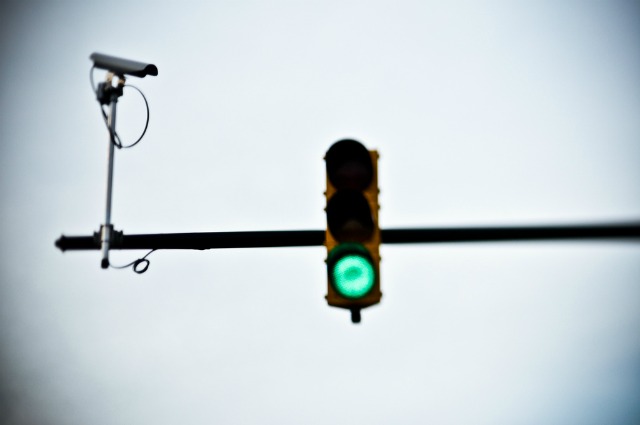 Photo by Chris Rief
How high a fine will it take to change the behavior of a driver who speeds? Or runs a red light? Or blocks the box? And is D.C.’s ever-expanding network of traffic cameras really seeking to promote safety for pedestrians and cyclists, or merely pad the coffers of a city that regularly runs into budget deficits?
Those were among the nettlesome questions that a new task force created by Councilmembers Tommy Wells (D-Ward 6) and Mary Cheh (D-Ward 3) sat down to debate yesterday, with an eye towards possibly putting forth legislation that would change the way the city doles out automated traffic tickets.
The discussion comes amidst a plan by D.C. to expand its network of traffic cameras and broaden they types of violations they record. According to MPD, starting in October of this year cameras will be purchased to cites drivers who run stop signs, fail to clear an intersection, fail to yield to pedestrians in a crosswalk, or speed through an intersection.
According to Lisa Sutter, Program Manager for MPD’s Photo Enforcement Program, some 16-24 cameras to monitor the different violations will be installed citywide. When added to the growing network of speed and red light cameras, Sutter said, the city expects to rake in some $91 million in fines in 2013—up from the $51 million it claimed in 2010 and $55 million in 2011.
But Wells and Cheh, both advocates of cycling and walking, said that with more cameras coming to D.C., residents and visitors have to be better convinced that the technology is being used to promote safety, and not just generate revenue. (According to a recent poll, many drivers think they’re for the latter, not the former.)
Sutter insisted that safety is the goal, and that the cameras are having an effect—in those sites that have gotten cameras, she said, violations dropped between 60 and 80 percent within two to four months. Still, said Wells, residents need to know why D.C. assesses the fines it does, which range from $75 to $250 depending on the violation.
“We need to have a rationale behind it,” he said. “Or it will be based on the presumption that the fine is contingent on how much money D.C. needs.”
That, though, won’t be easy to determine. Sutter said that it set its fines based on what other juridictions do—fines did increased in 2010, though—and that automated traffic fines are the same as those that a regular police office would dole out. (Officers can assess points, though, while cameras don’t.) Still, both Montgomery County and Prince George’s County have lower fines for speeding violations, though the members of the task force seemed to differ on whether those two jurisdictions were too low or D.C. was too high.
Laura Langbein, a professor in American University’s Department of Public Administration and Policy, said that fines have to be set according to the damage that a specific violation can cause. Essentially, she argued, you have to determine everything from how many days someone might be out of work to what an average human life is worth and set fines accordingly. Is that more than what D.C. currently charges, or less? The task force’s members had no answer yesterday.
Still, Cheh said that fines need to reflect the severity of the violation, and should be used as a means to change the culture of driving in the city. “Some of these offenses are so inherently dangerous that we have to make a statement that we’re not going to tolerate them,” she said.
But even beyond that, Cheh admitted, just bringing up traffic cameras can be a political minefield. For every camera that one group of residents protest, she said, there’s another group that supports them. Sutter said that she regularly gets requests from residents for cameras on their streets, and that the majority of tickets aren’t going to D.C. residents—on average, she said, Maryland drivers pick up 50 percent of the automated tickets, Virginia residents get 15 percent, other jurisdictions get 10 percent, and D.C. residents get 25 percent. Wells quipped that Maryland motorists “drive like they own the place,” while Virginia vehicles seem to be operated by “perpetual tourists.”
The task force will meet through the fall—the next meeting is on September 10—and try to formulate recommendations that make it into law, including possible graduating fines, better education campaigns and alternative punishments.
But even if it does agree to changes to how the city collects automated traffic fines, they likely won’t go into effect for another year—D.C. has already budgeted for what it expects to make off of fines for the fiscal year, meaning that any changes do how fines are assessed would require the D.C. Council to find money to make up the difference.