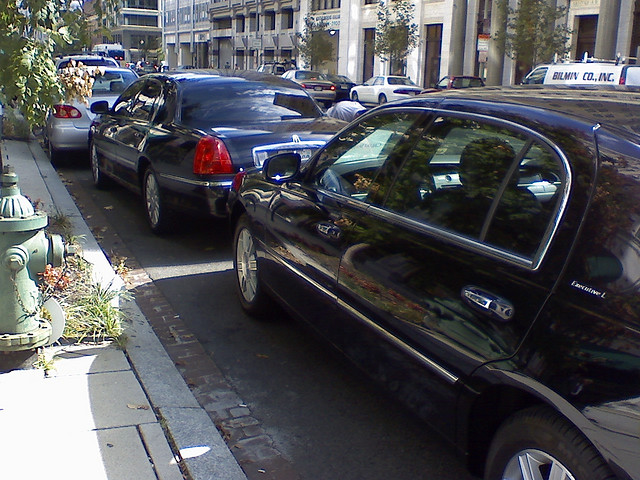
 Photo by Dan Macy
In the first four hours of a hearing yesterday about proposed regulations over livery sedans, members of the D.C. Council’s Environment, Public Works and Transportation Committee questioned witnesses along what appeared to be a closed loop, repeatedly coming back to the same talking points about the inefficiencies of the District’s taxicab fleet, the increased use of mobile applications to hail rides and even the laws of supply and demand.
Of course, while the hearing was officially designated as covering “public vehicles-for-hire,” the real focus was on the future of the upscale livery service Uber’s operation in D.C.
The panel’s chairwoman, Councilmember Mary Cheh (D-Ward 3), scheduled the hearing after the publication last week of dozens of new regulations floated by the D.C. Taxicab Commission that would, if enacted, severely overhaul the way sedan services operate here.
Uber, which has had several prickly encounters with the commission and the Council in the nearly 10 months since it established a foothold in D.C., promptly called the proposed rules an attempt to drive it out of business in the Washington market.
Travis Kalanick, Uber’s outspoken founder and chief executive, was among 42 witnesses signed up to offer testimony yesterday. Joining Cheh on the dais were Muriel Bowser (D-Ward 4) and Jim Graham (D-Ward 1), both of whom also engaged in the often repetitive questioning that kept witness panels in front of the Council chamber for up to two hours at a time.
The first panel included John Mason, the director of taxi oversight for Transport for London, who appeared from the British capital over a Skype link. Among the qualities of the London taxi fleet Mason mentioned is a fleet that is entirely accessible to handicapped customers, drivers who are licensed only after a rigorous and years-long examination process and no bureaucratic difference between cabs that are hired through either a street hail or a smartphone app.
Visiting from London in person was Jay Bergman, a founder of the taxi-hailing application Hailo, which is making its own plans to enter the D.C. market. In an apparent appeal to both the DCTC as well as the councilmembers with whom Uber has clashed, Bergman spoke about working collaboratively with the regulators who oversee livery services in two cities—London and Dublin.
Bowser was one of the first to come to Uber’s defense, saying she uses the service regularly, including last weekend when she rode downtown for a $38 fare. But, she said, a hired car’s reliability is more important than it’s relative luxury. “I’m cheap,” she told Bergman. “It doesn’t matter to me what kind of car it is.”
Still, Uber had plenty of unabashed defenders. One of the most vocal was Saad Hamadi, a Virginia-based owner and operator of a black livery sedan who said the San Francisco-based company has significantly improved his profession.
“My relationship with my customers is good, my work is smooth,” said Hamadi, who described himself as one of Uber’s highest-rated affiliates in the D.C. region. Hamadi said his income from Uber has helped him pay his mortgage, bills and education payments.
Of the regulations proposed last week, Hamadi was particularly concerned with a requirement that sedan fleets contain at least 20 vehicles to operate in D.C. The regulations also allow for individual cars, but appear to prohibit fleets ranging between two and 19 vehicles, a detail Kalanick said in an interview last week would put many of his affiliated drivers out of work. Cheh appeared to agree with that assessment.
Kalanick was finally seated about 1:15 p.m., ready to spar once again with D.C. officials whom he said are proposing rules “ranging from the Draconian to the inane.” He vigorously defende Uber not just as an effective bit of technology, but as a public good, too.
“What about the drivers?” Kalanick asked. “The average driver on the Uber system is making $1,000 a week and that’s filling out their dead time. Some are earning $3,000 a week.” He also repeated his assertion from last week that Uber has helped create “hundreds of jobs” in the livery industry.
“Our service was legal from the beginning,” Kalanick continued. He and Cheh returned to their July showdown, when Uber’s users rebelled against an amendment to a taxicab overhaul bill that would have implemented a price floor for the company’s services. Though Uber had participated in negotiations with Cheh’s office over the minimum fare, on the day the large bill was set for a final vote, Kalanick encouraged his customers to inundate councilmembers’ offices with disapproving emails and phone calls. Rather than allow the price-floor measure sink the overall legislation, the amendment was stripped out and replaced with one that exempts Uber from DCTC oversight through December 31.
But with that sunset in reach, the commission released a new attempt to put controls on the livery sedan industry, which is subject to far less oversight than D.C.’s fleet of nearly 8,000 taxis.
“These regulations would be uniquely restrictive among all major cities in the country,” Kalanick said. “They would ensure that tech solutions go elsewhere.”
Graham was having none of it, however. “I don’t want this city to be Uber,” he said, repeatedly reminding Kalanick that he was in Washington, D.C. whenever the Uber CEO attempted to compare his experience here to that in another major U.S. city. Graham also said that he was “interested in preserving” D.C.’s existing taxicab infrastructure, a sentiment that seemed to clash with many in the room, including Cheh, who—her dealings with Uber aside—has attempted to modernize the taxicab industry.
Eventually, Kalanick said, he would like to lower his company’s minimum fare of $15, provided Uber and its partner drivers can agree on a reduced price point. But Graham resisted.
“My concern is your fares dropping so that you are in competition with taxi drivers,” he said. Several times, Kalanick told Graham that his goal is to offer “high-quality cars at the best possible prices. And if I can get those prices lower, I will.” Kalanick said Uber was in operation in its home city of San Francisco for more than two years before it was able to reduce its base price from $15 to $10.
Kalanick also took many questions about Uber’s practice of “surge pricing,” in which it multiplies its fares by factors as high as six when its supply of luxury sedans is most stretched. One of the DCTC’s proposed regulations would also outlaw an increase in sedan fares during periods of peak demand. For Uber, Kalanick said that’s a situation that happens many weekends and on holidays like New Year’s (when some customers received bills in excess of $500), but not always.
“It’s not automatic,” Kalanick said. “If there’s no supply scarcity it will not happen. The algorithm works in a way where if there is not a supply scarcity it will not go up.”
But Cheh seemed unconvinced: “If there’s more demand, why should the rider have to pay more money?” she asked.
Kalanick responded with a yarn about toilet paper scarcity in the Soviet Union. “There were long lines because the price was too low and no one was willing to manufacture,” he said.
Cheh was a bit taken aback by the tale: “So they didn’t have any toilet paper? Wow.” But she had her own story with which to respond to Kalanick’s bit of Cold War history—an experience queuing to see the body of Robert F. Kennedy lying in state after the senator’s assassination in June 1968.
But as much as Kalanick tried to explain his business model, even in terms understandable to someone with the slightest reading of Adam Smith or David Ricardo, he could not back Graham off a very tempestuous ledge.
“You don’t know me, I don’t know you,” a visibly irked Graham said after Kalanick explained that Uber takes 20 percent of its drivers’ receipts.
“We’re getting to know each other, though,” Kalanick said jokingly.
“You don’t know me at all,” Graham replied. Later in the afternoon, after Kalanick and his D.C. employees left the John A. Wilson Building, Graham accused Uber of sending all its money to Kalanick’s hometown of Los Angeles and suggested the Council take steps to push Uber’s minimum price even higher in defining it as a luxury good.
Graham was not the only outright Uber detractor there, however. Ermias Wosenu, a representative of United Ventures Consortium, which represents a network of 600 D.C. cabbies, said Uber has cut deeply into his members’ revenue streams.
“It’s not the same playing field for both of us,” Wosenu said in an interview before his scheduled testimony. “We need to be regulated the same.”
After many hours of repetitive and sometimes bizarre testimony, it was nearly 6 p.m. when Ron Linton, the chairman of the D.C. Taxicab Commission and the regulator behind the raft of proposed rules, finally sat down before the dais. Uber, Linton said, echoing Graham’s statement earlier, is indicative of “a market demand for luxury-class vehicles.” The gist of last week’s proposal, he repeated, is to bring the rules governing sedan services in line with many of the same strictures that apply to taxis.
But Uber’s line all day was that the regulations raised last week would curtail, perhaps even wipe out, its operations in D.C., a market that Kalanick said has been “great” for his 20-month-old company because of what he sees as a relative dearth of comfortable and reliable transportation options that existed before Uber showed up.
“They were looking for scenes to create of confusion and fear,” Kalanick said of the councilmembers in an interview after leaving the hearing. “It’s no secret the councilpeople in D.C. are pretty far left, so I’m open to saying, ‘Here’s how capitalism works.’ “