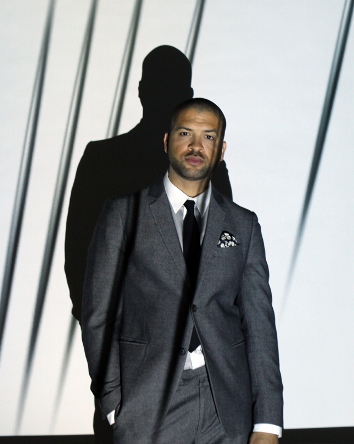
 Jason Moran.
 The jazz world suffered a huge loss in 2010 with the passing of Dr. Billy Taylor. Taylor was a master pianist, prolific composer, respected educator and pioneering jazz presenter. A District native, Taylor’s local impact was mainly felt through his tenure as Artistic Advisor for Jazz at the Kennedy Center, a position he held from 1994 until his death.
When it came to finding Dr. Taylor’s replacement, the Kennedy Center’s leadership went with a bold choice, tapping pianist/composer Jason Moran to fill the vacancy. Known for his innovative compositions and adventurous improvising, plus a deep respect and understanding for jazz history, Moran has the perfect blend of abilities to shine in this role. At just 37, the MacArthur Fellow can also relate to the younger audiences that large arts institutions so desperately need to attract.
The Kennedy Center’s move drew universal praise, but the proof will be in the pudding come this weekend, which marks the start of Moran’s inaugural jazz season. His programming has lived up to the high expectations, offering patrons a wide variety of performances that range from the traditional to the cutting edge with sprinkles of surprise. Traditionalists will appreciate sets from Jimmy and Tootie Heath, while more energetic crowds can see Medeski Martin & Wood and Soulive in a new standing room space. Moran will also be teaming up with comedian David Alan Grier for what is sure to be a memorable performance, and locals will be proud to see singer Christie Dashiell on the calendar. Moran and his band will also host a jam session on Election Night that is sure to be a highlight.
DCist interviewed Moran to get his thoughts on his new position and the upcoming season.
When you first found out that you were being considered for this position at the Kennedy Center, what was your initial reaction?
Maybe, “They’re calling the wrong Jason Moran.” You know, people have visions of themselves, or their own mythology that they begin to believe about who they are. I really think I’m a renegade, but I’m totally a traditionalist. So I thought this was an interesting decision because it’s kind of connected to what I’ve done in the past, and I have a great respect from what Billy Taylor has done. Kind of in the same way, he’s a renegade who creates these programs out of thin air like Jazzmobile or really taking charge over at the Kennedy Center, or taking the music to the nation. These are big ideas to accomplish. I also thought, “Wow, I might be a little young for this.” I’ve been presented with big ideas before, but this is taking on a national tone. So this would be a great time to rise to it.
When you first became the official Artistic Adviser for Jazz, what was the first thing you wanted to do?
Well my partner over at the Kennedy Center is Kevin Struthers, who works in the jazz department over there. He and I became teammates. He and I sat down and he showed me ideas that he had already begun developing for the season that exists now. And then we just started kind of stirring the pot. I just started sending tons of e-mails with ideas that I had — things we should think about not only with regard to artists, but the venue itself. I just started trying to get all these ideas out because there’s rarely a time in an artist’s career when you run upon an institution that’s willing to hear all of your ideas and enact probably 75% of them, or having the actual possibility of doing all of them, just because of their scope. We just put them in the pot, like a good gumbo. When we needed to scoop something out, something great should fall out of it because it’s a bunch of good ideas. It’s like having good shrimp, good sausage and a good roux.
Did you feel any pressure with respect to Billy Taylor’s legacy at the Kennedy Center?
Billy and I had a good relationship over the years. We would have long discussions. I don’t think the discussions would be as heavy as “The State of the Music,” but it was more like he was peppering me about, “Where are you in your development?”
One of the big things he would always ask me when we would meet was, “Are you making some music that people can dance to?” This is a very simple question to ask of musicians. I would always respond, “Yes, but the people rarely dance.” This is part of the reason why I do the Fats Waller program. Let’s bring dancing and movement to an audience’s brain and let’s try to make that happen. I didn’t feel any pressure. I think he would trust me.
From a big picture, thematic point of view, what did you want to accomplish with this first year of programming?
Sometimes what happens with institutions, and not just the Kennedy Center, but with art institutions, or dance institutions, or theater institutions, they begin to segment themselves. Then the discussion leads to more of an homogeneous approach to how they present. They present their favorite people over and over again. Our rule was to really start to up-end that. The spectrum of jazz music is so enormous. We have to really begin to present the gradations of color within that spectrum.
So now that the first year is done, are there any lessons learned that you can apply to the future?
Well, the season hasn’t even started. So, what is to learn, I have no idea. I haven’t seen audiences go experience a show. I haven’t talked to audiences after a show. From October until the very last performance, which late in May or June, there’s a lot to gauge. I think we have to have an ear to the ground to see what audiences are feeling. Or even the D.C. community. There’s so much great music happening now in D.C. I guess there always has been, but with the advent of The Howard Theatre and all these clubs opening up, and Bohemian Caverns doing a fantastic job of curating over there. It’s nice to feel like there’s not only energy in the city, but there are audiences that are ready to accept that energy.
Also, audiences, and myself included, should really consider how they interact with the space. The Kennedy Center has this huge atrium with all these flags and this massive red carpet. So how do we use that space? Over the following seasons I want to continue to tease out the areas of space that can become much more intimate or much more grand.
A lot of people think of the Kennedy Center as “Washington,” and not really “D.C.” How do you see that problem and how do you want to address it?
I’ll say this, D.C. is its own world. It’s interesting to hear this segment that you state that it’s Washington, and then there’s D.C. Tarus Mateen lives in D.C. now, and has for the past three or four years. He is one of the most supreme musicians. What he does in whatever environment he lives in is find out who is in the local scene and begin playing with these people in the local scene. He’s been my ear to the street down in D.C.
Some of the events I’m doing will rely on musicians from D.C. The election night show will feature musicians from that area. The comedy night with David Alan Grier will be supplemented by musicians in the D.C. area. It’s an on-going thing and the more time I spend down there, the more people I’ll meet. I’m also looking to meet with other curators to not only think about what’s happening in the music scene, but what’s in the art scene, the poetry scene, the theater scene. That world can become part of what we think of as jazz at the Kennedy Center. It’s all an experiment that continues to unfold.
Full schedule and ticketing information to the Kennedy Center’s ’12-’13 jazz series is available here.