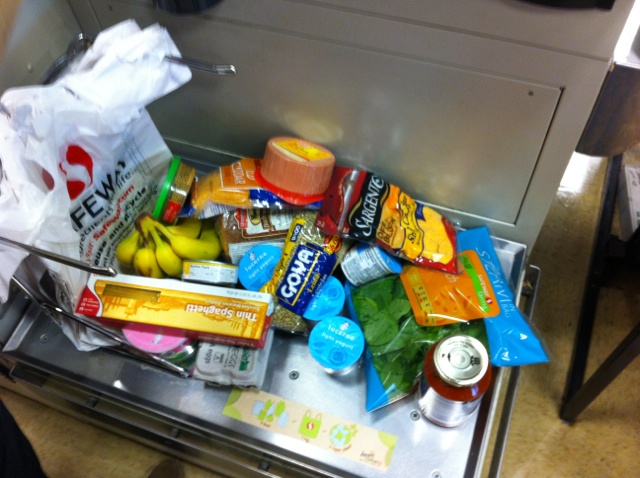
 This is what $30 buys.
Could you feed yourself on $30 worth of groceries a week? That’s it: Just $30 for the supermarket, no dining out or quick bites from the vending machine.
But for the more than 142,000 D.C. residents enrolled in the Supplemental Nutrition Assistance Program, $30 is the average weekly stipend. And it doesn’t buy much.
This week, anti-hunger activists and a few District officials are participating in the “Food Stamp Challenge,” an attempt to nourish themselves for a week on just $30. Alexandra Ashbrook, the director of D.C. Hunger Solutions at the Food Research and Action Center, is currently in her third day of the challenge. We met up Tuesday morning at the Safeway at 1747 Columbia Road NW, for a most complicated shopping trip.
Armed with just $30 and a Safeway discount card, Ashbrook roamed the aisles looking for the best deals that she hoped might create a somewhat balanced pantry that could last seven days. A hefty bag of spinach on sale for 99 cents was appetizing and seemed like something that could be stretched over many meals, but those prospects faded when Ashbrook realized that the package recommended finishing the leafy vegetable within two days of opening.
Bananas were also a good deal, going for 69 cents a pound. But that was it for fresh produce, which while sometimes inexpensive per unit, can also be very weighty. And some fruits and vegetables had to be eliminated entirely. On an ordinary shopping trip, Ashbrook said, she might have bought a package of raspberries. But $3 or $4 for a small carton that goes bad in two or three days would be a most unwise choice.
Ashbrook aimed high on some items, though, like a container of hummus to spread over bread. But when it came to getting a caffeine fix, things got a bit dodgy. Ashbrook, wary that most brands of coffee would take a significant chunk out of the $30 allowance, figured she’d have to go the week without. We spotted a jar of store-brand instant coffee for less than $3 and put it in the cart, but agreed that it would be one of the first things to go if the final tally exceeded the limit.
The food stamp diet, Ashbrook said, is difficult to make healthy, even though D.C.’s program is relatively strong. But eating on the cheap can lead to a drop in vital nutrients and general energy levels. “Just in a week you see yourself getting tired and grouchy,” Ashbrook said.
The District’s food stamp program operates on a sliding scale. People living at 130 percent of the federal poverty level or below qualify, but the formula for determining how much a person on food stamps receives is rather outdated.
“The biggest flaw is the benefit level,” Ashbrook said. Food stamp allowances are calculated based on the Thrifty Food Plan, a federal dietary plan pegged to the consumer price index. The plan, however, hasn’t been re-evaluated since 1996.
Although D.C. shows very strong enrollment levels for children receiving free meals at school, the District’s food hardship rate is the worst in the United States. In 2010, 37 percent of D.C. households with children were unable to afford enough food, according to D.C. Hunger Solutions. And with only seven of Washington’s 43 full-service supermarkets located east of the Anacostia River, many people at or below the food stamp line face the added burden of living in a food desert.
Health problems, such as allergies or diabetes, only complicate things further, said Sheena Simpson, an Americorps volunteer who is working with Ashbrook’s organization. “It’s really hard to eat following doctor’s orders on a budget,” she said.
But perhaps the underlying concern for anyone trying to do their grocery shopping with such a limited amount to spend is getting enough food to last the week. Ashbrook’s haul, which eventually included eggs, shredded cheese and Oscar Meyer turkey bologna—”I haven’t eaten this since I was a kid,” she said—looked pretty meager in the checkout line. She expected it would last five days.
Or, consider what the celebrity chef Mario Batali said this summer when he attempted to live on a food stamp budget for a week: “I’m fucking starving,” the portly Italian-American toque said just a few days into his attempt.
This week, D.C. Counilmember Mary Cheh (D-Ward 3) is also trying the food stamp challenge. When she did her shopping on Monday afternoon, her final tally was initially a hair over $30; she removed a banana from her purchase and finished with 50 cents to spare.
“I had to decide what could last me for a number of dinners,” Cheh said in an interview. “It was hard to think through what you’re buying. When I go to the food store, when I see something I want, I’m going to buy it.”
Cheh called the experience is an “eye-opener,” and she said she doesn’t eat that much to begin with.
“What most affects me is what could this possibly be doing to our children,” she said. “To understand quite directly that I can’t buy blueberries because they’re way too expensive even though they’re very healthy but I can buy three boxes of pasta, you wonder how this steers food choices.”
Cheh said she wasn’t going hungry but, like Ashbrook expected for herself, she’s far from satisfied. “I’m not an exotic eater, but I would have liked to buy some salmon,” she said.
And any culinary indulgences she might normally enjoy are off the menu. For one thing, Cheh admitted to being a big fan of D.C.’s cupcake industry: “I don’t have any cupcakes. Where are my cupcakes?”
But Cheh said she realizes the “food stamp challenge” is an artificial gesture. Come next Monday, when the seven-day project is complete, she’ll go back to her usual diet. People who actually do rely on food stamps will still rely on food stamps.
The next real challenge for anti-hunger activists is trying to ensure that food stamps remain an entitlement program. The budget proposed by Republican vice-presidential candidate Paul Ryan would transform SNAP into a block-grant program, meaning that instead of qualifying recipients by income level, it would be funded at a capped level each year. Ashbrook said that would drastically weaken anti-hunger efforts.
“The program wouldn’t be able to respond,” she said.