Martin Austermuhle
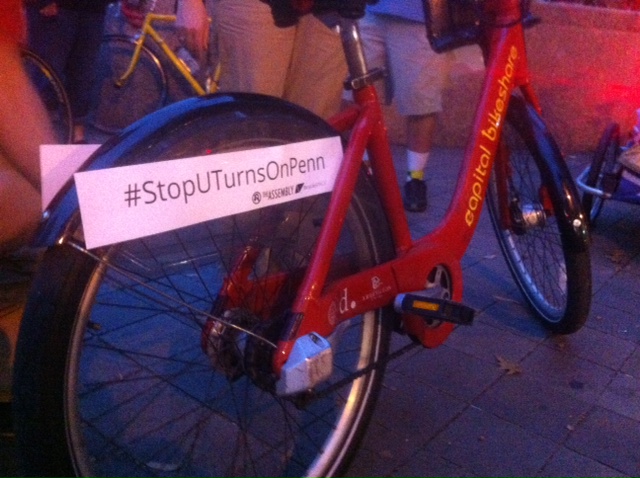
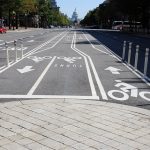
A group of cyclists rolled back and forth along the length of the Pennsylvania Avenue bike lanes this morning, trying to raise awareness among drivers and policymakers of the danger posed by drivers making illegal U-turns through the lanes.
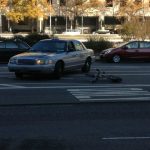
The rolling protest, organized by local bike shop Bicycle Space, capped off two weeks of discussions between cycling advocates and city officials over how to best prevent the turns, which cyclists say that drivers often make. On one day last week, one local cyclist counted 25 drivers making the U-turns at 13th Street; another cyclist caught a near-hit on video.
D.C. police officers have been out along Pennsylvania Avenue this week writing tickets for drivers that make U-turns, and the D.C. Department of Transportation has said that it is finalizing an informational campaign targeting motorists and taxicab drivers.
During today’s protest, cyclists handed out small fliers that cited the laws that apply to drivers, cyclists and pedestrians. “We’re trying to make people aware of safety issues,” said Phil Koopman, a co-owner of Bicycle Space. Some of the cyclists admitted that the problem wasn’t just enforcement, but also education: U-turns across double lines aren’t illegal in D.C., but they are across travel lanes or medians. (That being said, there are signs warning that U-turns are illegal along the length of the roadway.)
Beyond that, though, Koopman said that he hopes to see a more physical separation made between the bike lanes and the car lanes. That may be more of a challenge, though—any changes to the bike lanes would have to be approved by the Commission on Fine Arts, which in 2010 rejected a plan to paint the lanes green and line them with bollards.
Earlier this week, Shane Farthing, executive director of the Washington Area Bicyclist Association, wrote to the commission, asking that they work with city officials on further measures to ensure the safety of cyclists who use the lanes.
“As ridership has grown, safety and enforcement concerns have been revealed, urban transportation design for bicycling has evolved, and operational lessons have been learned in the intervening years, I hope that you will join me in a discussion of the project, it’s successes and failures, and the opportunities available to meet the goals of the CFA while also improving the safety of bicyclists and pedestrians along this important national corridor,” wrote Farthing.