Martin Austermuhle
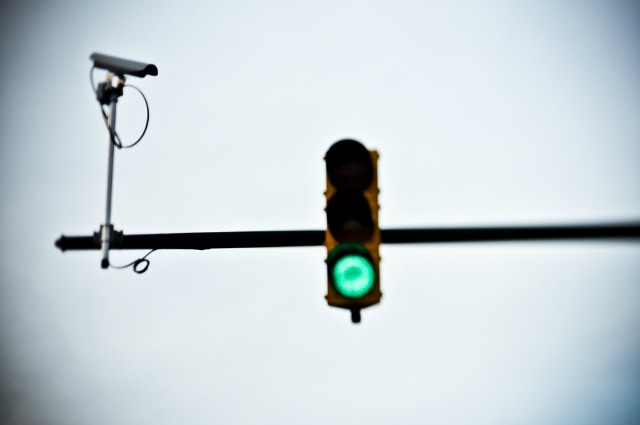 Photo by Chris Rief
Mayor Vince Gray today announced that some speeding cameras fines would be lowered as of this coming Monday, while the most flagrant speeders would pay more for their transgressions.
Under Gray’s plan, the fine for speeding between 1 to 10 miles per hour over the speed limit would drop from $75 to $50 (even though MPD doesn’t send out tickets for those violations) and the fine for 11 to 15 miles per hour over would drop from $125 to $100. At the same time, drivers going 25 miles per hour or more over the posted speed limit would see fines increase from $250 to $300. (The large majority of speeding fines are for 11-20 miles per hour over the limit, according to MPD.) Other fines—including red light violations—would remain the same.
Gray also said that the D.C. Department of Transportation would begin reevaluating speed limits on certain roads, likely resulting in the limits increasing or decreasing, depending on the roadway. He also pledged to dedicate revenue from the city’s extensive automated traffic enforcement program to hiring 100 new police officers, bringing MPD’s total force number to 4,000.
“We believe this strikes the right balance between ensuring the safety of motorists, cyclists, pedestrians and those who live on thoroughfares while also making the system fairer for those whose violations are less dangerous than the most flagrant speeders,” said Gray at a press conference.
The sudden proposal came shortly after legislation was introduced by councilmembers Tommy Wells (D-Ward 6) and Mary Cheh (D-Ward 3) that would lower almost all speeding fines to $50, closer to Maryland’s $40 fine. Wells and Cheh crafted their proposal after meeting with a task force over the course of two months in August and September.
And while Gray didn’t explicitly speak out against Wells and Cheh’s bill, D.C. Police Chief Cathy Lanier left no mystery as to where she stood on it: “I think if you drop the fines down to $50, there’s absolutely no deterrent and some people see that as the cost of doing business,” she said.
Eric Goulet, Gray’s budget director, outlined another problem with Wells and Cheh’s proposal: he said it would bring in roughly $35 million less money than currently expected, which would force the D.C. Council to make up the money in other ways.
As for Gray’s plan, Goulet said it would pay for itself. According to numbers he shared, D.C. took in $27 million more than expected in traffic camera fines in the fiscal year that just ended. With that remaining consistent through fiscal ’13—D.C. already expects to take in just over $90 million from the cameras—Goulet said that the city could absorb the loss of $24 million in revenue from Gray’s proposal and have $3.5 million left to train the 100 police officers.
In a statement, Wells sounded pleased with what Gray offered. “I’m pleased to see the Mayor is listening to the same people that Councilmember Cheh and I had pulled together over the summer as a task force. Their message was clear: speed cameras work to reduce speed and make streets safer, but the city must be smarter about setting fines. In particular, I’m glad to see the Mayor has agreed with our proposal that a portion of the ticket revenue must be reinvested back into safety improvements, rather than going into the black hole of the general budget,” he said.
But some council staffers expressed frustration that they were never told that Gray was formulating his own proposal. Additionally, they said that Lanier’s insistence that higher fines served as a deterrent wasn’t true; the task force heard evidence that after fines were raised two years ago, violations didn’t decrease appreciably.
The frustration wasn’t limited to one side, though: Wells was quietly accused of political pandering for proposing that all fines be lowered. Additionally, Gray scheduled his new fines to take effect on Monday—the same day that Cheh will hold a hearing on the bill she and Wells presented.
Lanier, though, remained unwavering in her support for the cameras. “A $100 ticket, a $125 ticket, really shouldn’t feel so bad because you could’ve killed somebody if you’d hit them,” she said.