

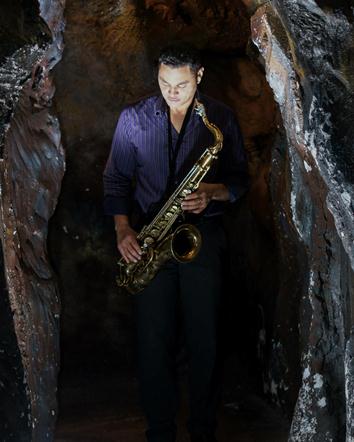
 Lyle Link, photo by Gary Young.
Back during my college days at the University of Maryland, I was a non-music major who spent a lot of time in the music building, playing with various jazz groups and making use of the practice rooms there. I encountered many fine musicians during that time, one player always stood out. Lyle Link played alto saxophone and students in the jazz department held him in the highest esteem. Now, nearly fifteen years later, Link has expanded his palette to include tenor saxophone and flute, and has developed into one of the local jazz community’s most distinctive voices. His talent earned him a nod from Bohemian Caverns owner Omrao Brown to serve as November’s artist-in-residence at the historic club. The month long run of Tuesday night sets concludes this evening.
Link’s initial inspiration came at the age of nine, when he wanted to play the piano after seeing classical legend Vladimir Horowitz perform on television. At about the same time, his school’s music teacher gave him an opportunity to choose either a woodwind or brass instrument. Link chose the saxophone, and also learned some piano from his older brother. He played in school ensembles from elementary school through college. Though he studied formally with acclaimed saxophonist Chris Vadala while at Maryland, Link is largely self-taught. The public library proved to be a rich educational resource for the young musician, whose training came from recordings that he would painstakingly transcribe and learn how to play. Jazz icons such as Charlie Parker, Thelonious Monk and Duke Ellington where his teachers, but Link was also exposed to classic Motown, funk and R&B through his parents, as well as the popular hip-hop and reggae of the time.
Recently, Link has taken his music in more international directions. First, his tastes grew to include bossa nova and other genres from Latin America. Travels to Syria, Jordan, Turkey, China and Vietnam have broadened his scope even further, and he is currently trying to incorporate those influences into the jazz idiom.
Link’s musical skills are very much in-demand, and he graciously took time out of his hectic schedule to answer some questions from DCist about his career and the residency at Bohemian Caverns.
You’ve been in the area for quite some time now. What changes do you see in the local jazz scene?
When I was growing up, the One Step Down, just outside of Georgetown, was an important club in the D.C. jazz scene. Many famous artists performed there. I caught the tail end of it, first visiting the club in the late nineties. Twins Lounge — the old Twins on Colorado Avenue — was also popular, before it moved to U Street. I met many musicians there, especially on Sunday nights when they hosted a jam session. Those sessions gave some of the younger players an opportunity to meet, play with and learn from the older players, many of whom had seen or performed with some of the icons of jazz. Unfortunately, many of them have passed and so those opportunities just don’t exist anymore. That said, there are many places to play around town and there seem to be more opening all the time. Gio Russonello, of CapitalBop, has done a fantastic job promoting venues and getting the word out about the city’s jazz scene to a new audience of listeners. There are so many great players here in the Washington, D.C. metro area.
What did you want to accomplish with your residency at the Caverns?
I have spent much of my musical life working as a sideman. I consider myself to be very lucky and fortunate that people have called me to contribute to their projects. These experiences have taught me how to work in a supporting capacity, as an accompanist as well as a featured soloist. I have learned to be flexible, to be sort of a chameleon, and play in the style of the particular gig that I’m hired for, as much as I’m able. The challenge with this though is that, artistically, one can lose the direction and focus that’s needed to carve out an individual identity. When you’re busy working constantly, fitting into other musicians’ projects, it’s easy to lose focus regarding your personal voice and direction. So, I’m now trying to get in touch with that more, through composing and assembling my bands. I have always composed, but rarely perform my work in public. The recent stint at Twins, and now at Bohemian Caverns as the Artist-in-Residence, has enabled me to perform some original music and act as bandleader for a change. I hope to do this more and hope to record soon, in order to document this music.
You started out as an alto player, but now play a number of woodwinds. What drove you to develop these new skills?
In jazz, many saxophone players start on alto and switch to tenor. When I played alto exclusively, I went through phases of wanting to sound like David Sanborn, Cannonball Adderley, Gary Bartz or Kenny Garrett. And playing tenor, I got into Dexter Gorden, ‘Trane and Joe Henderson. We all imitate in order to learn. But when I started playing the tenor saxophone, I never stopped playing the alto. I think of them as different voices. Some people call me for gigs and say, “bring your tenor.” Others say, “play alto on this one.” In order to work, I play all of them. I love them all but on my gigs, I tend to bring soprano, alto and tenor. Sonny Stitt was and is a huge inspiration, since he handled alto, tenor and baritone so masterfully. But I have been focusing on the tenor for quite some time now. And working with Siné Qua Non lately, I’ve been playing soprano and alto saxophones, as well as flute and alto flute.
What are your overall thoughts on the D.C. jazz scene? Who are some of the musicians you admire most?
At the risk of leaving out great players, I’m reluctant to name specific people. There is no shortage of great musicians in the DC metropolitan area as well as Baltimore. I have had the honor to work with some of the older players who have since passed, like Lawrence Wheatley and Ellsworth Gibson, as well as people who are still on the scene like Butch Warren. I’ve watched younger artists like Elijah Balbed grow over the years. Friend and bass clarinetist/composer Todd Marcus comes to mind, since he has chosen the arduous but rewarding path of working nearly exclusively on bass clarinet, a feat in and of itself, as well as really making a name for himself as a composer and bandleader. I recently started working with Michael Bowie on his exciting project called Siné Qua Non, which features Mark Prince, Victor Provost, and Sam Turner. The band performs Michael’s original arrangements, which integrate jazz, classical, and world music, using a unique instrumentation consisting of flutes, soprano and alto sax, steel pan, upright and electric bass, drums and percussion.
What do you hope the audiences walked away with after seeing your performances this month?
I think that, regardless of form, artists are trying to express something, to say something. The difference is simply the medium. My canvas just happens to be music and my tools happen to be the saxophone and flute. While more abstract, music is in some ways the most “primitive” of all the art forms in that it has the unique ability to transcend language, culture and ethnicity. It is has the power to evoke human emotion in a visceral, unparalleled way. Many of my compositions have a back story regarding their inception and I’m hoping audiences come away with a glimpse of what I’m attempting to say. I am attempting now to be more communicative with audiences. Many of us perform but fail to communicate with listeners, often focusing on the music. Some see that as a kind of pandering. I don’t. I admire musicians like Cannonball Adderley, for whom speaking to audiences and explaining things was not anathema to being a great artist. We have to create our own audiences now, and that means that we have to connect with them. Having said that, the music ultimately has to speak for itself. As someone famously put it, music picks up where words fail.
Lyle Link performing “Inheritance” with the Todd Marcus Jazz Orchestra:
Lyle Link concludes his residency at Bohemian Caverns tonight with 7 and 9 p.m. sets. $10 in advance/$15 at the door.


