Martin Austermuhle
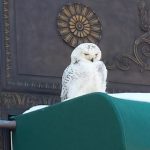
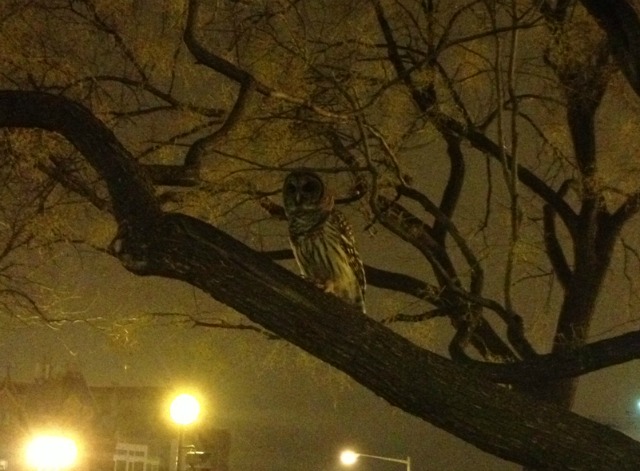 Photo courtesy of a tourist from Tucson
In D.C. you’re likely to see seagulls, pigeons, ducks, and geese. But a DCist tipster spied something a little different in Dupont Circle on Saturday night: a Barred Owl, also known as a Hoot Owl. “Saw it swoop down and snag some dinner around 11pm on Saturday,” she writes. Last week Capitol Hill residents saw a similar owl, while last November Mt. Vernon residents teamed up to rescue an injured owl found sitting on a sidewalk.
While owls are indigenous to the area, they’re aren’t often spotted in D.C. neighborhoods. But as their natural habitats have slowly been encroached upon, the owls have adapted, and D.C. isn’t a bad place for them to settle. There are plenty of trees, for one, and the city has an abundance of what the birds of prey like to eat: mice, rats and squirrels. (A small group of religious types believe that the streets around the U.S. Capitol were designed to create the shape of an owl, a symbol of the occult.)
The owls aren’t likely to stay for too long, though, said Kent Knowles, who works for the Raptor Conservancy of Virginia. “They will not stay in the city…it’s not their normal hunting grounds,” he said, adding that they’re more likely to be found in places like Rock Creek Park.
The recent sightings may have to do with their mating habits, he added—the owls are currently looking for mates and territory, and will quickly move on if they don’t find it. “They’re not going to hang around concrete areas,” said Knowles.
As great as it is to get up and close with nature, owls can be an aggressive bird: last September a few runners in Rock Creek Park complained of being attacked or harassed by the birds. The owls, if kept as pets and released into the wild, can apparently mistake humans as sources of food.