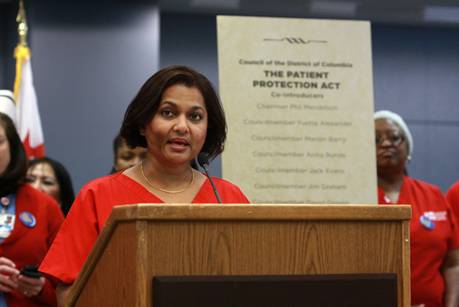
 Rajini Raj, a nurse at Washington Hospital Center, talks about the Patient Protection Act. (Photo via National Nurses United)
After representatives of the union representing the nursing staffs at several D.C. hospitals said their ranks are inadequate to handle the number of patients their facilities take in, D.C. Council Chairman Phil Mendelson said he plans to introduce legislation to do something about those shortcomings.
Mendelson tomorrow will introduce the Patient Protection Act, which he said at a press conference will improve the quality of both the environments nurses work in and the care they provide to patients. He called the bill “common sense, today’s version of the eight-hour day.”
Nursing shortages are hardly specific to D.C., though it is a lingering problem. According to figures provided by National Nurses United—which represents employees of Children’s National Medical Center, Washington Hospital Center, and several other local hospitals—57 percent of D.C. nurses think their numbers are too few, and 60 percent say increased workloads in recent years have resulted in less-than-satisfactory attention to patients. Mendelson’s bill would mandate specific staffing levels in hopes of correcting those issues.
However, as The Washington Post points out, Mendelson has been stymied before in his attempt to do something about the quality of nursing at D.C. health facilities:
Mendelson introduced similar legislation six years ago. He said he expects opposition from the hospitals because of the perceived increase in costs.
“But I’m not convinced it will increase costs,” he said in an interview before the press conference. Improved nurse staffing leads to better-quality care, which, in turn, means fewer errors and staff turnovers, which are also expensive, he said.
Mendelson was joined at the press conference by about 200 nurses represented by National Nurses United, who recited chants of “Patients over profits.” Several nurses spoke out about improving the nurse-to-patient ratios at their hospitals.
“I have seen first-hand patients brought into the operating room unprepared for what they’re about to face because nurses in other units were short-staffed,” Bonnie Linen-Carroll, an operating room nurse at Washington Hospital Center, said. “It is a disgrace that this happens in hospitals in the capital of the richest nation in the world—but it doesn’t have to be this way.”