Martin Austermuhle
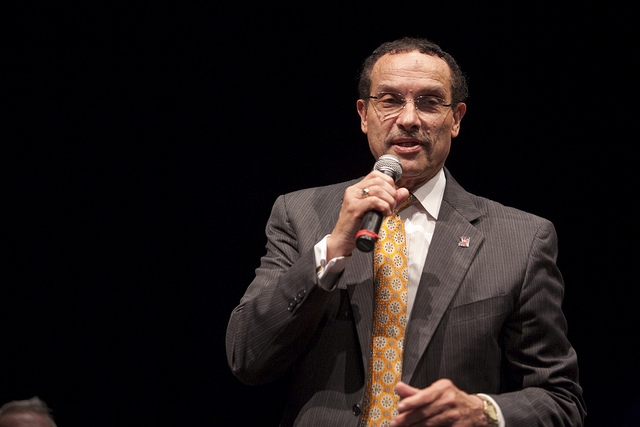 Photo by aperryproductions
Flush with cash, a reinvigorated real estate market and tens of thousands of new residents, it’s hard to deny that D.C. is booming. But the city’s progress hasn’t been felt equally by all of its residents, and many fear that they may become victims of it.
In yesterday’s annual State of the District Address, it was left to Mayor Vince Gray to thread the needle of this urban reality. He largely did so in the hour-long speech, hailing D.C. as a “big-league city” while also admitting that the it runs the risk of “becoming a city of only ‘haves.'” And in the most substantial policy proposals of the night, Gray pledged $100 million for the construction of 10,000 units of affordable housing, promised pay raises for cops and firefighters and pledged to make D.C. an easier place to do business.
In opening the speech, Gray drew comparisons between the winning ways of both the Nationals and ‘Skins and the city’s upward trajectory. “[J]ust as these great professional teams are getting things done and making us proud, so too is the District of Columbia making big things happen,” he said, citing a the usual statistics for D.C.’s march forward: a 51-year low in homicides, 55 cranes dotting the city’s skies, 1,100 new residents per month, and a lower-than-average unemployment rate.
To keep D.C. ahead of the curve, Gray said that D.C.’s economy needed to diversify away from its longstanding reliance on the federal government as a driver of growth. “My administration is working with the fierce urgency of now to make sure the District’s economy continues to grow, diversify, and reach new heights – no matter what happens with sequestration and the federal budget,” he said.
To that end, Gray said, the city would continue investing in the burgeoning tech sector, including a 15,000-square-foot space on 15th Street NW he is inaugurating today. Called 1776, the space, a partnership with Startup America and Startup D.C., will serve as yet another tech incubator—a “collaborative space that will help us nurture and incubate ideas that become small District companies that then grow to become big District companies,” he said.
He also defended the $32 million tax break given to LivingSocial last year, saying that it was structured to ensure that the company keep hiring D.C. residents, and said that he would meet with tech investors at the annual South by Southwest conference in Austin next month.
Gray touted the city’s first culinary incubator, Union Kitchen, and celebrated large-scale development projects that are coming to fruition after years on the drawing board. He said that D.C. officials were looking further asunder for investors, and noted that he would travel to Qatar—which invested $700 million in CityCenterDC—to sell the city as a wise investment destination.
Still, all the talk of progress gave way to the sobering reality that D.C. is becoming increasingly difficult for many people to afford. Saying that the city was in danger of closing itself off to seniors and public sector workers, Gray recognized that the city had to act quickly to ensure it remains diverse and open.
“I’m proud of what we’ve been able to accomplish over the last two years, and I hope that you are as well. But, while we celebrate, we must also be sober and clear-eyed in realizing that our prosperity gives us an unprecedented opportunity to make a great city even greater,” he said.
Chief among his proposals was a $100 million investment in creating 10,000 units of affordable housing, a move that would “go a long way towards ensuring we remain the type of compassionate, inclusive city we want to be.” (A task force on affordable housing he created last year is expected to report back to him soon.) He also pledged to better connect residents to available jobs, give public sector workers like police and teachers long-awaited pay raises and said he would create a $15 million investment fund that would allow non-profit groups to compete for $100,000 grants.
Gray also promised to work on two other legislative initiatives: procurement reform and the bureaucratic hoops that business have to jump through.
In closing, Gray returned to the optimism with which he opened the speech. While admitting that significant challenges are left to be faced, he said he remained confident in the city’s ability face them head on.
“After all, just a decade ago, who would have guessed that by 2013 the District of Columbia would have gained more than 60,000 new residents? And even five years ago, who would have guessed that our annual homicide total would be fewer than 100; that public education would be growing in enrollment, diversity, and quality; and that we’d have a budget surplus and a rainy-day fund balance near record highs?”, he asked.