 Backtrack a few months ago, to when a presidential election was going on. Among the many predictions, one made a bleak statement about the interest of a crucial voting bloc. It was said that 18 to 30-year-olds have become disenchanted with politics since 2008, and they would not turn out in large numbers to vote this time.
And that was super wrong. Just as many younger voters showed at the polls (about 50% of the age group), and their proportion of total voters ticked slightly up to 19% on Election Day 2012. In addition to the 60% of young voters that contributed to President Obama’s reelection, generation-gap ballot measures passed, like state amendments to allow gay marriage and lower restrictions on marijuana use. Surprised spectators called this a sea change, demonstrating momentum on the side of this population and their causes.
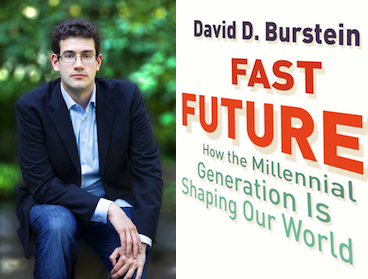
David Burstein, 24, author of Fast Future: How the Millennial Generation is Shaping Our World (Beacon Press, February 2013), wasn’t so surprised. “Civic participation is being redefined by this generation, “ he tells DCist. In 2008, many people new to politics got engaged by Obama, then maybe went on to do other things, but “there was a spirit that created a boom of social-minded activity. The organization … has continued to take on a life of its own.” Burstein will speak about his new book on Monday, February 18, at 7 p.m. at Politics and Prose.
Burstein founded Generation18 to jumpstart the youth vote during the 2008 election. Between 2007 and 2008, the organization registered over 25,000 new voters, held over 1,000 events in 35 states, and produced get-out-the-vote PSAs featuring celebrities. This experience inspired Burstein to see today’s 80 million Millennials (now ages 18-30) as much more than narcissistic moochers mooning over cat photos online: “I was hearing a lot of media conversations about how this is the ‘worst generation,’ and I thought, that’s not what I’m seeing. So I wanted to write this book with a different message.”
A major difference separating Millenials from past or future members of this age bracket, Burstein says, is their straddling of the pre-digitial and digital ages. They are familiar and adaptive with technology, they see how quickly change can happen today, and they understand how to succeed in that world. But, without being born with smartphones in their hands, they appreciate the importance of basic core skills and how to ferret out information and context. Burstein praises Millennials’ unique “pragmatic idealism”, a blend of lofty idealistic goals with the practicality to accomplish them — the characteristic that will enable Millennials to tackle issues like the economy and environment.
This makes him very optimistic about the capabilities of America’s largest and most diverse generation, and he says you should be, too. Despite a tough economy and job market, for example, studies have shown that Millennials feel buoyant. Burstein continues, “other generations feel shaken and disrupted by moments of crises, but this generation is used to constant change and adapting, so there’s less anxiety.” Though this may partially be a shift in values, like not caring as much about a high salary, the author says “this is one of the most exciting times to be young. There’s never been more possibility, it’s never been easier to start a business, or more socially acceptable to go out of the country and share a powerful message with the world.”
So, Fast Future tells a much different story than the one predicted pre-election. It sees Millennials with a manifest destiny to carve out the greatest in business, technology, culture, and politics, and a roadmap for how to do it. The book also speaks of the specific events, like 9/11 and Columbine, that shaped this generation’s sensibilities, and shares current Millennial success stories to learn from.
A graduate of NYU, Burstein directed and produced a documentary based on his 2008 voter registration effort, 18 in ’08, as well as a 2012 follow up, Up to Us, in partnership with OurTime.org and Comcast. He writes on social innovation for The Huffington Post, has appeared on CNN, Fox News, NPR, ABC, and C-SPAN, and in The New York Times, USA Today, The Boston Globe and more. He lives in New York.
The talk will be free and open to the public, and followed by a question and answer period and book signing.