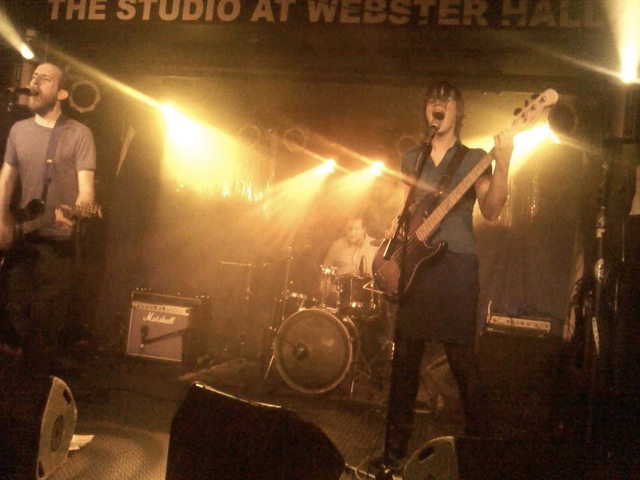
 Southern Problems last November at Webster Hall in New York. From left: Dan Schwartz, Andrew Graber, and Andy Bowen. (Photo by Holly Nipperus)
Last year, when local garage rock trio Southern Problems released their debut album, Space, we commended them on framing their songs about loneliness and frustration in such an original manner. Bassist Andy Bowen has referred to the band’s general naïveté in recording the album with Devin Ocampo as “Eliot Ness and the Keystone Cops” but the album is a promising beginning and Southern Problems has since opened for Ted Leo and taken their very dynamic live show to stages all over the city.
We talked to Bowen about the conceptual nature of Southern Problems songwriting, the band’s world view and her experience performing as a trans woman in a band.
Find them online: http://www.facebook.com/southernproblems
Buy their record: http://southernproblems.bandcamp.com
See them next: Tonight at Comet Ping Pong (5037 Connecticut Avenue NW) with Miyazaki and Short Lives. 10 p.m., $10.
Listen:
How did the three of you meet?
Andrew [Graber] and I met on the first of the sixth grade. First day, first class. Mr. Ford’s Art Class in Severna Park Middle School, 1997. So, that was that! We’ve been good friends ever since. I’d just moved into the neighborhood and it was this very clique-ish neighborhood so he was one of the only kids that was nice. So, that was that. And Dan and I met on the first day of college because we both lived across the hall from each other. So, there’s a lot of “first day of school” stuff going on with our band which might explain some of our naivete.
Do you think that there’s a naïveté about your band?
Yeah. I think there is. We’re totally shooting in the dark. We’ve always shot in the dark. I’m pretty clueless about musical trends. We kind of make music that we like and see what’s there. I was talking to Ryan Little about our respective bands and he was like, “Well, you guys started this thing without a lot of ambition but have done okay.” And I mean, that’s pretty much accurate. We started this off just wanting to play music and the D.C. punk scene is really friendly so we’ve been able to play a lot of really neat shows and play with some of our heroes and even record a record with one of our heroes, so, it’s been pretty cool.
It’s interesting is based on your story about Newt Gingrich going into space just because it’s a high-minded but humorous concept and I feel like that’s something you do in other outlets as well. You had a blog with Apocalypse in the title, right?
It was called Armageddon Sampler and I think that’s kind of our world view. It’s definitely my world view. And I don’t know if Dan articulates it as his world view, but it’s in there. We’re people with ideals. We’re all in different capacities, activists. We all try really hard to fight for social justice as a matter of existing. That sounds pretentious, but it’s true. At the same time, I don’t want to promote the stereotype of the humorless activist and I try not to take myself too damn seriously. So, I think that’s pretty much where we are as a unit and as individuals.
You mentioned earlier that you don’t pay attention to current trends so much as playing music that you like. What is some music that you like?
So, as an individual, I would say my favorite albums of all time are Prince’s Sign O’ the Times, Erykah Badu, Mama’s Gun and I’ve always been partial to John Lennon’s Plastic Ono Band. So, that’s kind of where I am. The reason why I love those three records so much is that they do such a beautiful job of melding the personal and the political. They’re really seamless like that. You can have a political band like the Dead Kennedys. They’re all intense political content, but I’m always attracted to those artists that can manage to meld those worlds. Prince didn’t usually do that. I sort of think he didn’t write Sign O’ the Times because it’s so much better than any of his other material. His lyrics were never that good before and were never that good after. “Sign O’ The Times” is just a beautiful song in every way, shape and form. I’m not convinced he wrote it.
We listen to music that is recent. I have listened to channel ORANGE more times than is probably socially acceptable. But then again I feel like if you were queer and living through the summer of 2012, then you weren’t allowed to not listen to channel ORANGE that many times. So, we pay attention to shit but we write what we want to write.
I know that you’ve actually written one or two songs that I’ve seen Southern Problems perform, but what is the percentage of songs that you write for Southern Problems and what goes toward your own project?
So, I am going to release a solo album on May 1 called The 26th Anniversary Edition and that’s eight songs. A couple of them are songs that I had written a bunch of years ago. At least three of the songs on the record date back a decade. I wrote the music and basic lyrical ideas when I was in high school, which sounds like totally worrying, like “Oh my god, why would anyone want to listen to that in their mid-twenties or record that, for that matter,” but at the same time, I’ve rewritten the lyrics drastically. So, it’s not high school poetry, I hope.
So, we’ve had a rule with Southern Problems that even though we’ve all been writing songs for a really long time and we had songs that we’d written before starting this band, that we all feel very strongly about not playing those as Southern Problems just because we want to start fresh. I think that Chad Clark was writing on his Facebook wall awhile ago that bands are formulated around a specific idea and I feel that Dan [Schwartz] has a very strong perspective in his songs and he writes songs that he specifically says are not Southern Problems songs. He recorded an entire EP a year and a half ago that were awesome songs, but he said they weren’t Southern Problems songs. He just has that perspective. When it comes to the songs I write, on one hand I have a sense of what the band sounds like and at the same time, it’s based on the feel of the band.
Is your new material also conceptual?
I think our second album is still in a sense a concept album. It’s not as tightly conceived as Space. Space tells a story. It’s one centrally directed story. All the songs on our next album are grappling with maintaining dignity in the state of ugly historical circumstances. I think that’s the central concept. So there are some really personal songs on it. At the same time time, the songs that we know are going to be on that record have kind of an atmosphere of 21st-century foreboding. There are personal songs, we didn’t make fresh fruit from rotting vegetables here, but nevertheless there’s a sense of pervasive “We have an ugly situation that everyone we know is living through so how do we maintain perspective and happiness and dignity through all of that?” I think that’s the idea of the second record.
Will you be doing the artwork for the second album, too?
Probably. So, I think the album is going to be called Some Ghosts. I think we’re pretty comfortable with that title. Joni Mitchell did this. Joni Mitchell did some of her own covers, or at least a lot of it. I know she did the cover of Court and Spark. I think she did Ladies of the Canyon. When I think of an album, I don’t just think of 8 to 12 songs. I think it’s packaged with artwork and it came out at a specific time of the year. All of the circumstances of the album are a part of the album so I just like the notion of having complete control over that as a band. And I really love making linoleum cuts because I’m not a very good visual artist, I don’t think. I don’t think I’m a very good musician, either, right? But I like making art. It makes me happy to make art. It keeps me sane and so I write songs in the same way that I make a picture.
What has been your experience of being a trans woman in a band?
It’s been great. Throughout the course of the band, I have spanned gender presentation which has been quirky and fun. It’s been really fulfilling because my general articulation of my gender identity has been that presenting and living as a woman, even when I was living my life appearing as a guy, living as a woman is something that I perceived would make me feel like a supercharged version of myself. It wasn’t the wrong body narrative which some people have and I’m not discounting that. That’s totally something that rings true for a lot of people. It doesn’t ring true for me. But my perspective was much more that by transitioning, I would be able to be the most fulfilled I could possibly be. I think that’s been the case.
Honestly, I’ve been writing songs since I was a tiny child but between leaving college and really seriously facing the notion of transitioning, I had sort of a dry spell. I think the experiences that I’ve gone through physically and emotionally and intellectually through transitioning—I think it’s opened up my songwriting. I’m pretty amped up when you see us play. I’m kind of batshit. At our previous show at Rock and Roll Hotel, I was literally leaping on and off the stage. I’ve always been kind of a batshit performer like that, but at the same time, since transitioning, I think it’s infused my art with an energy that wasn’t there before. It’s nice living my life now and knowing that my pre-transition presumption that transitioning would make me feel like Super-Andy has come out to be true in every sphere of my life. Playing music has always been an incredible high for me and since transitioning it’s been even more of a transcendent high just because I like being a public trans person. My gender identity is something that you don’t see everyday and I have very few qualms in showing you what it is.