Martin Austermuhle
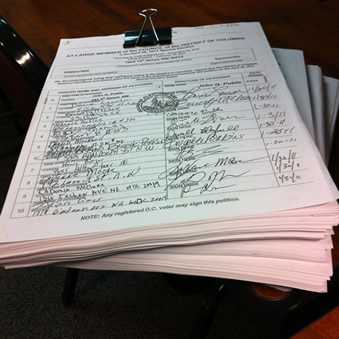 A candidate struggling to stay on the ballot for the At-Large special election scheduled for April 23 has accused the Board of Elections of failing to properly file change-of-address forms for tens of thousands of D.C. voters.
In a letter sent to Councilmember Kenyan McDuffie (D-Ward 5) this week, At-Large D.C. Council candidate Paul Zukerberg accused the D.C. Board of Elections of not properly updating the addresses of 16,331 D.C. voters, including over 13,000 that petitioned to have their addressed changed on Election Day last November. As a consequence, wrote Zukerberg, the elections board is “denying citizens the rights to participate in the democratic process.”
Zukerberg has a particular interest in the situation because he’s one of those citizens. The nominating petitions he turned in to get on the April 23 ballot were challenged by a supporter of Elissa Silverman, one of his competitors, and the Board of Elections ruled that some 800 people who had signed his petitions were not registered at the addresses they listed on the forms. This isn’t particularly uncommon—many voters forget to update their addresses when they move, leaving their signatures on nominating petitions at risk to be disqualified. Still, the board’s decision left Zukerberg short of the 3,000 signatures he needed to remain on the ballot.
Not one to quietly accept the decision, Zukerberg—at his own expense—checked the city’s voter rolls against the Postal Service’s change-of-address database, and found that many of those disqualified signers had properly changed their address—but the elections board had not updated its own rolls to reflect that. Zukerberg said he presented enough evidence earlier this week that 100 people who had signed his petitions had properly filed change-of-address forms. With those signatures ruled valid, Zukerberg says, he’ll be able to remain on the ballot.
“This is not about whether I have enough signatures, it’s about a system that’s broken and data that’s flawed,” he said today on NewsTalk with Bruce DePuyt, alleging that the election board doesn’t have the proper resources to keep up with laws regarding when and how residents can’t register to vote or change their addresses.
The elections board, for its part, is denying any claims of widespread errors in its voter database. Agnes Moss, a board spokeswoman, said yesterday that the 13,000 change-of-address requests made on Election Day were properly entered into its database earlier this month, and that further updates are made as they come in.
Still, Zukerberg may be half right. Clifford Tatum, the board’s director, said at a D.C. Council hearing yesterday that the biennial process of sending postcards to people who didn’t vote in November to check if they still live at the address listed in the voter rolls had been pushed off due to the upcoming special election. Additionally, the elections board admitted in a recent report that those 13,000 change-of-address requests from last November were delayed by a technical error.
Even if he doesn’t prevail—his pleas will be heard next week—Zukerberg will have tapped into a deep well of problems with the way the city manages and runs its elections. People with knowledge of the city’s elections board admit that it is underfunded, understaffed and prone to problems that can affect voters and voting. The Pew Charitable Trusts recently found that D.C.’s elections were second-to-worst in the country in 2008, and that only voters in Florida waited longer than those in D.C. to cast ballots in 2012.