Martin Austermuhle
 Image via Shutterstock
Yesterday was just another day for most candidates fighting to win an At-Large seat on the D.C. Council on April 23. But for two of them, it was a simple struggle to stay on the ballot.
After a brief hearing, the D.C. Board of Elections ruled that Paul Zukerberg, a defense attorney and first-time candidate, would remain on the ballot, having submitted exactly the amount of valid signatures—3,000—needed to get there. Later in the afternoon, though, it said that another first-time contender, John Settles, wouldn’t make the cut, having fallen short by 159 signatures.
There was nothing particularly strange about this. Every candidate for elected office in D.C. is required to turn in a certain amount of signatures to get on the ballot for a primary or general election contest. After those signatures are submitted, residents or other candidates are allowed to comb through them and challenge any signature that may seem suspect; if your John Hancock looks off or your address is wrong, the board can move to subtract the signature from the candidate’s final count. If enough signatures are challenged, you could well end up off the ballot altogether.
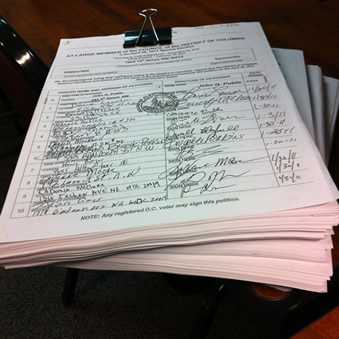 There’s an undeniable value to having candidates meet a basic threshold before being allowed on the ballot. Without a signature requirement, ballots would be populated with frivolous candidates who really have no chance or intention of winning. (For the April 23 special election, for one, close to 20 people said they would run, but only eight turned in nominating petitions.) Moreover, the process of allowing residents and fellow candidates to inspect and challenge signatures on nominating petitions serves as a basic check on campaigns that may seem to cut corners in order to get on the ballot.
In 2002, for example, Mayor Anthony Williams was denied access to the ballot during his re-election bid due to thousands of forged signatures that appeared on his nominating petitions; as a consequence, he was forced to run a write-in campaign. Two years later, an initiative that would have legalized slots in the city faltered among similar accusations of invalid signatures on petitions that would have put the question on the November ballot.
Both Zukerberg and Settles’ nominating petitions were challenged by Michael Tacelosky, a supporter of Elissa Silverman, who is also in the race. Settles turned in just over 4,300 signatures, and Tacelosky challenged 1,482 of them. Of Zukerberg’s 4,600, Tacelosky challenged 1,945. The challenges were based on a number of factors: the signers were not registered voters, were not registered at the address listed, were duplicates, or the signer’s printed name wasn’t legible.
After a first review, the board said that 1,275 of the challenges to Settles’ signatures were valid, leaving Settles under the 3,000-signature threshold. (Among those challenged: 31 homeless residents.) For Zukerberg, the board ruled that 1,693 of those challenges were valid, leaving him only 26 short of what was needed to get on the ballot. After some back and forth with the D.C. Registrar, Zukerberg was able to prove that he had enough signatures to get on the ballot. Settles, though, wasn’t so lucky.
During the process, Zukerberg argued loudly that the process was unfairly stacked against candidates because the city’s voter rolls have not been updated. As a consequence, he said, signatures that would otherwise seem valid were scrapped by the elections board—most of them because they didn’t have the right address listed.
An outside firm hired by Zukerberg checked the Postal Service’s official change-of-address database against the D.C. voter registry, and found 63,341 cases in which the addresses did not match. Basically, those residents could be getting mail at a new address in town but are still registered at their old address, resulting in a mismatch that would leave their signature on a nominating petition up for challenge.
Should it be surprising that there are that many address mismatches in the registry? No. People move, after all, and often forget to update their voter registration, which takes sending a change-of-address notification to the elections board or allowing the DMV to share a change of address with the board.
To keep the registry current, the elections board does a biennial canvas in which it sends postcards to all residents who didn’t vote in the prior general election. If cards are returned with a forwarding address attached, the board updates the voter’s file. If the cards are returned with a forwarding address outside of D.C. or with no forwarding address at all, the board can start a rather long process of removing that voter from the rolls. (In 2010 it removed over 90,000 inactive voters; some had not voted in eight years.)
Still, there’s a problem with this canvas—it only happens during odd-numbered years, and D.C. has had special elections each of the last two years. As such, anyone who moved during that time and hasn’t told the board as much could be flagged if they sign nominating petitions.
In Zukerberg’s case, he said that that fact alone almost kept him off the ballot—according to his campaign, 101 signatures on his nominating petitions that were scrapped by the elections board belonged to residents that had filed change-of-address forms with the U.S. Postal Service but had not had their addresses similarly updated in the city’s voter registry. The biennial canvas would likely have caught many of those—but this year’s canvas has been put off as the board prepares for the April 23 special election. (D.C. law allows the board to check addresses using the Postal Service’s change-of-address database, but a postcard still has to be sent to that voter to verify.)
There’s another problem, though—voters who changed their addresses while voting during last November’s general election. According to an after-action report issued by the board earlier this month, just under 14,000 voters changed their address at the polls. The report, though, admits that many of those address changes may not have gone through due to a “voter registration database error.” The board confirmed that these change-of-address requests were finally processed—in February, after nominating petitions for the April 23 special election were due.
This certainly isn’t the first time such issues have come to the forefront. During the lead-up to the 2011 special election, Interim Councilmember Sekou Biddle (D-At Large) challenged the petitions of a number of his competitors, challenges that they in turn called bunk and a means to distract them while they got them resolved.
Last year, supporters of Initiative 70, a citizen’s initiative that would have prohibited corporate contributions to local campaigns, similarly complained that they were denied a spot on the November ballot due to a miscount of signatures by the board, including a number of address mismatches. Ironically enough, Silverman—who supported the challenges of Settles’ and Zukerberg’s petitions—was among those that criticized the board for how it dealt with the signatures of residents backing Initiative 70.
For its part, the board has denied Zukerberg’s claims. In a statement released today, it called his accusations related to the 63,341 address mismatches “wholly inaccurate and have absolutely no merit or basis in fact.” And in the filing announcing the decision to leave Settles off of the ballot, Deborah Nichols, the board’s chairwoman, had stronger words to share: “[T]he Board will not abide by aspersions cast without a scintilla evidence to support them.”
Additionally, one person with knowledge of the matter said that the registry that Zukerberg used to check addresses isn’t one that the elections board can legally use to make changes to the city’s voter rolls. (Zukerberg disputes that point, and D.C. law says that the board can use the database to check addresses.)
Still, Zukerberg and Settles’ want to see something done. “The Board of Elections needs to answer the question of how they can limit voter choice, and impact elections using faulty data,” said Settles in a statement. “This is not about whether I have enough signatures, it’s about a system that’s broken and data that’s flawed,” said Zukerberg during a TV interview last week.
Of course, there’s a simple way to avoid this problem that many candidates have adopted: just submit at least twice the number of signatures as required. Others, like Silverman, verified as many signatures as possible before submitting, effectively ensuring that the majority were good.
Either option is time-consuming, though, and puts a significant onus on the candidate to check that each voter signing a petition hasn’t moved and forgotten to tell the board as much. Some have argued that the board should do with individual petitions what it does with petitions for initiatives: check each and every signature itself, thus taking residents out of the equation.
Of course, the elections board recognizes that there’s a better solution, which it outlined in its after-action report: D.C. needs “a modernized voter registration system, complete with a beginning-to-end online registration update feature and compatible with DMV electronic data.” Maryland and 11 other states have it so far, and last year Councilmember Tommy Wells (D-Ward 6) introduced a bill that would bring it to D.C.
For now, the best everyone can do is make sure their registration is up to date. You can do that here.