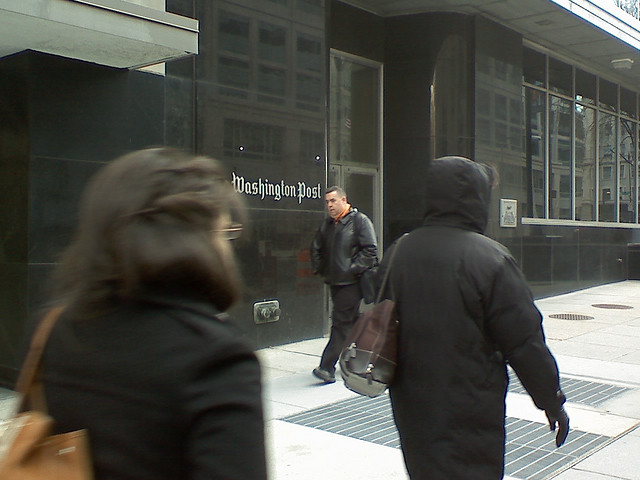
 Photo by Dan Macy
The Washington Post is adding to its website today an advertising model that will put it in the same league as Forbes, BuzzFeed, and Gothamist LLC. Visitors to the Post’s homepage today will find, amid the day’s articles, a block of text about how rural communities in West Virginia are incorporating smartphones into their local economies.
The linked article, however, is not bylined by any Postie, but by CTIA, the trade group representing mobile phone network providers. The Post is moving into the realm of branded content, laid out to appear fairly similar to actual articles but filled entirely with advertising copy about the entity paying for the space. It is calling the platform BrandConnect.
But whereas those other companies are entirely or increasingly focused on digital publishing, the Post is treading new ground as the first major U.S. newspaper to offer its advertisers the same look with which it treats its reported content.
In the ad, which displays under the same banners and drop-down menus as one would see when reading any ordinary Post article, CTIA flaunts a smartphone app being used in several small towns in West Virginia. The key visual difference seems to be that the ad is written in a sans serif font.
“It’s an effective supplement to standard ad placements,” Steve Stup, the Post’s vice president of digital sales, says in an emailed statement. “With BrandConnect, CTIA will share their own blog posts, video case studies, and infographics related to wireless communication.”
BrandConnect was first reported Monday night by Digiday, a website that covers the online marketing industry. Of course, the Post is hardly alone among publications in introducing Web advertising pages that are designed to look practically indistinguishable from editorial content. It could be lucrative, especially to a newspaper publishing division that lost $53.7 million in 2012.
Some customers, like CTIA, will provide their own content. But if future clients do not, the Post’s advertising department plans to tap a network of freelancers to create the posts. The CTIA campaign will run about three months, Stup says.
Forbes and The Atlantic routinely feature sponsored content at or near the top of their home pages. Meanwhile, so-called advertorial content is the primary component of the business model at BuzzFeed, where branded lists of photos, videos, and other items are interspersed with the output of the fast-growing site’s editorial staff.
“It’s basically moving past the era where advertisers can fake it and actually create something people will engage with,” BuzzFeed founder Jonah Peretti told The Guardian in January.
There are obvious differences between sites, of course. Given BrandConnect’s offer of integration in the Post’s website, it seems CTIA’s campaign will be driven more by text than, say, colorful, photo-heavy lists with titles like “13 Ways Congress Can Deregulate Our Members.”
But the Post echoes Peretti’s angle, with Stup saying that BrandConnect is designed to “let marketers become content creators and engage even more with The Post’s readers.”
As for Gothamist LLC, which owns DCist, sponsored posts appear regularly, positioned in between editorial sections. Many advertisers also pay for sponsored Facebook and Twitter posts published by the official accounts used by the company’s sites. Recent advertisers include ABC, Patrón Tequila, the British Tourist AuthorityBritish Airways and Visit Britain, the dating website HowAboutWe, and American Express.
Even though CTIA’s ad does not take up that much real estate on the Post’s home page, and acknowledging that media companies are constantly looking for new revenue models that don’t tarnish a well-earned editorial brand, the introduction of sponsored content can be dangerous. In January, The Atlantic suffered some Internet-wide humiliation when it published a post sponsored by the Church of Scientology that looked so similar to the magazine’s regular content, many readers were led to believe that an Atlantic staff writer had just penned several thousand words praising Scientology leader David Miscavige on the eve of the publication of a penetrating new book about the controversial church. BuzzFeed’s model, meanwhile, has been knocked for using people’s photos without asking their permission.
One thing the Post won’t be doing, at least for now, is issuing sponsored tweets from its main account, @washingtonpost. In January, the Associated Press rented out its Twitter account to Samsung, which published several posts about new products under the @AP banner.
The Post, like many other papers, has long included printed “advertorial” sections, including those placed by the governments of China and Russia. But online sponsored content can be more deeply ingrained in a website than a pull-out “China Watch” section is in the paper. Despite the inherently disarming appearance and occasional ethical murkiness, branded content seems destined only to grow as part of the online advertising model, both for new companies like Gothamist and BuzzFeed, and, now, legacy brands like The Washington Post.
Correction: This article originally stated that the British Tourist Authority purchased sponsored posts on Gothamist LLC. The clients are British Airways and Visit Britain.