

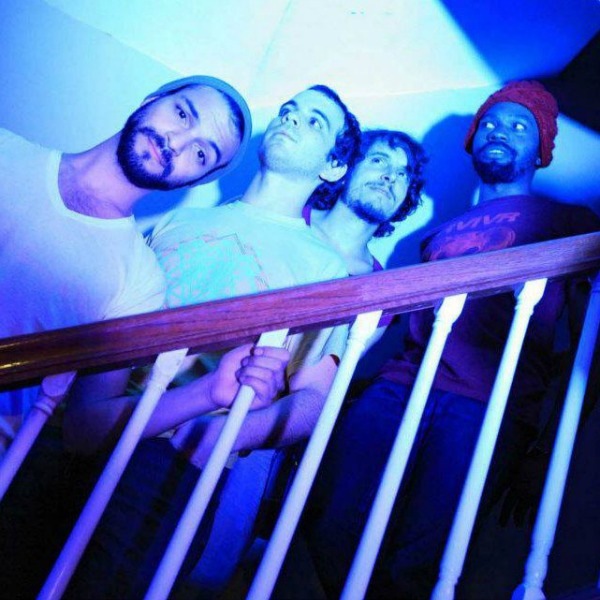
 Photo of Paperhaus by James Cullum.
Sometimes growth, musically and otherwise, moves slowly and almost imperceptibly. It crawls along over the course of years and might only reveal itself in matured lyricism or complex time signatures. The musical growth of Paperhaus has been more rapid and more visible. Eighteen months ago when they opened for ambient Americana act The War On Drugs, it was easy to play “Guess the Influences,” a telltale sign of a new act. While it was easy to appreciate their points of reference—Television and Explosions in the Sky in the guitar riffs and Bob Dylan and Morrissey in the lyricism—it was also a sign that they had not quite carved out their own path.
However, their most recent EP, Lo Hi Lo has an assurance of purpose that Paperhaus did not have in 2011. Singer/guitarist Alex Tebeleff, bassist John DiLascio, guitarist Eduardo Rivera and drummer Brandon Moses can (and certainly will) talk emphatically and at length about the music they love if you give them the inch. However, Lo Hi Lo no longer a connect-the-dots of the bands they love instead painting a picture of the sounds they love.
“Twisted Tumbled” is the most sonically diverse track (although at seven minutes, it can afford to be.) It has a soothing psychedelia that persists throughout the track, but they aren’t afraid to switch on a dime to a louder and faster pacing and exploding into bluesy harmonies. It also allows more room for jamming than poppier songs like “Corazon.” There’s still an absolute optimism about them that I can only hope remains after two months on the road. Then again, touring is a spark for growth as well.
We sat down to talk to the band about the Kickstarter (which ends today) that they set up to fund their current tour, the DIY venue that they call home (literally) and the direction that their music is taking.
Find them online: http://www.paperhausmusic.com
Buy their music: http://paperhaus.bandcamp.com
Alex, I’ve caught on that you’re a big Bob Dylan fan…
John yawns.
Okay, so not all of you are?
Alex: Well, I got him more into it. John hadn’t listened to a lot of it. So, I got him a little into it. I got Eduardo more into it.
Eduardo: I grew up with Alex, so… We’ve known each other since 7th grade.
Alex: We’ve been playing music together since we were thirteen.
Eduardo: The first time I met Alex was was on the soccer field. He came up to me in gym class and he said, “Tupac’s still alive.” And I was like, “Who is…this kid? I must play music with him.”
Alex: Paperhaus actually started in freshman year of high school. He’d gone to Churchill, I’d gone to Wootton, so Potomac area of Maryland. And we’ve been playing together for ten years now.
Eduardo: So, through that, he’s gotten me into 90% of my music.
Alex: I don’t think we could stay playing music together if he didn’t get into Dylan because I was OBSESSED. I’m still pretty…
Was…?
Eduardo: Is. Forever will be.
John: Definitely.
Alex: He’s probably my biggest influence.
But it sounds like you have other influences that you bring to the table that are not Bob Dylan.
Alex: Most music we all listen to.
John: I made kind of a facetious yawning gesture only because I like to bust Alex’s chops about his obsessions. I, of course, respect Bob Dylan a lot. I love Highway 61 Revisited. And his lyrics…I think of him as this guy that came out in a time of history where people were listening to a lot of really bland music. It was the 1950s and this guy comes out and starts singing these deep, prophetic songs. It almost sounds like the Book of Isaiah. He sounds like this crazy Biblical prophet. And I like Bob Dylan but I think my influences probably came more from guys like Scott Walker. He definitely is a huge influence.
Alex: Huge on me as well. Scott Walker is one thing that John and I connect on specifically.
John: I like guys who paint a picture with their music. I’ve always liked Frank Zappa…
Alex: That’s our biggest point of contention.
John: I understand why somebody wouldn’t like Frank Zappa but, again, I just find the way that he paints the picture with his sounds. The way that he uses music to paint the picture that he’s talking about. He paints a very comical circus-like picture of things, but it still impresses me and I like the humor of Zappa. He does get out of hand in the ‘80s when Steve Vai joins the band. But the We’re Only In It For the Money album is amazing. It blows my mind. He liked to freak out, too. The Beatles liked to freak out.
(opening chords to Iron Man play over PA)
Alex: Oh my god!
Eduardo: This is his most recent obsession. When we were on tour we listened to Paranoid like 400 times.
Alex: I’d say between Eduardo and I, Marquee Moon is the album we’ve listened to more than anything else.
John: I’m avoiding it, actually.
Alex: But I love that era of music: Television, R.E.M., Talking Heads, Velvet Underground. I’ve listened to every Velvet Underground album and every B-side four hundred times.
John: There was this Russian band that I was really into called Kino. I was really timid about sharing it with these guys at first but everyone really dug it. Kino was this band around the time of glasnost/perestroika and this band was headed by this guy named Viktor. His father was Korean and bordering Kazakhstan and they moved to St. Petersburg when he was very young. He grew up there and started playing rock music. They used to have DIY rock concerts. That was the only thing they could do. So this guy came out of that. Anyway, the famous singer heard his songs, produced his first album and this guy skyrocketed and became the first big time Russian pop star. Anyway, he died in a car crash when he was 28, so he was elevated to this kind of legend status. He’s like the Kurt Cobain of Russia in a lot of ways. So, I started playing Kino for these guys and they really dug it and we’ve started playing Kino’s songs.
Alex: I sing it in Russian, too.
John: You’ll start hearing it in our own songs. We’re like, “Hey, this sounds like Kino!”
Alex: They remind me a bit of R.E.M. actually.
Eduardo: They sound a lot like The Cure and The Smiths.
Alex: It’s a little brighter than the Cure.
John: Some of it’s pretty dark, though. You haven’t heard the ones where he sounds like Dracula. So, Russian rock. Another influence on us. That’s kind of an interesting one. That’s the thing. I’m interested in Paperhaus expanding our sound. I want our sound to be unique and I feel like our band should present something that no other band has presented yet. I feel like that’s an amazing thing. Like, if you could even do just that as a band — even if you’re not popular or you only have one great album — you just create something where you know that that’s the first time that music has been played that way before. Or you make some innovation to music that someone hasn’t tried yet. Even if it’s just one thing, few people in the world get the opportunity to be a part of something like that. So, I was glad when we found that influence because I felt it could add something. There’s no way that there’s another band in D.C. that’s influenced by a Soviet rock band.
Alex: I doubt that there’s another band in America that’s influenced by a Soviet rock band.
So, Alex and Eduardo, you two have known each other since you were thirteen. How did you meet John and Brandon?
John: I’d been traveling around the world. I studied Russian in college and I went to Russia for awhile. It was awesome, actually. I spent about four years working there. St. Petersburg is by far the coolest city. So, acquired the language and Russian’s always been my thing besides music. For some reason, I’ve always been obsessed with languages. I went to China for awhile. I studied Chinese. I went Japan for two years and I had just come back from Japan and I went to Florida and crashed with my parents. That did not last very long. I was like, “Fuck it, I’m gonna go to D.C.” My sister was here. So, I came up here and I was out one night and met these guys. Actually, it was my sister who had met them and they were all trying to get with my sister.
Alex: So basically, me and Ed weren’t playing as much but we were living in the house. Then Brandon moved in with us and I had become good friends with Brandon and we all started playing a lot. I was going over there and playing the Red Door Room a lot.
When was this?
Alex: December 2010. So, I became really close with Brandon and we began hanging out and playing a lot. It just so happened that Brandon was working on a song where he looped a guitar part and he was trying to work out a drum part. So, the way we started jamming was with him on drums. He wasn’t a drummer but that’s just how it started. We just kept on jamming for some reason with him on drums and me on guitar and bass. I was like, “Ed, you should hang out.” And the night before that, we had met Kristie. We didn’t know anything about her but we wanted to try a girl singer.
You had actually wanted a girl singer?
Alex: Yeah. I was interested. I hadn’t worked with a lot of females and I was excited with the idea of working with a female musician. So, we brought her along and she brings her brother, John. Me and Brandon were like, “Who the fuck is this guy?” And I remember the song. It was “California When You Were Gone.” And Kristie really didn’t work with us as well as we hoped. It wasn’t bad but it didn’t click. John immediately clicked.
Eduardo: So, I get a call from Alex and he’s like, “You’ve got to come over. Bring your guitar. Bring your amp. You’ve got to come.” I’m usually the one that falls asleep at 10 p.m. or 11 p.m. It’s 11 p.m. and I said, “Fine. I’ll do it this one time.” Because I have to work really early in the morning. So, I come over. They’re jamming and everything. I set up and they’re all sounding really good. I was nervous the first time we played. I had never played that song before.
Alex: This was an older song. I’d written it in the shower six or seven years ago.
Eduardo: Where he writes 60 or 70% of his songs.
Alex: But it’s a song about California going into the sea. We don’t play it anymore, really. I think we’re probably going to end up redoing it a bit now that we’re a much better band. But, it happened and the four of us just kept on playing. Our first show was with Lightfoot. We’ve also played great shows with Pree.
Eduardo: We had a chance to play with Pree on the last show of our tour in Richmond. We did acoustic shows together.
Alex: They’re some of our close friends in D.C.
Eduardo: The people of Frau Eva, Pree…it was so refreshing. We were on tour and the entire time we were meeting all these new people and on the last leg of the tour, they came to play the show with us and literally our rape van approached and they had their rape van right next to ours. They came out and it was so refreshing seeing people back from D.C.
Alex: There were hugs all around.
John: There’s not just anyone from D.C. that I’d be that excited to see.
Alex: There’s a little bit of a scene developing amongst our group of friends.
Eduardo: There’s a lot of cameraderie right now. I think one of the newest ones is Lightfoot. A bunch of the members moved a block and a half away and they have a studio in their house. I think the connection between the two bands is really cool because we’ve got this music venue going on, they have a DIY studio going on, Ivan, the guy producing us lives half a mile away. Something’s brewing right now in Petworth.
Where do you see the Paperhaus in terms of DIY in D.C. It seems like more of a focal point than it’s been before.
Alex: We’re definitely the most active place.
Eduardo: It’s definitely impressive in terms of how much attention it’s garnered. It originally started off as an acoustic showcase of D.C. musicians. After that it’s just kind of built up and Alex tells me every day. We filter through so many acts that are trying to get through. If we can’t take them all, which we can’t, we try to give them off to other DIY venues around the city. And just kind of give them options.
So is there a network of DIY venues?
Alex: Sort of. I think people are trying to do that more. The punk community is much better at communication in that regard. I think the rest of D.C. has some catching up to do.
Brandon: And they’re starting to. There’s Hole in the Sky, there’s the other kid who always comes to the house…
Eduardo: From Dead Kennedy Center?
Brandon: Also, Dead Kennedy Center, but there’s another kid that always comes to the house that I never talk to and I just got two invites from him to shows at his house. There’s not a lot of people holding super regular shows but enough to kind of handle the energy. As a collective, there’s enough to go around to accomodate various bands.
Alex: There’s other occasional places. The big thing is that we did 50 or 60 shows in 2012. As far as I’ve noticed, that’s the most I’ve seen anywhere. And it’s really intense, I’m not going to lie. Living with that is tough.
Eduardo: It forces us to clean the house, though.
Alex: But it’s our way to connect with not only people outside of D.C. but people in D.C. in a way that’s really substantial and fulfilling. It’s definitely been the most interesting experience of my life. There’s no question that if D.C.’s going to have a neighborhood that’s going to become a focus of music and creative pursuits in general. Petworth is the only place with all the fundamental things you need. First of all, it’s cheaper than anything else in Northwest. That has to be number one. It’s very difficult to pursue something creatively while working your butt off at some 9-5. You’re just not going to have the energy to pursue something really creative. It’s not conducive to that.
Eduardo: Also, people around Petworth are a lot more understanding. The whole structure of the neighborhood. They’re not high rises. We don’t get our streets cleaned.
Have people called the cops on you?
Alex: Twice in two years.
Eduardo: That’s a pretty good record for the amount of shows that we have. When we first moved we were pretty up front about what we do. “We are musicians.” The house before us were musicians. It wasn’t anything out of the blue. We also try to limit it on the weekdays to a respectable time and cut it off so they can get some sleep.
Brandon: Not that playing music through 50-100watt amps is ever really respectful to your neighbors.
Eduardo: We’ve had them come in before. The neighbors just sit outside and Brandon will see them and invite them in and they’ll come in and just listen.
Brandon: Sometimes the neighbors come over for beers during parties. Sometimes the kids come in and just stare awkwardly at people.
Eduardo: We let them hit the drum set a bit.
But it sounds like you will be vacating.
Alex: We’re going to be gone from March til May and then we’ll start back where we left off when we get back in June but we’re touring. April and May we’ll actually be touring and this month we’ve been perfecting the sound just to get away.
This is going to be longer than any tour you’ve ever done.
Eduardo: There was a one week tour and a three day tour.
Alex: It’s been hard. We just realized that the only way we could really do this is if we got away from everything. That’s why we’re doing it like this. I started booking super early because I’m kind of a cautious person when it comes to this kind of shit. I don’t like procrastinating. It never works out when I procrastinate on anything and I guess I’m sort of taking the lead on the booking end and asking the guys for help when I need it. I just started early, luckily. Because some of the dates that are hard to book are already booked and some of the easier ones I haven’t started yet because I know we’ll have an outlet in some manner.
You have a Kickstarter that you have up right now. Can you explain what the Kickstarter is for? (Editor’s note: Paperhaus has, since the recording of this interview, reached their goal. The Kickstarter project ends tonight.)
Alex: We don’t have enough money to do this properly. So, we’re trying to get enough money to do this properly.
This, meaning the tour?
Alex: The album, the tour, PR.
Eduardo: It’s all encompassing. The original plan was for maintenance of the house when we’re away, to be able to upgrade our monitors, speakers and then fund the rest of the tour. We’ve been doing numbers and it’s going to cost a pretty penny. We figure that what we’re helping with is shows in the city. Maybe someone will be able to help us out as we’re trying to pursue a tour.
Brandon: I mean, artists use their patrons.
Alex: Historically, it’s true, whether it be a record label that actually cares about music and not just about money or…
Brandon: …The de Medicis.
Alex: Most great artists were able to achieve success with — and Kickstarter has been a really positive development for artists. In a time when people don’t buy records anymore, it’s a really positive way for people to support artists.
Eduardo: That’s what it comes down to is mutual support of the community so we can do what we want to do. No fluff. We want to be able to eat and go on tour.
Brandon: Definitely not for profit. We’ve hosted free shows and given all the money that we make at shows to bands.
Alex: We’ve never made a dollar off of any of the shows we’ve ever done. And we have a strict policy that 100% of the money goes to the out of towners.
Eduardo: This guy (pointing to their roommate Andrew Passell), makes lentils.
Brandon: He cooks for almost every band.
Eduardo: We hope we find the same type of people when we’re on the road.
Alex: I guess it’s just the aspect of The Paperhaus that I want to emphasize is that it’s our way of giving back to the community. We know how it feels and we want to give touring bands an opportunity to play a place that’s not a shitty venue where they won’t make any money. If you’re not going to make any money, at least you’ll have a place to stay. We don’t really promote that much at our shows. People just come and it’s always people who really give a shit about music. I mean, we’ve had plenty of parties where people get wasted but the shows are really about people really listening to music and really care about listening to what’s happening. I think that’s really something special aside from the band that this house has really become something.
Brandon: Like any NPO, we’ve got to do those fundraisers.
How has the Paperhaus sound changed since the band’s inception? I know that you’ve gotten new equipment and are always experimenting. What sounds different with your new material?
Brandon: Early on, it was either Eduardo’s song or Alex’s song and there was very little of me and John in the process. It was like, “Hey, we have these songs. Play them.” We tried to keep up. Especially me trying to keep up because I wasn’t that good at drums and I was determined to learn quickly. I saw Jess Matthews at one of our last shows and she said, “I guess you’ve been playing nothing but drums lately,” after she saw the set. But, now it’s more collaborative. We were able to kind of craft the psychedelic thing. At one point we were in New York playing shows and we sat down and we were like, “What is this band? What do we want the band to be?” A bunch of things were said but what floated to the top is that we were all interested in the psychedelic. That became the foundation for the new vision of what Paperhaus is and was going to be. It was already undergoing a transformation. I think if you saw our set now, you’d be pretty surprised as to what was happening and what was recorded prior.
It was already a little bit psychedelic. There was that very clear Television influence.
Alex: You’re never going to hear me and Ed play guitar without hearing that. We’ve listening to that since I was 15.
Brandon: Well, the psychedelic concept wasn’t where we were like, “We’re an indie folk band that suddenly wants to be psychedelic.” We became self-aware at that point. It was about what we wanted to be, but we found who we wanted to be through who we were and we wanted to focus. When we brought that self-awareness to it, it did what becoming self-aware in a group or as an individual does. It allows us to grow and expand. I feel like you’re not going to be paying attention to the psychedelic qualities of this record, Lo Hi Lo.
Alex: It’s a pop record for sure.
Brandon: Real Estate was such a contributing influence, and Lower Dens and stuff like that. Those were the two bands we were all listening to at the same time.
Alex: Days is one of the most beautiful records I’ve ever heard. Real Estate blows me away. Kurt Vile and the War on Drugs, also. Also, the Smiths.
Brandon: Oy.
Eduardo: We went through an intense Smiths period at the same time…except for Brandon. I think that the biggest difference between this record and the last record was that it was the most selfless thing that we could fucking do. We each wrote songs and we each let the other people do it.
Alex: A perfect example is “All Through the Night.” I did a song, a partial structure. The melody was there. The lyrics actually came out of a jam that we did and I wrote lyrics during this jam and then expanded upon them and came to John and was like, “So, I’ve got this shell, what do you think about it.” We started jamming on it and all of a sudden, one of my favorite guitar parts I’ve ever written came pouring out in response to this bass line. He added this whole new part which made me create a whole new part. Then we brought it to the band and the structure started forming. Some of the songs aren’t one person bringing something and then the songs fluorishing and developing. We literally have the next full length record written pretty much. It’s going to be way more intense to record. We’re waiting until we have some time and money to do it properly. That’s going to be the real psychedelic album. Those songs were created out of jams. A lot of these songs started at Gold Leaf and then evolved and continued at the house. The next level is totally writing these songs together out of the blue. No input whatsoever from anyone other than what the four of us come up with together.
Eduardo: Is that a Delorean?
So, what sort of effect has Back to the Future had on the songwriting of Paperhaus? Go.
John: A lot.
Eduardo: So, Marty McFly was just the greatest character ever. He’s very cool, very nerdy, kind of a rebel but very sweet. And that’s our band! That’s what I think about every time I play music. What would Marty McFly do?


