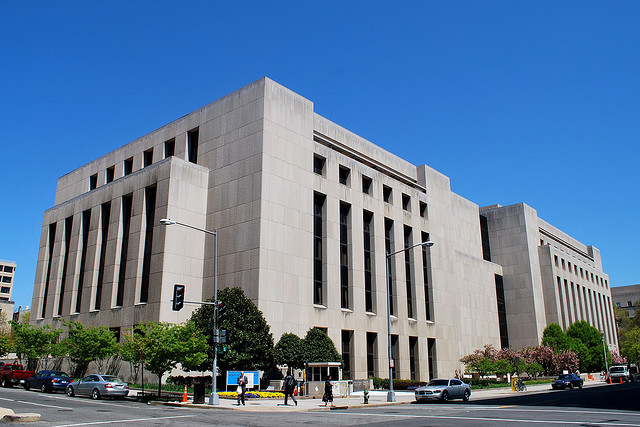
 H. Carl Moultrie Courthouse (Photo by M.V. Jantzen)
If one had to guess the legislative body that trampled over the wishes of D.C. voters yesterday and said “Congress,” they’d be wrong. In fact, that designation can go to the D.C. Council itself, which yesterday voted to delay the city’s first attorney general election by four years, despite the overwhelming passage in 2010 of an amendment to the Home Rule Charter that called for an elected attorney general beginning in 2014.
While the 2014 Democratic primary, assuming an attorney general election would mirror D.C.’s other races, is still nearly 11 months away, interest in the position has been fickle at best. The office’s current holder, Irv Nathan, wants a “lawyer’s lawyer,” but so far, nobody—whether they be like Atticus Finch or Foghorn Leghorn—has declared their candidacy.
Additionally, there is a split between Mayor Vince Gray and some members of the Council as to what powers an elected attorney general might have. As The Washington Post reported earlier this week, Gray and Nathan want more than one-third of the District government’s lawyers to start reporting to the mayor’s office rather than an elected attorney general.
Lawyers working in D.C. agencies report to the attorney general, who, in turn, reports to the mayor, a system intended to maintain consistency in the city’s legal work.
Mayor Vincent C. Gray (D) and his appointed attorney general, Irvin B. Nathan, are backing legislation that would have those agency lawyers—about 150 of the office’s 350—report directly to the mayor.
But several Council members, including a few of the 11 who voted to authorize the 2010 referendum, disagree and want to delay making the city’s top lawyer an elected office.
Councilmember Jack Evans (D-Ward 2), who is running for mayor next year, introduced a bill yesterday calling for a four-year delay. “We are just not ready for this,” Evans said, according to the Post. That did not sit well with Council Chairman Phil Mendelson, who as an at-large member in 2010 pushed through the measure authorizing the public referendum on the attorney general position. Mendelson called Evans’ maneuver, which passed on an 8-5 vote, “an embarrassment.”
But the amendment, when it was voted on by the public in November 2010, was quite clear. “If voters approve of this amendment and the U.S. Congress does not reject the measure,
residents of the District of Columbia would begin voting for the Attorney General in
2014.,” the amendment reads.
Congress didn’t reject it. D.C. voters wanted an elected attorney general by a three-to-one ratio. But who needs Congress when the D.C. Council is there to reject the public will?