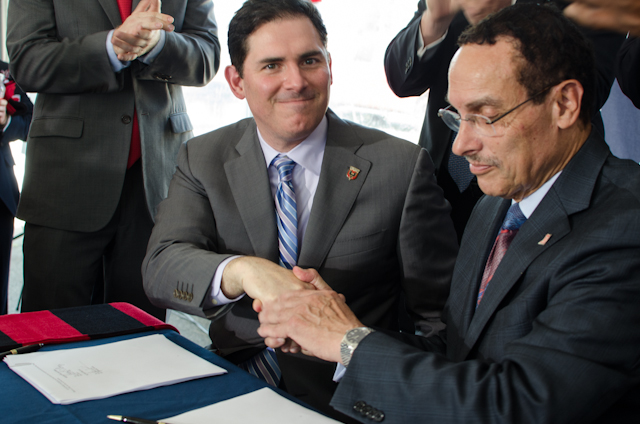
 United co-owner Jason Levien, center, and Mayor Vince Gray sign the term sheet for the stadium deal. (Photo by Pablo Maurer)
By Benjamin R. Freed and Pablo Maurer
Mayor Vince Gray, other city officials, and D.C. United co-owner Jason Levien unveiled today a ambitious $300 million plan that, if executed successfully, would result in the soccer franchise having a new, 20,000-seat stadium at Buzzard Point in Southwest D.C.
Since the first Major League Soccer season in 1996, United, the sport’s winningest franchise—despite a woeful 2013 campaign—have played their home games at Robert F. Kennedy Stadium, a half-century-old football coliseum with crumbling infrastructure and underwhelming amenities. Meanwhile, United have seen their rival clubs build soccer-specific venues of their own as the league has grown up. But if the District pulls off a series of land swaps and cash deals with the companies that currently own Buzzard Point, United would be suiting up at a gleaming new facility as early as the 2016 campaign.
“The winningest franchise in Major League Soccer will be staying right here in the nation’s capital,” Gray said in announcing the stadium plan on the nine-acre plot where the stadium would be built.
United will front the $150 million expected cost of actually constructing the stadium, which in renderings provided by the team is projected to be modern and glassy, with clean lines and wide plazas. But before any ground can be broken, the District agreed to secure the land, which will be done so through several land and cash deals that still need to be formalized.
The other $150 million would be covered by the District in obtaining the land, or as Gray called it, the “horizontal” part of the project. Two acres are owned by the development firm Akridge, which would swap its plot for one of three city buildings, most likely the Frank D. Reeves Municipal Center at 14th and U streets NW. The D.C. agencies in the Reeves Center would be relocated to the Anacostia Gateway complex on Martin Luther King Jr. Avenue SE.
The remainder of the land is owned by Pepco and the investor Mark Ein. While Pepco’s regional president, Thomas Graham, and Ein stood on the dais behind Gray, neither of their firms have reached arrangements with the city to sign over their Buzzard Point holdings to the stadium project. Still, their presences, along with Matthew Klein of Akridge, lends credibility to the project.
The deal will also need the approval of the D.C. Council, some members of whom attended Thursday’s announcement, including Jack Evans (D-Ward 2) and Tommy Wells (D-Ward 6), whose jurisdiction includes Buzzard Point. Both Evans and Wells are also candidates in the 2014 mayoral election.
“The stadium is a unique way for the city to get some of the things we need to continue growth and development,” Anita Bonds (D-At Large). “I love the idea of this land swap.”
While Evans told reporters he believes the Council has the votes to put its stamp on the Akridge swap and any other deals that need to be worked out in order to pull off the stadium plan, some of his colleagues might remember that the construction of Nationals Park soured many residents on civic financing of sports facilities. That stadium, which opened in 2008 and would cast its shadow over a United stadium, was built with public funds that, after cost overruns, cost nearly $700 million.
As for the Reeves Center, which was constructed in 1985 under then-Mayor Marion Barry at a time when much of 14th Street NW was still a husk from the riots of the late 1960s, the roughly 1,000 D.C. government employees who work there would be moved to a new facility, also called the Reeves Center, in Anacostia.
“The tradeoffs are excellent,” Barry, now the D.C. Council member from Ward 8, said, though he acknowledged Akridge’s intended razing and redevelopment of the existing Reeves Center will present several zoning challenges.
Barry also said he will be looking to see that a majority of people hired to construction jobs on the various projects that result from this deal are D.C. residents. But he seemed comfortable with the cost to the District. “You got to spend money to get money,” he said.
There are other infrastructural issues that need to be sorted out, too. Buzzard Point is about a 15-minute walk from the nearest Metro station, at Navy Yard, and the roads are currently narrow and littered with divots and potholes. Terry Bellamy, the director of the District Department of Transportation, said that the roads would be improved under the agency’s larger plan to redevelop the streets along the South Capitol Street corridor, which is centered around the replacement of the Frederick Douglass Bridge.
Gray said there would be plenty of parking, though, with the city working on an arrangement with the Washington Nationals to use the neighboring baseball team’s parking lots on soccer days. “We look forward to welcoming D.C. United to the neighborhood,” the Nationals said in a statement.
Still, this stadium plan comes after years of half-starts and teases, including a period in which Maryland Gov. Martin O’Malley flirted with United’s former owners about moving the team to Baltimore.
“We’ve gone down this road several times,” said United head coach Ben Olsen, who has been affiliated with the team one way or another since 1998. “But it’s a huge first step with the District of Columbia. “There’s nowhere else this team needs to be but the District. I can’t wait to see it one day happen here.” Olsen also said that as a D.C. resident, it is a “big deal” for him that the team will stay rooted in the city.
“This is a landmark day for D.C. United,” said Levien, who bought United last year along with the investors Erick Thohir and Will Chang. Levien also said that he instigated a conversation with Gray’s administration “within 24 hours” of taking ownership of the club. In addition to getting a stadium out of the arrangement, United also stands to take control of a strip of Half Street SW to develop with retail, hotels, and other amenities.
Levien compared the potential effect of a new stadium to what has happened in Kansas City, Kan., where Sporting Kansas City’s new stadium has “galvanized the community.” Indeed, several United loyalists reacted to today’s announcement with glee.
Donald Wine, who has attended United games since moving to D.C. six years ago and belongs to the supporter club Screaming Eagles, said he and other fans have waited for an announcement like this for a long time. “It’s obvious there are still things that need to be worked out,” he said. “This is what we’ve dreamed of. We want a home of our own.
And, Wine said, he and other fans are even contemplating real estate deals of their own now that United appear headed to Buzzard Point. “This is a great area,” he said. “We’ve talked about buying some row houses here and having block parties.”