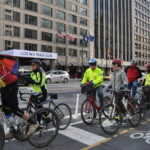
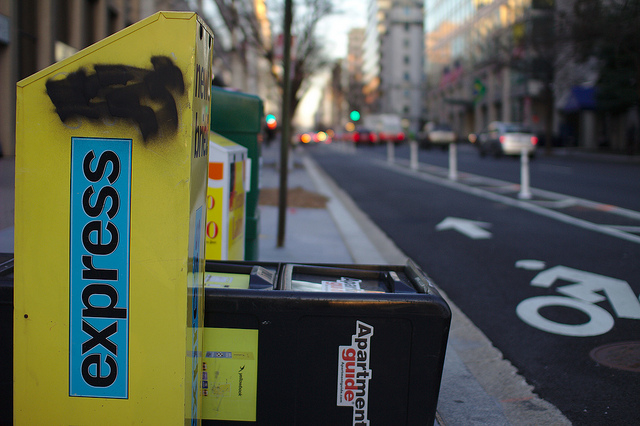
 Unlike the L Street bike lane, the M Street track will be buffered by parked cars — for the most part. (Photo by Rich Renomeron)
The debate over the proposed M Street NW bike lane —specifically the 1500 block of M Street where the Metropolitan AME Church sits—has turned into quite the policy headache over the past few months.
When it was announced in May that construction on the long-awaited cycletrack would begin in August, the news was met with much turmoil from the Metropolitan AME Church, whose representatives were pretty angry about the proposed changes, specifically that the new bike lane would take away on-street parking for the church on Sundays.
The District Department of Transportation has finally reached a compromise on the bike lane. In a post on DDOT’s blog, they explain that, in order to appease the request of the Metropolitan AME Church, they’ll alter the track on their block:
Although the M Street project will provide over a mile of protected lane, this block will be designed and maintained as a “traditional” bike lane to the left of parked cars without the buffer of parked cars or flexible posts. We will include green paint for much of the block to increase the visibility of the lane. The design revisions have included other minor changes and adjustments based on feedback we received at our May public meeting and in working with other corridor stakeholders.
The Metropolitan AME has been “an important institution on this block since 1925,” DDOT writes. The agency explains that during the designing stages they realized that the cycletrack would have significant impacts on the church’s day-to-day functions and that “during the design process, it became clear that the original cycle track design would have had an impact on church operations that take place within the block and limit the ability to accommodate special events at the church along with routine activities.” Not wanting to disrupt the relationship with the M Street community, they reached a compromise with the bike lane on that block.
It’s hard to say whether this is the right decision or not, but Greater Greater Washington editor David Alpert does a great job of weighing the four potential options DDOT could have done to resolve this issue and analyzes each one after speaking with DDOT Associate Director for Policy, Planning, and Sustainability Sam Zimbabwe:
There isn’t room to preserve all of the Sunday on-street parking on the block and add a cycletrack. Therefore, one of four things would have to happen:
1. The block loses a significant amount of parking and flexibility, which particularly affects the church.
2. People can park in the cycletrack on Sundays and during midday funerals.
3. The cycletrack becomes just a classic painted bike lane.
4. DDOT moves the tree boxes and completely rebuilds the ndorth side sidewalks to create a sidewalk-level bike lane at much larger cost.
Though DDOT went with option number three, Alpert explains in his analysis the problems with each of the other ones. This mostly revolves around the high cost of outfitting the cycletrack any other way, as well as how hard it is to find another option to appease the Metropolitan AME Church community who were greatly opposed to any sort of bike lane at first.
But not everyone is happy with the DDOT’s handling of this issue. The Washington Area Bicyclist Association outlines the problems with DDOT’s compromise with the Metropolitan AME Church and how it ignored a proper dialogue with the bicycling community who would be using the bike lane:
We respects the diverse interests of our partners in Washington, D.C. We’re all in the business of public space together, and we hope that the city will work to create a downtown that serves the gamut of needs of residents and visitors alike. Such work requires participation, dialogue, and intelligent compromise in a fair and open process.
Unfortunately, those elements have gone missing as the M Street cycletrack has evolved. The result is a poor solution that compromises the intent of the project’s goals, the past promises and visions of the mayor and DDOT, and faith in the public process that determines so much of how our city works. Even worse, DDOT’s sudden reversal has incited a public discourse that has lost the constructive tone of mutual respect and the goal of meeting the needs of all parties concerned with the cycletrack.
With construction of the lane set for October, three full months after it was supposed to begin, it’s still too early to tell if the DDOT’s decision was the right one. But Zimbabwe reassures Greater Greater Washington that, if things don’t work out for the bike lane at the 1500 block of M Street, changes will be made.