Adèle Exarchopoulos (Sundance Selects)
The most explicit shot in Abdellatif Kechiche’s graphic coming-of-age lesbian love story is its most defensive. Mid-way through Blue is the Warmest Color, after we’ve seen teenage Adèle (Adèle Exarchopoulos) and her older lover Emma (Lea Seydoux) in the graphic throes of multi-positional ecstasy, Adèle poses for Emma as the latter, an up-and-coming artist, works on a new series of paintings. The pair’s love scenes are graphic, but this is the one scene in which you see the actress/subject’s vagina.
It’s here that the director explicitly makes the case for movie sex: “I am making art!” But if you are going to make a graphic love story, make a graphic love story. Couching it in terms of art comes off like a ploy to make it safe for Steven Spielberg to champion an explicit lesbian movie at Cannes (it happened!). Kechiche does this again in an extended party conversation in which Emma defends the work of Gustav Klimt as art while a party guest dismisses it as decoration. Substitute Klimt for the film and you see the director putting up his aesthetic dukes. And padding a three-hour movie.
Blue is the Warmest Color is adapted from a graphic novel by Julie Maroh. The movie features sensuous appetites beyond sex: I can’t remember the last time I’ve seen so much food in a movie, and the expression of bodies in motion isn’t limited to the bedroom—dancing is as important to the way Adèle expresses herself as food and sex. But when Adèle poses for Emma, you see that she’s not the one controlling how her body is seen. The artist is in control. The fact that Emma is an older artist makes her a stand-in for a director exploiting his young charges.
The art defense is not the only way Kechiche’s film goes for the obvious. Adèle’s coming-of-age arc is more neatly drawn than most. We meet her in the classroom, studying love in 18th century literature. Adèle tells her older lover about the book they’re reading, Marivaux’s The Virtuous Orphan or: Life of Marianne, and, ha-ha, in this three-hour movie they discuss how intimidating it is to read a long novel. Young and lost, Adèle is floored by this blue-haired vixen she passes by in the street. By the end of the movie, Adèle is in the classroom again, but in a different context.
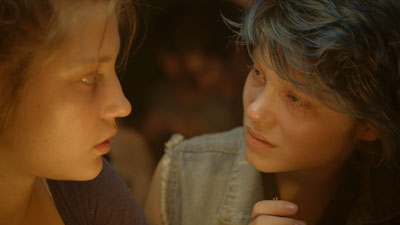 Adèle Exarchopoulos and Léa Seydoux (Sundance Selects)
The movie sounds forced and over-structured, and it is, but hand-held camerawork works in the movie’s favor, giving a intimate vérité look to something very preordained. And the two leads deserve the plaudits. Seydoux and Adèle Exarchopoulos have been caught up in press reports that they felt punished in take after grueling take, but what’s on the screen seems real, even when it becomes a game of name-that-position-we-haven’t-tried-yet-and-let’s-frame-this-in-wide-screen-to-fully-take-in-the-69. Really, it’s a good use of a wide-screen ratio; the compositions separate two characters in conversation, and can only completely capture the lovers in one position: horizontally.
Screen sex can be used to express character—cf. Last Tango or almost anything by Dusan Makavejev. But if sex in Last Tango in Paris explicitly conveys the character’s power dynamic, the love scenes here don’t reflect the changing power dynamic nearly as much as the script does.
For all its flaws I liked much of Blue is the Warmest Color, thanks to its strong lead performances. Exarchopoulos especially hits all the right notes of awkwardness, discovery, and finally a tentative confidence. So if the movie works, it’s not as a cause célèbre, but as something fairly conventional. I’m not sure if that makes it quietly subversive or just, you know, conventional.
—
Directed by Abdellatif Kechiche
Written by Abdellatif Kechiche and Ghalia Lacroix, based on the graphic novel by Julie Maroh
With Léa Seydoux and Adèle Exarchopoulos
Rated NC-17 for explicit sexuality and conventional structure in the guise of art
Opens today at Landmark E Street Cinema, Landmark Bethesda Row, and Angelika Mosaic