In April, the District of Columbia will hold the primary to its 2014 mayoral elections, ushering in either a new era for D.C. politics or more of the same. Either way, with this year’s race already heating up, there will be quite a few candidates on the ballot for you to choose from. Deciding which candidate will be the best choice for you can sometimes be difficult, so DCist is going to help make things a little easier with our newest feature “Get To Know A Mayoral Candidate.” Between now and April, DCist will be interviewing each mayoral candidate about their campaign and where they stand on certain issues, like the Height Act, campaign finance reform, marijuana decriminalization, and more.
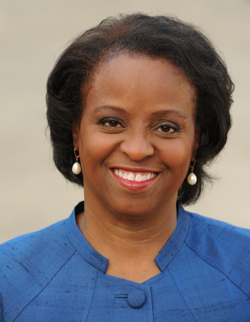
Here’s an interview with former State Department aide Reta Lewis, who re-kicked off her campaign last week
In your campaign kickoff speech, you talked about how being an outsider to D.C. politics is a strength. Why is being an outsider a good thing?
It was very exciting to be out there with family, friends, and residents of the District of Columbia to talk about my vision for the city and to talk about me as an individual, as a candidate who has lived in this city for 35 years. I love Washington, it’s a fabulous city, but you know what? We can’t just be good, we have to be great.
As an outsider in this race, we’re in a change election. Just like we’re having changing demographics. When I go around this city—it doesn’t matter what Ward i’m in, it doesn’t who I’m talking with—it’s clear that we’re not going to change things unless we change the people that are bringing the change. I am the individual who can do that, because I have not been a part of the status quo. And if you’re going to change the status quo, you’ve got to be a fighter and someone who’s willing to step in there and say “You know what? We’re going to change the conversation, we’re going to have a new perspective.” But the perspective that I’m going to bring as a new mayor will not be about being just another mayor, it’s going to be about putting people first, and that’s where we need to start in our conversation here in D.C.”
How would you improve WMATA? Do you think there needs to be more
accountability and oversight?
One of the things, as it relates to overall transportation planning for any city, is that it’s gotta be about smart transportation and it’s gotta be about a collaborative with our regional partners. But more importantly, since those lines come anywhere, our residents just want to be safe. They want it to be efficient, they want it to be safe. As residents, it’s inexcusable when the elevators don’t work, it’s inexcusable when the escalators don’t work because it affects so many people. It affects the elderly, it affects the moms with kids in strollers, it affects those who are disabled. And so safety is very important. But for all of our system, it really does come back to transparency, and it really comes back to some vigorous oversight, and I think we have to make sure we’re working with our own agencies in breaking down as many silos as we can to make sure that we deliver better services, but we have to also work with our regional partners.
Do you think the city is focusing too much on bike infrastructure? Not enough?
Washington is a beautiful city and I live smack-dab in that community. I’ve lived in the Fifth and Massachusetts Avenue community from the beginning. I have been down here in the first building that was in the transformation of Chinatown, and then I moved into a residential unit right on Mass Avenue. I have seen this demographic change.
We’ve got a young demographic in this city, but we also have a lot of people that just want to get out of their cars. We want to get a low carbon footprint. We want people to be able to walk and bike to work. But the discussion that we need to have is the fact that people are pitting communities against each other, and we don’t have to do that. We don’t have to have brown, black, and white citizens and residents against each other. We don’t have to have a community that pits the rich against the poor. We don’t have to have a community that pits the two-wheelers against the four-wheelers. We are all in here together, and we’re going to have to have a community where our quality of life says that “we are here to help each other.”
How do you feel about the District’s push for marijuana
decriminalization?
I totally support decriminalization. The reason being is that it’s all about the law having an adverse effect on our population on Hispanic and African American males. We all know that once a person gets a mark on their record, that it really goes to how productive they can be as a citizen, it goes to jobs, it goes to whether they can get good housing. It goes to so many things. We can’t afford to let minimal amounts of marijuana have an impact and then sit back and not do something about that.
What about legalization?
That’s going to be a very controversial issue in this community, and I think we’re going to be talking about that in all sectors, but I will tell you that my first job was in the Drug Enforcement Administration. With my background at American University in the Administration of Justice, and working at the DEA, I fundamentally would want to make sure that we understand what we’re getting ourselves in for.
How do you feel about the proposed changes to the Height Act?
Every time I leave Washington and come in from the airport—whether it be from Dulles or Washington National—I see what a beautiful city Washington is and it just warms my heart, just as it does to the residents. Any decision to make a change in that law, we just have to make sure that we are totally understanding what that’s going to look like. We will not want to wake up and see something that—as citizens, as residents—we did not really come together as a community to make sure we understand what that change is. I know some of the reasons why they want to change the height restrictions, there have been some significant conversations about how when you get these changes it will be able to affect how many units go in buildings—that people can get affordable housing. We still have to look at Washington from an overall perspective and balance all the interests, because we do need to have great places for people to live.
What is the best way to create more affordable housing in the city?
First of all, the administration that I would lead would work totally in collaboration with the citizens. We see so many citizens that are on our current list right now that are trying to find housing for themselves and their families, and they have been for years. We have organizations that have been getting it right in this community. We have institutions in this city, as well as communities around the country that have gotten affordable housing right. We need to be able to be open to, not only the good practices that we have here in Washington to see how we can duplicate them, but also the next practices, and then be able to be open to what others have to say about how we can change that landscape.
Do you think the Washington football team should change their name?
I love our sports teams, I love our Washington [Football Team], I live right by the Verizon Center, I love our soccer team, I love sports. Throughout my career I’ve worked with numerous sporting events and teams, but I’ll tell you that when it comes to anything where a large group of individuals in any community in the United States—or anywhere—feel like it is discriminatory against them, I totally support that change. It’s a private decision, but it’s still in Washington, D.C., and the public, as they say, is all about it.
How do you feel about the recent campaign finance reform amendments? Do you think the D.C. Council should close the LLC loophole?
I am for sweeping campaign finance reform. It’s the only way we’re going to clean up the system that people view as one that is not working for everyone; that is a system that’s about the protection of people who have incumbent status. Part of that change means answering pertinent questions, like, “where is the enforcement mechanism? Where is the oversight mechanism?”
In my speech, I said how the support of the people’s will be about an independent Attorney General. In 2010 we called for an election of an independent Attorney General, and not only once, but twice, justice has been denied in this community, because our current system of political establishment has delayed the election and put it off. How can we say we want to look like every other state in the country—at least 43 states in the country have elected Attorney Generals—when our people in this community voted for it, but our political establishment says no?
I believe we have to not only close the different loopholes that allow people to do a “pay-for-play” system, but the most important thing—we’re doing campaign finance reform four, five months out from the election! The people who are running are constantly battling trying to find out what the rules are, the citizens don’t know what all the rules are. We’re getting prepared to elect the next executive in this community and so many rules and laws are unstable. People are uncertain as to what the laws are. But, I welcome those changes, I think we need those changes, and whatever they are, I’m happy to abide by them.
What would your top priority as mayor be?
As mayor, I’d be coming in to Washington, D.C. in a new administration by bringing in a fresh perspective. We have to get the issues around reform and rooting out corruption wherever we see it. We cannot be expecting our residents—and people around the country or around the world—to trust us or respect us if we can’t get that right. It’s not just about what’s happening with our elected officials, but it’s also about what’s happening with any public servant. We have to be vigorous in our work to make sure that they know we have an open and transparent government, that we’re open for business.
Secondly, we saw how sequestration and government shutdown have impacted so many residents. We saw in sequestration that D.C. lost over 7,000 jobs. We can no longer, in this Washington, D.C., rely on jobs just from the federal government and the city government. We’re no longer a sleepy little town. The only way we’re going to do that is to diversify this economy, and to diversify this economy—with the kinds of contacts and relationships that I’ve had—we’ve got to be looking at how to bring in all kinds of industry, working with all kinds of partners and all kinds of stakeholders, to say that we can be about the business of bringing in good jobs.
Thirdly, we have to have a high priority of education. We have to continue to be empowering our teachers, and empowering our administrators, and keep the politics out of what needs to happen within our school systems, because the only priority we can have should be about the kids. And to make sure they have the best public education we can offer.