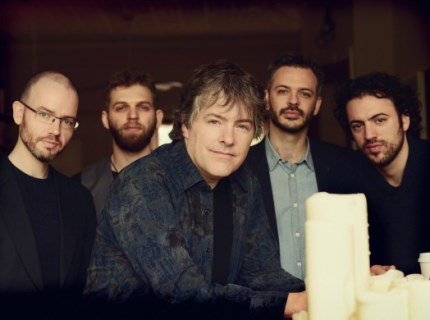
 Banjoist Béla Fleck (center) performs with the string quartet, Brooklyn Rider (also pictured), on Saturday at the Sixth & I Synagogue.
 Thirty years ago, the banjo wasn’t considered among the world’s most versatile instruments, understandably being associated with country, bluegrass and other roots music. Then Béla Fleck came along, destroying any preconceptions associated with the instrument. After releasing a few bluegrass albums in the early and mid-’80s, Fleck teamed up with fellow groundbreaking musicians Victor and Roy “Future Man” Wooten in 1988 to form the core of Béla Fleck & the Flecktones, one of the most innovative groups of the past 25 years.
In addition to employing his instrument in jazz, international and rock settings, the 10-time Grammy winner has also developed a healthy interest in classical music. His 2001 release, Perpetual Motion, took well known classical pieces which were then re-orchestrated to feature the banjo as the lead voice. His most recent foray into the classical realm is The Impostor, a concerto for banjo and orchestra that Fleck composed and recorded with the Nashville Symphony.
“After writing for orchestra for the Impostor concerto, I have to admit that I felt a lot of freedom to be more daring rhythmically,” Fleck said in a recent interview with DCist. “The challenge of writing for orchestra is that even with a great conductor, some things are just not practical for large groups of musicians to play.”
The Impostor was released this year and also features the piece, “Night Flight Over Water”, another original composition that Fleck recorded with the string quartet, Brooklyn Rider. The piece will be included on the program as the five musicians join forces on Saturday at the Sixth & I Synagogue
“With a string quartet, it’s so many fewer people, and they are all essentially soloists,” Fleck said of the collaboration. “And with a group on the level of Brooklyn Rider, there was nothing I conceived of that they couldn’t pull off. So they made me look really good, as a composer.”
Fleck started composing “Night Flight Over Water” by writing a dozen rough sketches that he showed to the quartet. The concepts were fleshed out and honed down to the three movements, “Tumbledown Creek”, “Hunter’s Moon” and “The Escape”, which make the final piece. Additionally, the group will be performing “Culai,” a work in five movements by contemporary Russian composer, Lev ‘Ljova’ Zhurbin. The Gypsy music of violinist Nicolae Neacsu was the chief inspiration behind this work, and it takes its title from Neacsu’s nickname. The concert will also include solo improvisations from Fleck, Brooklyn Rider performing as just a quartet and a four movement piece for banjo and string quartet that Fleck composed with bassist Edgar Meyer in 1985.
“They are of a generation that has wide musical influences from outside of classical music as well as from within, and they bring an open mind and amazing ability,” Fleck said of his collaborators. “It’s a unique combination and it’s hard for me to believe we wouldn’t come up with something very special and in very short order.”
The Washington Performing Arts Society presents Béla Fleck & Brooklyn Rider on Saturday, November 23, 2013 at the Sixth & I Synagogue. Tickets still available for the 9:30 p.m. set. $35.