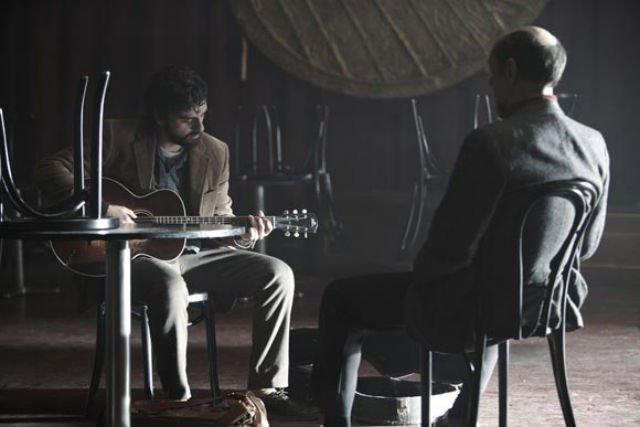
 Oscar Isaac and F. Murray Abraham in INSIDE LLEWYN DAVIS. Photo by Alison Rosa, Long Strange Trip LLC/CBS Films.
The Coen brothers look for real folk music and real folk in the mournful, uneven Inside Llewyn Davis. The brothers based Llewyn Davis (Oscar Isaac) on folkie Dave Van Ronk, a respected figure in folk music who never found the breakout success of contemporaries like Bob Dylan. Van Ronk is supposed to be a nice guy. Llewyn Davis is an arrogant dick. But Oscar Isaac’s performance makes Llewyn one of the most real people in the Coens’ canon, and makes this jerk watchable and maybe even likable. The key is in his conflict, the conflict between personal artistic voice and money.
The movie opens in 1961 at the Gaslight, a Greenwich Village folk club where Bob Dylan would perform just a year later. You can see the Coens’ uneven tonal shifts in the movie’s first scenes, some of which work beautifully, some of which don’t. After Llewyn finishes his set, he’s called outside the club by a “friend” who turns out to be a kind of shadow figure, roughing up the folk singer for heckling another singer the night before. Is it a dream? A loudly purring tabby pounces on Llewyn in the next scene, in an apartment where he has spent the night. This is one of many weigh stations where this essentially homeless musician crashes.
I like to think that both the figure in the alley and the cat are coming from inside Llewyn Davis, reflections of his self-loathing and restlessness. The cat belongs to the Gorfeins, a middle-aged couple of folk music patrons whose couch was Llewyn’s bed for the night. But when he lets himself out of their apartment the cat escapes with him, attaching itself to Llewyn on a subway ride where the cat watches out the train windows as the world passes by. I love the tone of these scenes of Llewyn wandering around the Coens’ vision of New York in 1961. Cinematographer Bruno Delbonnel paints these scenes in a lovely muted palette, cold and wintry, and the wistful folk music that accompanies these scenes sets a beautiful tone.
But Coen brothers quirks set in, and when the movie moves away from that tone it loses me. Justin Timberlake and company get the sound of a novelty folk group number on the nose with “Please Mr. Kennedy,” and it is funny but problematic. Llewyn does what he can with a part he clearly holds in contempt. Can he get paid to play music he really feels? My struggle with the movie is Llewyn’s. He doesn’t think much of “Please Mr. Kennedy,” but it’s a chance to get paid. Llewyn has a personal voice, but he is surrounded by characters who for the most part feel like self-conscious caricatures of colorful personalities, a.k.a., your typical Coen brothers supporting role.
Oscar Isaac completely sells Llewyn, his big sad eyes conveying the loss and hurt behind the caddishness. The actor told a preview audience that immediately after performing music in front of somebody, he feels ashamed. You can feel that shame in a scene where he auditions for folk music impresario Bud Grossman (F. Murray Abraham, Isaac’s best foil in the movie). This fuels the performance of a self-loathing character that’s talented but not legendary, like the real figure that turns up late in the movie, who built a career on reinventing himself. What works in Inside Llewyn Davis works so well that I wish I could recommend the movie more. It looks and sounds great, it’s bittersweet wandering tone a lovely depiction of loss. The movie’s rich central figure feels like he’s lost in a sea of phonies. If only the movie didn’t feel that way too.
—
Inside Llewyn Davis
Written and directed by Ethan and Joel Coen
With Oscar Isaac, Carey Mulligan, Justin Timberlake, John Goodman
Rated R for language including some sexual references
Running time 105 minutes
Opens today at Landmark E Street Cinema, AFI Silver, Landmark Bethesda Row, AMC Loews Shirlington and Angelika Mosaic.