The Washington Humane Society ended the year with a big problem that required a big solution. In a 48-hour time span days before Christmas, 26 dogs were surrendered, leaving the shelters and administrative offices packed with animals. The solution was simple but costly: Waive all adoption fees through Christmas Eve. And it worked. Over 100 animals were adopted in less than a week, ending a year that saw record adoptions on a high note.
In the calendar year 2013, the Washington Humane Society took in 10,474 animals. That breaks down to 5,228 cats, 3,348 dogs, 417 small animals and 1,481 other animals, including wildlife. The live release rate — or number of animals that left both the Georgia Avenue and New York Avenue shelters alive — for the year was just over 80 percent — likely the highest it’s ever been. In 2007, for example, the live release rate for cats was 22 percent.
Scott Giacoppo, the Washington Humane Society’s vice president of external affairs, says programs implemented over the past few years contributed to the success. “We’ve reevaluated our adoption policies,” he said, adding that they’ve worked to change the perception that it’s difficult to adopt a pet. “It’s not so much an interrogation as it is just a conversation.”
 Via WHS Facebook.
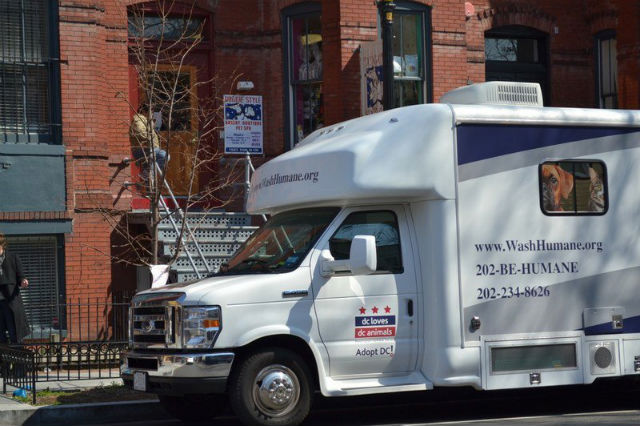
WHS is also doing more off-site adoptions than ever before, Giacoppo said. “We’re going out into the community,” he said. “People might not have wanted to come to the shelter, and now we’re going to them.” The expansion of the foster program has also enabled WHS to treat animals “they may not have had the resources to treat.”
“We’re looking at animals as individuals now,” Giacoppo added, saying they now treat diseases and injuries that weren’t treated in the past. Their Cat Neighborhood Partnership Program — where feral and outdoor cats are trapped, neutered or spayed and returned — has also cut down on the number of felines who come into the shelters only to be euthanized after they get sick or can’t adapt to being indoors.
Another aspect to the success is the Pets At Home program, where WHS works with landlords to keep pets with their owners.
“A lot of it has to do with our reputation in the community,” Giacoppo said. “Years ago, our reputation was admittedly not that great. Our officers were seen as people that just came and took animals away. Our shelter was seen as a dark, dreary place where animals come to die. And many years ago that might have been the case.”
Giacoppo says that WHS is, of course, looking to achieve a 100 percent adoption rate. But there will always be some animals that come into the shelter who can’t be adopted, either because of illness they can’t treat or aggression they can’t rehabilitate.
“It’s the constant pushing and determination to help every single animal that we get our hands on that makes [WHS] what it is today,” he said.
When asked how WHS is able to offer discounted or free adoptions, like they did many times last year, Giacoppo said with a laugh, “If you ask our [Chief Financial Officer], they’re gonna say you can’t do it.”
“It’s a financial hit for us. But in times of crisis, sometimes we have to do it. And I don’t think our donors would mind in a situation like that, because they’re the ones carrying the bill. All the public out there who make donations to us, they’re the ones who keep our doors open.
“It boils down to saving lives,” he added. “If we hadn’t done that, animals would not have made it out alive.”