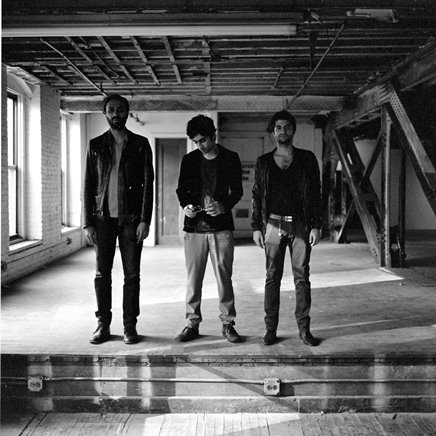
 Dawn of Midi, (l-r) Qasim Naqvi, Aakaash Israni and Amino Belyamani, performs at Black Cat tomorrow night. Photo by Falkwyn de Goyeneche.
When bassist Aakaash Israni, pianist Amino Belyamani and percussionist Qasim Naqvi came together and formed a trio, their intentions always pointed to the music spectrum’s more experimental side. Under the moniker Dawn of Midi, they released their debut, First, in 2010 and put out a live album the following year. These recordings were largely unstructured and highly interactive — qualities often associated with avant-garde jazz. Last year’s recording, Dysnomia, marks a deliberate change in the group’s approach to composing and performing.
“[Dysnomia is] an attempt at synthesizing different rhythmic languages that we have been fascinated by for many years into a cohesive work for our given instrumentation,” said Israni, who will be performing with Dawn of Midi tomorrow night at Black Cat. “Most of these rhythmic languages come from various parts of Africa.”
Though the band is acoustic, its name suggests a connection to both the past and contemporary. “MIDI” is the acronym for “Musical Instrument Digital Interface,” the technological standard upon which most electronic music is based. The three musicians had been listening to a lot of trance music, but not just the “boom-tsk, boom-tsk” variety. Rather, they also drew from various traditional musics that were designed to put dancers into a trance-like state. Like these inspirations, Dysnomia‘s effect on the listener is absolutely engrossing. Works by Philip Glass, Steve Reich, or other minimalist composers are strong comparisons, as the music is highly repetitive with changes in rhythm and texture being drawn out in incredibly subtle and nuanced ways. The music may start as background music, but it draws one in and becomes a sensory blanket that wraps around audience.
Dawn of Midi’s varied influences reflect the members’ own diverse backgrounds. The pianist Belyamani represents the only direct connection to Africa. He was born in Morocco and came to the U.S. when he was 18, while Israni and Naqvi have South Asian roots. Interestingly, the three didn’t forge a connection in clubs or rehearsal spaces, but rather on tennis courts where they used to play late night matches. The trio wanted to make a radical change after their live release, and Dysnomia was written over hundreds of rehearsals. The result is a through-composed, nine-part suite that is presented live in the exact manner as the recording. This no doubt requires a tremendous amount of focus and discipline from players who developed as improvisors, but the structure is essential to the performance.
“Maintaining the trance-like vibe is central to the experience,” Israni explained. “For those who have heard the album already, it can be very interesting to see how it is actually produced on these acoustic instruments, as it doesn’t look the way it sounds.”
The album got a major boost last year when it was featured on a short episode of the popular NPR program and podcast, Radiolab. Since then, Dawn of Midi has continued to support the recording to much critical appreciation. When DCist asked Israni what he hoped tomorrow’s audience would walk away with after hearing Dysnomia live, he offered a single word — “wonder” — an apt descriptor for one of 2013’s most compelling recordings.
Dawn of Midi performs at Black Cat on Wednesday, January 29, 2014 with opener Geometric Shapes. 8 p.m. doors. Tickets $10 in advance/$12 at the door.