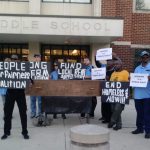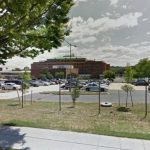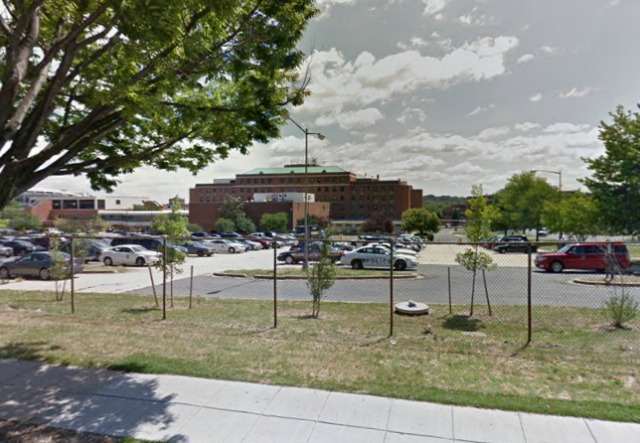
 The D.C. General Hospital building, which is now used as a homeless shelter. Photo via Google Street View.
Residents of D.C.’s largest family homeless shelter testified today that they’ve been without heat and hot water. This comes amidst a major explosion in the number of families seeking shelter in either D.C. General or hotels.
Councilmember Jim Graham’s Committee on Human Services held a hearing today on the crisis the city is facing in sheltering homeless families during the current hypothermia season, which runs from the beginning of November to the end of March. The Department of Human Services reports that, as of February 2, there were 285 homeless families — 355 adults and 536 children — at D.C. General. There were 469 families — 603 adults and 897 children — at hotels. Of that, 110 families are in housed in Maryland hotels, which will soon no longer be an option. (The City Paper has more on this issue.) And to make matters worse, over 100 of these families will have to leave to honor Cherry Blossom Festival reservations in the next six weeks to two months, according to DHS Director David Berns.
Several residents of D.C. General reported that they’ve been without consistent heat and hot water for over a month.
“I am here to ask that D.C. General be completely shutdown and closed due to the health hazards that exist,” a shelter resident and father testified. He said there’s no air ventilation in most of the rooms, no working water, no system of dispensing toiletries and pest control issues. The resident said he and others weren’t notified of fumigation, which sickened his fiancé. He said he had to stay up in shifts to make sure that roaches did not get on his five-month-old son.
One resident of the shelter testified that some areas of D.C. General have heat, while others don’t. Another described the shower water as “so cold it’s like icicles in the water.”
Michele Williams, chief of systems integration at the Community Partnership for the Prevention of Homelessness, said heat outages take place in common areas, like hallways and cafeteria rooms. There are individual heaters in bedrooms, she said. Williams said a recent cold weather-related water main break affected hot water in the entire campus. “They’re working to get that resolved and fixed,” she said. “We do have water outages pretty frequently.” Williams could not provide information on how long hot water outages have lasted, but said she would.
(The Community Partnership coordinates D.C.’s Continuum of Care and runs D.C. General on behalf of the city, while the Department of General Services maintains the building.)
Graham said D.C. spends more than $1 million a month to maintain D.C. General and asked Williams for “complete documentation” of the problem. “Why hasn’t the committee been informed about this?” Graham said. “I’m dismayed that this has not been brought to our attention.” A representative from DGS was not in attendance.
“We either have to commit to getting this right and appropriate for human life to be there, or shut it down and move everybody out,” Graham said.
One homeless mother of four and victim of domestic violence spoke of being unable to get back on her feet while at a shelter: “I would have better endured getting hit every day than to be homeless with four children.”
The Interagency Council on Homelessness winter plan projected that 509 families would be placed in shelters during the whole season. So far, around 700 have been placed and “we’re only 60 percent through,” Berns said. At this rate, “well over” 1,000 families will be placed at D.C. General and hotels. The unbudgeted cost thus far is estimated at $20 million, Berns said.
Berns said he attempted to empty D.C. General and the hotels through rapid rehousing last year. But instead of the 60 placements a month needed, DHS only placed 37 people per month in housing. “I consider this a personal failure, as well as a community issue,” Berns said. This would have taken 275 people out of D.C. General and hotels.
“If we continue at this pace, we’ll have about 750 more families in placement at the end of this season,” Berns said. “That’s a huge unanticipated amount. We expected to finish this … hypothermia season with about 200 families in hotels that we would rapidly move out. But if we end up with 750, we won’t empty the hotels at the current pace until well after the next hypothermia season. Not only won’t we empty it, but we might still have hundreds of families in hotels at the start of next year.
“This isn’t just a crisis of today and what we’re doing for the families who come in. This is a fiscal crisis, as well.”
Berns later said “D.C. General is dead,” lamenting the fact that money must go to fixing the building rather than to creating more housing.
“It sounds bad,” Berns said of the crisis. “It’s worse than it sounds.”