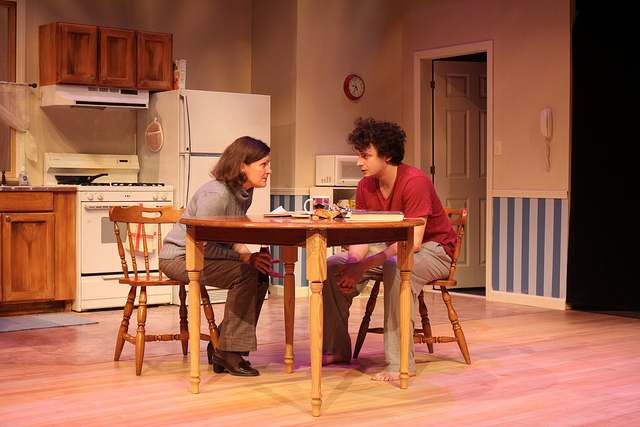
 Photo via Forum Theatre DC’s Flickr stream.
By DCist Contributor Riley Croghan
An hour before the final preview of Forum Theatre’s Pluto at Round House Silver Spring, I manage to find a free moment to talk with artistic director Michael Dove and Los Angeles-based playwright Steve Yockey. Throughout our conversation, communication is occasionally rendered impossible due to a creepy, horror-movie-like screeching, as the house tests a sound cue for one of the final scenes of the play.
“During notes after last night’s show, I asked if that moment could be just deafening,” Yockey explains after the fourth interruption. “I asked if it was possible… to almost physically hurt the audience. Everyone agrees it was possible, so we’re trying it out.”
Pluto does not shy away from making its audience uncomfortable. Signs line the hallway in front of the theater warning of simulated gunshots, which are indeed loud enough to make you flinch, even if you know they’re coming. The subject matter—dealing with an atrocity at a community college—doesn’t make for light fare, either. But the heart of the play isn’t about a wide-scale tragedy. Pluto is far more concerned with exploring something much simpler: The relationship between a mother and her son.
Dove explains that this central relationship—more than half of the play consists of dialogue solely between Jennifer Mendenhall’s Elizabeth and her son, portrayed by Mark Halpern—was one of the deciding factors that convinced him to have Forum produce the play. “I first caught a reading of the play at the National New Play Network annual showcase… and I immediately fell in love with it,” Dove says. “Several people who were familiar with Forum’s aesthetics came up to me afterwards and said, ‘That’s totally a Forum show, isn’t it?’ It really clicked for me.”
“I love intimate plays that deal with personal interactions to frame much larger themes … Through [the two characters], we try to pick up some large societal questions that get the audience thinking about their own community, and the way they interact with the people around them,” says Dove.
“He also liked the bit with the upside-down cherry tree,” Yockey adds. Dove laughs and says, “That didn’t hurt. That was fun.”
Pluto was picked up by Forum as part of a rolling world premiere through the National New Play Network; the play debuts in Washington with closely timed premieres at theaters in Atlanta (last fall) and Orlando (after D.C.).
Dove had a chance to compare notes with Melissa Foulger, who directed the production at Actor’s Express in Atlanta, and says he was surprised at some of the differences in their handling of the material. “We had a chance to compare notes about staging, but also on how we handled marketing and audience engagement,” Dove explains. The rolling premiere allows for “a nice competitive edge” between the directors of the simultaneous productions, he says.
According to Yockey, each director has thus far chosen a different way to handle one of the trickier staging questions posed by the script, which calls for a giant cherry tree to protrude from the ceiling of the otherwise humdrum kitchen set. Before the play even starts, the giant blossoming set piece suspended from the ceiling conveys that this will be anything but an average day in the lives of a “normal” suburban family.
One character—wearing plain clothes and a sparkly dog collar, sitting cross-legged beneath the tree as the audience files in—is eventually revealed to be a talking three-headed dog. Dove jokes that for that role, “it was a tough casting process.”
“We auditioned a few two- and one-headed dogs, but none of them could talk, so we went for [human actor] Kimberly Gilbert instead, ” he says.
Yockey is no stranger to building fanciful worlds as a backdrop for serious real-world problems. His earlier work, Octopus, frames an AIDS-related crisis within a fable-like setting, one which calls for copious amounts of water on stage, and a monstrous sea creature.
Pluto is peppered with its own fair share of stylized horror, including a dark presence apparently stalking the characters from within their own refrigerator. The title of Pluto takes on many shades of meaning as the play progresses, but an early explanation for the title is provided by Elizabeth, when she learns that the ninth planet is no longer officially considered to be a planet at all. According to Yockey, “I wanted to deal with scale in an intimate and an epic way, from the intimacy of a mother-son relationship… to the epic scale of the solar system changing in size.”
And while the play deals with an epic-sized tragedy, Dove balks at the suggestion that it might be a “tragic” play. In exploring the smaller relationships between people, Pluto has a “mix of heart and whimsy and tragedy and humor,” he says. “The play is really about how people communicate with each other—and the fallout that happens when they fail at that.”
Pluto runs February 20 to March 15 at Round House Silver Spring. Tickets are $20 advance, or pay-what-you-will at the door one hour before the show.