

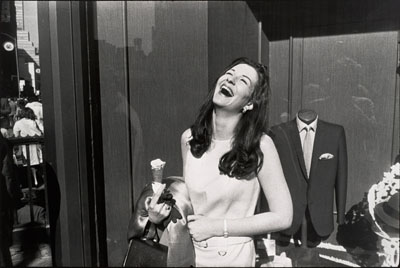
 Garry Winogrand. New York, 1968. gelatin silver print framed: 40.64 × 50.8 cm (16 × 20 in.)San Francisco Museum of Modern Art, Gift of Dr. L.F. Peede, Jr. ©The Estate of Garry Winogrand, courtesy Fraenkel Gallery, San Francisco
“When you put four edges around some facts, you change those facts.” Photographer Garry Winogrand (1928-1984) believed that photography changes perception, and in fact his dynamic street photography changed the way photographers saw the world. A traveling exhibit of Winogrand’s work, the first career-spanning retrospective of the photographer in 25 years, has landed at the National Gallery of Art.
I drooled over the exhibit’s massive catalog, which I reviewed for Spectrum Culture last year. There’s tons of great work from the man John Szarkowski calls the most important post-war photographer — that’s right, more so than Robert Frank. But the book too easily categorizes a chaotic work into chapters that make sense, chronologically and thematically. Organizing such a massive collection would be a challenge under the best circumstances. Co-curator Leo Rubinfien selected images from some 20,000 contact sheets, a job made even more difficult by the fact that Winogrand left behind hundreds of rolls of film that he never got around to developing.
Winogrand only published a few books in his lifetime, eager to work constantly but not so eager to make any sense out of it. The National Gallery of Art’s exhibit is a better way to take in this sprawling work than in book form. It helps that at the Gallery, you’re not struggling with a six-pound doorstopper.
As I wrote in my review of the catalog, “From skewed horizon lines to the organized chaos within the frame, Winogrand’s compositions threatened to fall apart by design.” So the early commercial work in one of the Gallery’s display cases makes perfect sense: a 1957 Sports Illustrated cover that previews a welterweight boxing match in Cleveland. The controlled chaos of boxing, the precise punch that sets an opponent off balance, is a neat metaphor for what the photographer does with a camera.
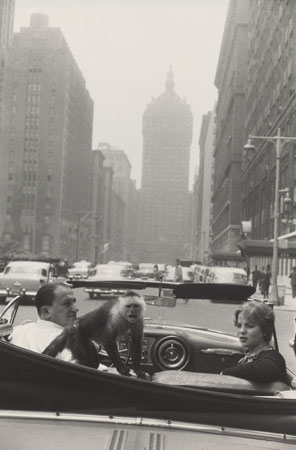 Garry WinograndPark Avenue, New York, 1959gelatin silver printoverall: 32.7 x 21.7 cm (12 7/8 x 8 9/16 in.)framed: 40.64 × 50.8 cm (16 × 20 in.)National Gallery of Art, Patrons’ Permanent Fund© The Estate of Garry Winogrand, courtesy Fraenkel Gallery, San Francisco
The exhibit, like the book, is divided into sections. “Down from the Bronx” surveys Winogrand’s early career, from the commercial work he soon abandoned to the roving eye he developed on the streets of Midtown Manhattan. “Any moment can be something.” Winogrand’s skewed angles and grain — that controlled chaos — is the very definition of street photography, more so even than Henri Cartier-Bresson, whose “decisive moment” school was perhaps too perfect. Winogrand’s imperfections and his hunger for the next image make his work vital and exciting.
Garry Winogrand presents generous overview of the photographer’s career, but the display cases tell a story that’s not in the published catalog, including the key to a film photographer’s soul: contact sheets. One from 1950 shows Winogrand still trying to find his way around a subject, shooting it multiple times before he found something that worked. A contact sheet from 1962 reveals a photographer who had sharpened his eye, barely wasting a frame as he confidently shot one subject, and then moved on.
“Student of America” documents Winogrand’s escape from New York, funded by Guggenheim Fellowships that sent him out on America’s highways. The exhibit and the catalog leave one aspect of his career unfortunately unexplored: the striking color images Winogrand made across America in 1964. “Boom and Bust” covers the years 1971 to 1984, a period of work that is less known and less well regarded than his classic New York street shots. But this may be as much a function of American attitudes changing, his subjects appearing distrustful and distant. Garry Winogrand is essential viewing, not just for the student and connoisseur of photography, but also for anybody who wants to see a vision of American optimism in decline.
Garry Winogrand is on view until June 8, 2014 on the Ground Floor of the West Building at the National Gallery of Art.


