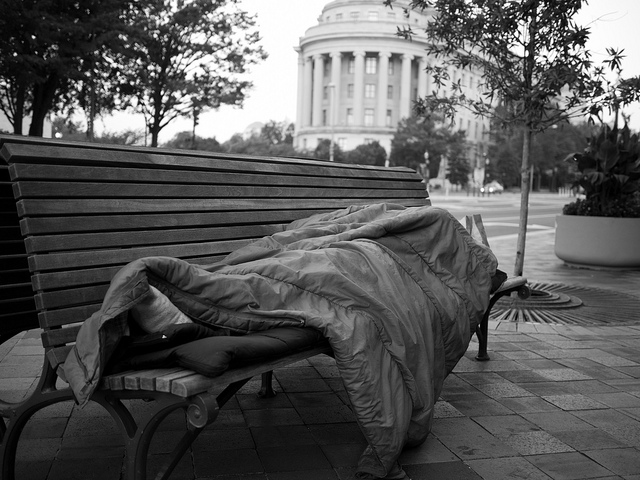
 Photo by Devin Smith.
The city can’t house homeless families in recreation centers on freezing nights, a D.C. Superior Court judge ruled today, saying a private room must be provided if apartment-style shelter is not available.
Citing the “powerful and persuasive” testimony of two homeless mothers and one homeless grandmother on Friday, Judge Robert Okun ruled that the irreparable harm done to these families “far outweighed” the “relatively modest monetary harm” the city will face by housing these families in apartment-style shelter or private rooms, rather than recreation centers.
An attorney for the District of Columbia once again said the city would not be able to comply with the ruling and asked for a stay pending appeal. Okun said he did not doubt the city is making “good faith efforts” to shelter homeless families. But repeated that he had to issue a preliminary injunction because of the psychological harm done to one of the most vulnerable populations — the children of homeless families.
With the ruling, the judge said the public interest “will be affirmatively enhanced” as it will “protect some of the [city’s] most vulnerable residents.”
Since January 30, the city has housed homeless families in recreation centers on hypothermia nights, when the temperature falls below 32 degrees. Spaces are divided by partitions six feet tall that do not have a door or a lock.
Dalanda Griffin — a mother to three children under the age of five — testified Friday that her children were unable to sleep because the lights were on all night in the Benning Park Recreation Center. In addition, one of her children suffers from asthma and there was no place in the partitioned area to plug in his nebulizer. Smoking near the door to the recreation center further aggravated her son’s medical condition, she testified.
Her children were also not able to go to school the day after their stay at Benning Park as they had wet themselves, smelled of urine and had no place to shower. The following evening, Griffin’s family stayed in the hallway of a residential building rather than return to the recreation center, as it offered some privacy,
“My son wanted to go home, and I was embarrassed to tell him we didn’t have a home,” Griffin said.
Jenique Fultz testified seven days after giving birth to her first child. When her daughter was five-days-old, they were assigned to sleep at Benning Park. Fultz said she expressed concern about sleeping in the recreation center, as she had an infant and stitches, but said she was told there was no other option. Fultz testified that she could hear vulgar language and loud singing, and smelled alcohol and marijuana. Her child was unable to sleep until 2 a.m., while she stayed up the whole night, fearing for the safety of her daughter.
Testifying for the city, Michele Williams, the family services administrator for the Department of Human Services, said the “weather has caused a severe crisis,” adding that there are no places to house these families on hypothermia nights other than in recreation centers. Williams said a member of her staff reaches out to hotels around the city everyday looking for available rooms for families. There are currently 420 homeless D.C. families sheltered in hotels or motels, 40 in Maryland. Williams said over 100 families have to be relocated by May 1 for tourist season.
Okun said he was “skeptical” that the city wouldn’t be able to comply with his ruling, saying the possibility was not a good enough reason not to provide families relief.