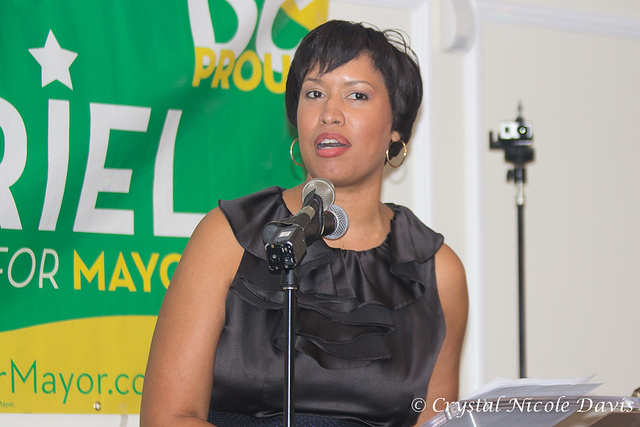
 Photo by Crystal Davis.
In the past month, Muriel Bowser has gone from one of four Councilmembers in a crowded pack vying for Mayor Vincent Gray’s job to the candidate most likely to defeat him.
Polls show the Ward 4 Councilmember neck and neck with the mayor, with her closest opponent more than 10 percentage points away. After serving as an ANC commissioner and working on Adrian Fenty’s first mayoral campaign, Bowser successfully ran for the former mayor’s Council seat and currently chairs the Committee on Economic Development. Shortly before a Washington Post poll was released showing Bowser ahead of Gray for the first time, DCist spent 30 minutes at her Georgia Avenue NW headquarters. Our interview is transcribed below.
Read interviews with other candidates here:
Reta Jo Lewis
Tommy Wells
Jack Evans
Andy Shallal
This interview has been edited for clarity and condensed for space. As with the other interviews in our series, DCist told the candidate that “the way this will be published is my question and your full answer.”
DCist: [This week] a judge ruled that the city can no longer house homeless families in recreation centers on hypothermia nights. You’ve been a critic of the Gray administration’s handling homelessness in the city. My question is, how do you plan to help these families, and what do you plan to do with D.C. General? Do you plan to keep it open? Send families to other shelters? Improve it?
Bowser: My policy is that people don’t get out of homelessness by having a bed for the night. They get out of homelessness when they have a home. We need to get back to the posture in our government that we will provide Housing First. This administration has backtracked from that model. When the stimulus funds dried up, we didn’t find the local dollars to make sure that we’re creating permanent supportive housing units. And that’s the policy that we’ll return to. We’ll figure out what the cost is, make an annual commitment, and that’s how you end homelessness.
What we learned from the first families and individuals that we put in those permanent supportive housing units — they’re still housed. They’re dealing with the issues that took them into homelessness in the first place. We also know that we’re going to have to do better at funding and getting out our local rent supplement vouchers so that people who have no income or very low income can actually go out in the market and afford to get housing.
We need the right people in place, as well, that are liaisons with the Interagency homeless council, with all the various departments in our government that have some hand in housing. But we need the right people, just very practically speaking, we need to have the right people in place in advance of hypothermia season to make sure that we’re doing the right thing.
I think the conditions at D.C. General, none of us can be proud of. We know that we need some low-barrier shelter, and we have to make sure that it’s clean, safe and decent. But my focus will be on how do we get people out and into permanent supportive housing.
DCist: How do you balance the desires of neighbors not to have shelters or not to have mixed-use developments in their neighborhood where homeless or formerly homeless families are housed?
Bowser: I think a lot of neighbors support mixed-income housing. What neighbors don’t tend to support is concentrating shelter housing. That’s the model we’re following in a lot of different regards — market rate, work force and permanent supportive units. We’re going to be very proud, for example, to welcome on Georgia Avenue a development that’s been approved for several years and now funded: The Emory Beacon of Light. It’s that model of mixed incomes. That’s what we want to do with all our public housing projects, as well. Have mixed-income housing.
DCist: Which hasn’t worked so well with the New Communities Initiative. Tearing down housing, saying it’s going to be replaced with mixed-use and still there’s barely any housing, on K Street NW, for example [where Temple Courts formerly was.]
Bowser: What hasn’t worked well?
DCist: Well with New Communities, hundreds of families have been displaced while only some have been put back into housing and others are still waiting.
Bowser: Do you think it worked well at Temple Courts?
DCist: No.
Bowser: OK. So before you say it doesn’t work well, let’s figure out what the replacement units are going to be and speed up — what hasn’t worked well is the production of new units, not the model. We want to transform communities that were dangerous and deteriorated into ones where there are more options. Those are four communities out of 8,000 units, and so we also have to speed up the investments. You know what the Housing Authority says we need for the other 6,500 public housing units? Just to bring them to 20-year viability we’ll need $1 billion in investment. So we better get started because in this city we can’t afford to lose any of those units.
DCist: This sort of transitions into the D.C. United/Reeves Center land swap plan. If this does go through, would you like to see affordable housing be a part of what replaces the Reeves Center?
Bowser: Affordable housing should be part of any government development, if government land is being used for development. I co-introduced a bill with Kenyan McDuffie, and I’ll be holding a hearing on it soon, that would set a goal of 30 percent of units produced on the land should be at various levels of affordability. That is a goal that is reachable and doable. What you point out, though, is when you say you have a land swap, this one owner is gonna trade with us, is you don’t get the plethora of ideas that come out of a competitive process. And so if we put out that the government is interested to repurpose the Reeves Center in a competitive environment, we may get all kinds of ideas.
At this point we don’t really know. My guess is that Akridge wants to build housing, but we haven’t really seen a proposal.
DCist: As you surge in the polls, the Gray campaign’s new website [MurielNotReady.com] makes a criticism that you’re light on experience. I’d love to hear two pieces of legislation that you’ve introduced as a Councilmember and how they represent part of your vision for the city. Two pieces of legislation, other than your creation of an ethics board.
Bowser: Why? Why would you talk to me and say other than the creation of the ethics board? That’s just so ridiculous.
DCist: We’ve talked about it a lot.
Bowser: We have? This is the first time I’ve ever talked to you.
DCist: [Laughter] I’m sorry. I’ve read about it quite a bit in interviews with you. [It was highlighted this week by the Washington Post.] So I was just looking for something I haven’t read about yet that maybe you haven’t been able to highlight.
Bowser: Well I’ll just talk to you about my whole work and you’ll figure out what you want to print, how about that? Let’s step back, because I think it’s interesting that my opponents will talk about my experience, but they won’t talk about anyone else’s. What’s Jack Evans’ experience? [Pause] Do you know?
DCist: He has a large legislative record from being on the Council for decades.
Bowser: But what does that have to do with being mayor? Nothing. What’s Tommy Wells’ experience? Ever write about that? It’s a question.
DCist: When we interviewed him, yeah. We talked about the legislation that he’s introduced.
Bowser: What does that have to do with being mayor?
DCist: Introducing legislation, what does that have to do with being mayor? It shows the vision of a candidate that they have, what they want to focus on, and what they think is a priority for the city.
Bowser: Well, this is what mayors do, this is what all the great mayors do. All the great mayors they set out what they think needs to happen in the future, they hire great people, they hold them accountable for delivering excellent service to the residents of the District of Columbia. I’m happy to talk to you about the laws that we’ve passed. I won’t not talk to about reforming ethics in the District of Columbia, because that is the single biggest issue, after schools, that residents are concerned about. They want a government they can trust. So I’m not going to dismiss working with 13 Councilmembers to take away some of the things that they like to do down in campaigns and down in city hall, because it is going to change how the residents trust their government over the long haul. So we’re very proud of passing ethics reform.
We’re very proud of making sure that people when they go in facing big banks that the D.C. government requires those banks to call them back, requires those banks to sit down in front of them and have face-to-face mediation, saving D.C. homes from foreclosure. We’re very proud that we got the Obamacare legislation, and many of pieces of it, in place even before the Affordable Care Act passed. We’re very proud to have children riding the bus to school for free instead of paying $30 a month, which is what they had been paying. We’re very proud of all of the open government legislation that we’ve passed that opens up D.C. government, open meetings. And make sure even the Council, and they’re still mad about this, all of our Council meetings used to be closed, including the breakfast. Now they’re not, they’re open. That’s the type of legislation that we got out to the Council to pass to see where the holes are and fill them.
DCist: Let’s talk about schools. First 100 days in office, what should the residents of the District of Columbia expect to see from you?
Bowser: Well, there are three things I think are important and that is focusing on middle schools and how we accelerate our improvements to middle schools. That’s where the big pinch is, in my view. The second thing is, how do we double the number of Tier 1 schools that we have. I’ll be looking to the chancellor and saying, “Chancellor, where are we with these 40-some schools that are Tier 2?” With the right focus, they can become more quickly neighborhood schools of choice.
I think we also want to expand our STEM focus in our schools, so that the traditional public schools are drilling down on making sure that students are prepared in science, technology and math for really good paying jobs, be they white collar or blue collar, upon graduation.
DCist: Good paying jobs east of the [Anacostia] River, in Wards 7 and 8, unemployment is still very high. What do you propose to do to lower the unemployment rate?
Bowser: We’ve talked about a couple of things. Did you get a chance to look at our State of the District address?
DCist: Yes.
Bowser: So we talked, and you will remember, about a few things. I think we spent, and I’ve reviewed a study that the [D.C.] Fiscal Policy Institute did in one year [on] workforce training programs. It was fiscal year 2010. They tracked, through all of the different agencies, where all the workforce training dollars were, $100 million. Virtually none of those dollars were tied to outcomes, to people actually getting jobs. So I think we need to reengineer how we spend that $100 million. I have several things I want to focus on. First of all, how do we expand summer youth and year-round employment opportunities to 24-year-olds and how do we work with our private sector partners, people who have contracts with us, to say, “How can you help us train and employ D.C. residents? Now, we know you’re not in the training business, so we will subsidize that as part of your contract as long as you employ our hardest-to-employ residents for the duration of your contract.”
The last thing that I’m very interested in figuring out and piloting is what I call a [Department of Public Works] or [Department of General Services] academy. I haven’t settled on the name. … There’s not a lot of attrition in these jobs, but there is and there will be more in the future. Our trash collectors, the leaf collectors, the painters, the carpenters, some skilled, some unskilled jobs that the D.C. government creates every year, we need a pipeline of trained people that when those opportunities become available, we can pay in that pipeline. That’s a way to train our folks, but also a way to preference our folks in the hiring process.
DCist: Another big employer in the area is Metro, which doesn’t hire many D.C. residents. I’m familiar with your returning citizens resolution, but I’m wondering more broadly on how we can get more D.C. residents, returning citizen or not, hired by Metro?
Bowser: Now when I got to Metro [in July 2011] … they have a week-long where they give the new board members, and there were several new board members at the time, a week-long kind of orientation. So director after director after director came in to give me this briefing, and I’m looking and I’m thinking, ‘This looks nothing like the District of Columbia.'” So that’s when I started drilling down into their hiring, and I became very concerned. I think at that time they were at 12 or 13 percent of D.C. residents hired. So I sat down with the General Manager [Richard Sarles] and I got a meeting with our Department of Employment Services director to find out what exactly was the relationship. And I learned then that there really was no relationship.
So I asked them to come up with a plan on how the D.C. government was going to make referrals to Metro to hire more D.C. residents. This is on the operations side, but also the administrative side. Metro’s big. It’s like 11,000, almost 12,000 now employees. So many of them are actually running the buses or trains, but many other people are in administrative, professional jobs, as well. And they’re good paying jobs, all of them. So we wanted people to have these opportunities on both side of the Metro operation.
I have been very disappointed. We had a hearing recently where — Metro just geared up to hire 1,000 people to operate the Silver Line and we learned that DOES in like 18 months had only referred seven people. So there’s clearly no energy, and it’s no wonder because we don’t really have … any [commercial driver’s license] programs, either. So out of $100 million, you’re telling me we can’t sponsor some commercial driving training? So, that’s just one glaring example about how there are jobs that become available and our residents, for one reason or another, aren’t matching the requirements.
DCist: So the solution to that is going into DOES and putting the right people in charge to institute these policies?
Bowser: I think it’s leadership. But I also think it’s making sure we have — that’s easy, right? You need people to drive buses. If they have the training to drive a bus, they’ll be more likely to be hired. That’s not hard. So why aren’t we having those types of programs to get our people trained to drive the bus? Now, I’ve oversimplified it a little bit. There’s a whole set of tests that Metro has to make sure that they get a good match for people to deal with the public and drive the bus. But from a policy end, having the CDL training is one of them. From another policy end is making sure the hiring policies aren’t so onerous that it automatically cuts out 10 percent of the labor pool in D.C.
DCist: I’d like to switch to a different transportation agency. How do you feel that the District Department of Transportation has been run under director Terry Bellamy? Some proponents of bike lanes [Bowser: Progressive transportation? DCist: Yes] would say that the department has backslide in the past few years.
Bowser: DDOT is a huge agency. It touches everything. It touches the average citizen, it touches the developer, it touches the restauranteur who wants to open, it touches everything. It’s kind of an unwieldy agency, in some ways. And it’s the agency I get the most complaints about — about responsiveness, about feeling like we’re going backwards in some ways, about streetcars, you name it. I’ve gotten every manner of complaint that you can imagine.
This is what I think a successful DDOT director must do, because all of those things that we’ve talked about are bad now, imagine how they’re gonna be when they are 200,000 more people that live here. We really need somebody who’s looking to the future, to look at our whole system and make sure that every mode we’re being very aggressive about — getting more capacity out of it, making sure it’s operating efficiently. Because we’re going to face total gridlock in this city and that can strangle our economic growth in a way that nothing else will.
DCist: So the streetcar, for example. Do you think that the city should let H Street get established, see how it runs before planning other lines and expanding? Or do you think the time is now to be aggressive about expanding the streetcar?
Bowser: No, I think we should be aggressive about planning other lines, for sure. But we do have to figure out what we got right and what we got wrong on H Street before we venture out on anything else. As tough as it is to go through all these hiccups on H Street, it’s my great hope that DDOT is learning what not to do next time.
DCist: Let’s turn to marijuana. Lots of talk about decriminalization, legalization. I’d like to talk about the medical marijuana program in the city, which critics say is very restrictive. Would you as mayor support expanding the list of qualifying conditions for medical marijuana?
Bowser: I think so, but I think that’s part of the larger conversation about … people’s changing views on marijuana in general. My sense is more and more Washingtonians think consenting adults should be able to buy marijuana legally and use marijuana in their private homes. We have a dispensary in Ward 4 that talks to me often about how difficult their business model is, that the current conditions make for their business model. … I just really see … that we’ve taken a couple of steps — medical marijuana, decriminalized marijuana. Now I think the next step is how we make legal purchase of marijuana available in D.C.
DCist: Sunday enforcement for parking at churches. This week the mayor said, “I don’t like the fact that people who may have just arrived in the District of Columbia are now calling the police and calling law enforcement officials to give out tickets on Sundays when people are worshipping in their respective houses of worship.” Do you support easing parking restrictions around churches on Sundays?
Bowser: I think we should be a city that’s welcoming to church-goers.
DCist: So as that goes with parking, do you think that if cars are double parked to attend worship services that we should not enforce that as a parking violation? Or if a car is violating the law it should get a ticket regardless?
Bowser: We’ve had a tradition of allowing people to park near houses of worship here forever. It seems to work pretty well.
…
I think what happens most often is there’s some sort of relationship between the church and the adjacent block. It usually doesn’t spill out beyond that. And generally speaking, I think that works.
DCist: The attorney general election. It was delayed for a variety of reasons, but it seems the main argument was that we weren’t ready for 2014. Is there any other circumstance — I think this may be difficult to answer — but as a voter, I’d like to know if voters pass something, pass a referendum again, would you consider overturning it?
Bowser: In this case, the Council made a recommendation to the voters for an elected AG, so that’s how it got on the ballot. It wasn’t the voters going around [for] signatures. And I think the Council got it wrong at that point. Then we should have delineated the duties at that time better. So we sent something to the voters that wasn’t quite right. And we shouldn’t have done that, but we did. The voters agreed with our recommendation and agreed to have an elected attorney general. And then we didn’t further, after that happened, delineate the duties in preparation for the election.
So at the last hour you’re kind of saying to folks, ‘Well, what’s this elected attorney general going to do? And what’s gonna be the mayor’s legal counsel?’ And those are big questions, no matter who the mayor is. The mayor and the city have to have … the right legal representation in all of the agencies, period. And no matter who the elected AG is, they have to know what their prosecutorial ability will be, which is limited, of course, with an elected AG. But also what is going to be their role in each of the agencies. I think that we will get that straight, and we will have an elected AG.