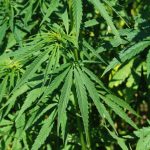
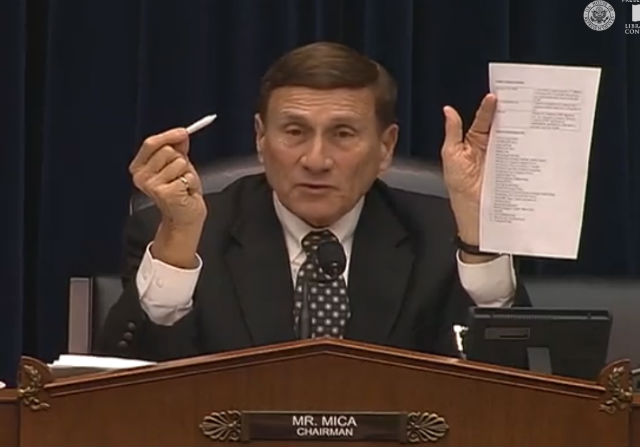
 Rep. Mica with a fake joint. Via CSPAN.
Despite passing by a 10-1 Council vote and being signed into law by Mayor Vince Gray, there’s still a chance D.C.’s marijuana decriminalization law could be squashed before it goes in effect.
As with any District law, the marijuana decriminalization act must undergo a Congressional review period — in this case 60 days, as it’s a criminal law — wherein Congress could enact a joint resolution to strike it down. Still, that would require the Senate and President to sign off on it, which has only happened three times since 1979. But despite the unlikelihood that that would happen, it’s not stopping members from scrutinizing the hell out of the law.
During a a House Oversight and Government Reform panel today—convened by Rep. John Mica (R-Fla.) to examine the impact of the local law on a federal level—Mica and a subcommittee heard the testimonies from a panel of witnesses representing different viewpoints of the contentious law. But Mica made sure to emphasize that he’s “absolutely not” singling out the D.C. on the matter of relaxed marijuana laws. He added that, since there’s several law enforcement agencies in D.C.—which he pointed out isn’t a state—it’s unclear what happens if someone is arrested on federal, versus local land.
Del. Eleanor Holmes Norton (D-D.C.) kicked off the testimonies, citing several studies that show the racial disparities in marijuana-related arrests in the District—stats that were the impetus for the bill, which was introduced by Councilmember Tommy Wells (D-Ward 6). No one from the D.C. Council was present for the hearing, which Rep. Mica was “disappointed” about. “My hope is that my colleagues, regardless of their views or those of their constituents on marijuana, will respect the decisions of all jurisdictions that have decriminalized marijuana, including the District of Columbia,” Norton said at the end of her testimony.
Peter Newsham, the Metropolitan Police Department’s assistant chief, emphasized to the committee that the District’s liberal marijuana law won’t stop them from “[sending] the message, especially to [young] people, of marijuana’s dangers…[and] to discourage them from using it.” He also reminded the committee that the possession of small amounts of pot is still a federal offense and those agencies aren’t bound by D.C.’s law.
Robert MacLean, acting chief of the United States Park Police, said that, should the law go into effect, the USPP will “work closely with the U.S. Attorney’s Office for the District of Columbia to determine our future enforcement options.”
Contrary to the testimonies of the previous witnesses, David A. O’Neil, acting assistant attorney general, Criminal Division, defended the federal law regarding the possession of small amounts of marijuana. He emphasized that the “Department of Justice is committed to enforcing [the Controlled Substances Act of 1970],” which makes it a federal crime to “possess, grow, or distribute marijuana.”
Echoing the data Norton mentioned in her testimony, Seema Sadanandan from the ACLU discussed the extreme racial disparities of marijuana arrests in D.C., citing how, in 2010, 91 percent of all marijuana arrests in the District were African-Americans.
But Mica and the subcommittee still questioned how this law would change those statistics. “There’s no question there’s disparity in prosecutions when it comes to blacks,” he said, “but I’m not sure that changing the law in the District of Columbia is going to benefit that population that much.” No decision was made by the subcommittee at the end of the hearing, but Mica said that his views on the law are “evolving” and he wants to hear more before recommending an action on it.
Still, not everyone on the subcommittee was swayed by the testimonies. Rep John Fleming (R-La.) says he’s going to introduce a House resolution to block the D.C. law. (He later told the Post he has no immediate plans to, but is considering it.) Speaking with CQ Roll Call during the hearing’s recess, he said that “any place that I can have a say—whether it’s nationally, whether it’s individual states, or even in the District of Columbia—I’m going to speak out about the dangers of marijuana.”
“This is the only place I have a say,” he said.