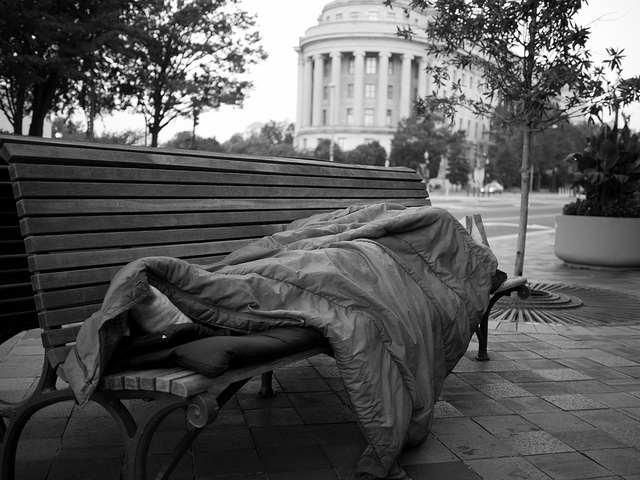
 Photo by Devin Smith.
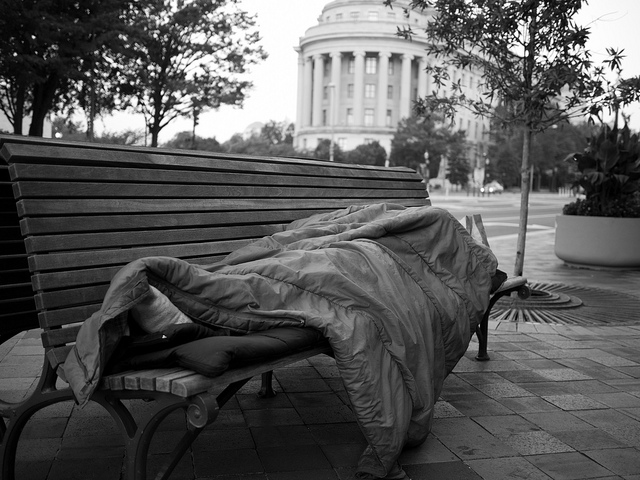
The number of homeless people in D.C. increased by 13 percent between 2013 and 2014, according to a point-in-time count conducted in January. Since 2010, that number has risen 18 percent, from 6,539 to 7,748 people.
Those numbers come from a new report by the Metropolitan Council of Governments, which looked at homelessness — defined as people “who reside in emergency shelter, transitional housing, domestic violence shelters, runaway youth shelters, safe havens, or places not meant for human habitation — in the entire Washington region. (That’s Alexandria, Arlington County, D.C., Fairfax County, Frederick County, Loudoun County, Montgomery County, Prince George’s County and Prince William County.)
Homelessness was up 3.5 percent region-wide, primarily because of D.C. “A number of complex factors, including a history of high poverty rates and a loss of affordable housing units, have contributed to the increase in the District of Columbia’s homeless population,” the report states.
Out of D.C.’s entire population, 1.2 percent of people are homeless. There are 1,231 homeless families made up of 3,795 people, including 2,236 children. That’s an increase of 50 percent since 2010. Just 23 percent of these adults are employed.
While present for years, D.C.’s family homelessness crisis came into focus this winter as the D.C. General shelter was filled to capacity and the city began housing people in hotels and later recreation centers, a practice later ruled illegal. In response to the crisis, Mayor Vince Gray began the 500 Families, 100 Days program on April 1 with the goal of placing 500 families out of shelter through rapid re-housing.
For the first time, the count looked at people being assisted by these temporary rent subsidies. One that day in January, 65 single veterans and 16 families with a veteran were in housing through a Veteran Affairs-funded rapid re-housing voucher.
Nearly 600 families who had been living in D.C.’s emergency shelters were being housed through the Department of Human Services’ Family Rehousing and Stabilization Program, while 23 families were in units funded by the Department of Housing and Urban Development’s Rapid Rehousing Demonstration Project.
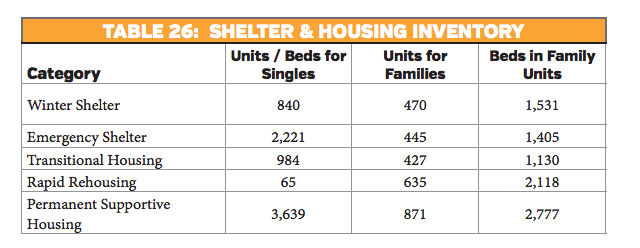 Via MWCOG.
D.C.’s single homeless population also increased from 2013 to 2014, although not as dramatically — a seven percent increase. Only 21 percent of these people are employed.
Of D.C.’s homeless population, 1,785 homeless adults and 133 families are chronically homeless, meaning there is “at least one adult person who is disabled and who has been continuously homeless for a year or more, or who has had four or more episodes of homelessness within the past three years.”
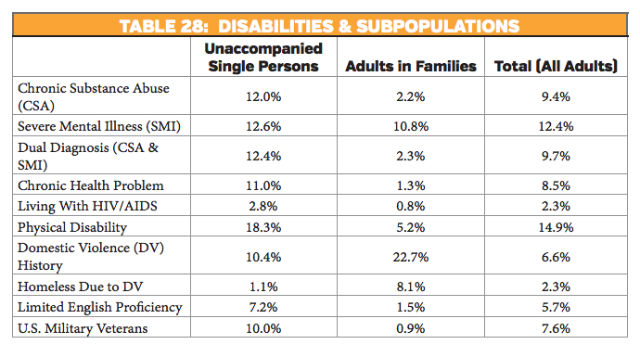 Via MWCOG.
While the news is troubling for D.C., seven out of nine areas in the region saw a decrease in homelessness. “Data collected this year confirm what each jurisdiction has observed
in practice, that the greatest barrier to ending homelessness in our communities is the lack of fixed, affordable permanent housing opportunities for the lowest income households,” the report [PDF] states.