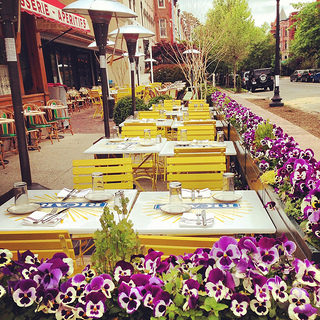
 Photo by ekelly80.
D.C. is considering increasing the fees businesses pay to rent public space for sidewalk cafes, under a budget proposal from Mayor Vincent Gray and endorsed by a Council committee.
Since 1992, businesses have paid $5 per square foot of public space annually for an unenclosed sidewalk cafe and $10 per square foot for enclosed cafes, with the total prorated based on length of use. Under Gray’s plan, the fee would increase to $8.30 and $16.30 per square foot, respectively, and the prorated total would go away beginning in July 2015. The authorization to rent surface public space would be transferred from the Council to the Mayor, under Gray’s proposal, and the penalty for “violating public space rental and utilization laws and regulations” would increase to include imprisonment and a $1,000 fine.
Citing inflation, the Council’s committee on Transportation and the Environment, headed by Mary Cheh (D-Ward 3), endorsed this proposal while recommending technical changes. After October 2016, the committee recommends, the mayor would be able to adjust the rent rate. For example, the mayor could establish a flat rate or a rate based on property values in the area.
Eliminating the pro-rata calculation would provide both the District and permit holders with more clarity as to the annual amount owed for possession of the permit. Moreover, codifying the possible methods that the Mayor may use in determining the cost for renting public space will provide increased transparency. The current permit rates for public space are below the market rate and the rates charged by other cities. And, the new rates better represent the cost associated with maintaining the public space and reflect the fact that there are opportunity costs for the District where the space could have been used in other ways. The Committee agrees with increasing the penalty for violating public space rental and utilization laws and regulations as a mechanism for deterring future violations. According to information provided by DDOT, these changes would make the District’s sidewalk café fees consistent with those charged by surrounding jurisdictions.
The proposal was met with resistance from some Councilmembers at a budget session held for the entire Council today.
Ward 6’s Tommy Wells said he understood the fee increase for an enclosed sidewalk cafe, but argued that unenclosed cafes can “add life” to neighborhoods and make them safer. (Of the hundreds of sidewalk cafes, only about 30 are enclosed, Cheh later said.) He also argued that the Council should retain control of the process.
Cheh said, while the increase would raise about $1 million a year and she’d be fine with finding that money elsewhere, the fees are already very low and haven’t been changed in decades. “I find it difficult to believe that increasing [the fees] … is a serious issue about whether we’re going to maintain these spaces for outdoor cafes,” Cheh said.
In turn, Wells said that, because the margins are tight in neighborhoods like Anacostia, the increase could be detrimental.
Council Chair Phil Mendelson said it makes sense to increase the fees. “We ought to charge the fair market rent for the private commercial use of our space,” he said to Wells. “I think you’re way overstating the value to public safety by encouraging outdoor seating.” While tying the fee to the adjacent property values seems logical, it can have unintended consequences, he said.
David Garber, an ANC Commissioner who represents Navy Yard, called the recommendation “out of touch and extremely short-sighted.”
“Sidewalk cafes are a mark of a successful commercial street. They bring life and color to sidewalks, and value to neighborhoods. Their users bring eyes on the street, and the significant amount of money spent at these cafes adds tax dollars to D.C.’s coffers,” Garber said in an email. “D.C. already has a reputation for being a difficult and costly place to start and run a business. When businesses and entrepreneurs are considering where to open, grow, and succeed, I hope that in the future our reputation is a little more friendly than it is today. Proposed fee increases like this won’t bring us there, and will ultimately cost us more than we hope to earn.”
At-Large Councilmember David Grosso said it’s “ridiculous” to send people to jail for violating regulations related to public space use, which Cheh agreed with and said she’d be willing to change.
The proposal can be seen on page 114 here [PDF.]