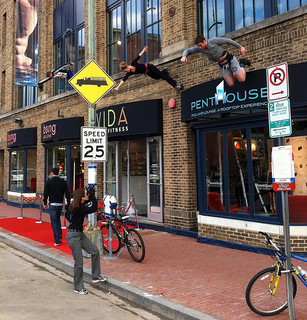
 Photo by Ted Eytan.
As part of a vote on the fiscal year 2015 budget, the Council approved several recommendations from the Tax Revision Commission, including some that will cut taxes for many D.C. residents.
Also approved was the so-called “yoga tax” — a 5.75 percent sales tax on “water consumption for home, storage of household goods/mini storage, carpet and upholstery cleaning, health clubs and tanning studios, car washes, and bowling alleys and billiard parlors.” That tax, which first was considered in 2010, was part of the commission recommendations published months ago. But its adoption in a budget that appeared 18 hours before the first Council vote seems to have blindsided many, a claim Council Chair Phil Mendelson addressed thusly: “The burden is on the public to pay attention to what we’re doing.”
A Facebook group started by Roam Fitness founder Graham King opposing the tax already has over 200 members. And VIDA Fitness, which has seven locations in D.C., sent an email to its members today, informing them of what the tax is and providing contact information for Councilmembers.
VIDA plans to lobby against the fitness tax as we do not believe D.C. residents should be monetarily penalized for being healthy. The fitness tax would result in an increased cost to fitness-related services across the board.
…
The final vote on this issue will take place in June. If you’d like to voice your concerns to the Council Members, we’ve provided contact information below.
Aaron Moore, director of operations for VIDA, says he’s not concerned that current members won’t keep or renew their membership. (“They won’t be happy about it,” he said, but they’ll do it.) It’s the people who perhaps need a gym membership the most — the obese, the sedentary — who may see this as “one more reason for them not to get active,” he said.
“At it’s most basic level, to really simplify it, the more people that are healthy, and the more people that have gym memberships, the more money it saves D.C.,” he said. “You want to incentivize people to do it. And you don’t incentivize people to do things by levying taxes and making things more expensive.”
As for Mendelson’s comment that the public needed to educate itself, Moore said the Council Chair’s “hiding behind the process”: “Saying ‘Oh, there was this vague policy document that no one really looks at,’ instead of really putting it out there.”
In 2010, when the tax last appeared, Moore said there was enough warning given that people could give their input, which was mainly negative. VIDA will once again mobilize people and will work with small business that would be affected, including Flow Yoga.
“We’re choosing to do what Mendelson chose not to do: Educating the public about what the tax is.”