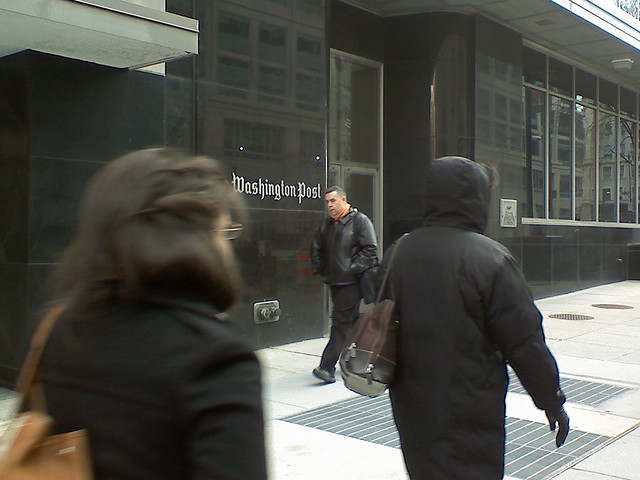
 Photo by Dan Macy
In the past week, the Washington Post and its new opinion venture, PostEverything, have published two pieces on violence against women. Both have thousands of people outraged at their central ideas: That being a college rape victim is a “coveted status” and that women can prevent abuse by getting married.
The first piece was written by Pulitzer Prize-winning columnist George Will and suggested that sexual assault against college women isn’t as big of a concern as the Obama administration would have you believe. While the Post’s opinion page editor did not respond to DCist’s request for comment, more than 38,000 people have signed a petition calling for Will to be fired.
The second was written by National Marriage Project director W. Bradford Wilcox and University of Illinois professor Robin Fretwell Wilson. Using the false assumption that correlation equals causation, the piece made the case for women to “stop taking lovers” and get married in order to save themselves from domestic violence. The headline was changed from “One way to end violence against women? Stop taking lovers and get married” to end with the answer “Married dads.”
PostEverything editor Adam B. Kushner apologized for the original headline, but said the piece’s content is in line with his site’s mission: “Publishing a wide range of perspectives about issues in politics and culture.”
Karma Cottman, executive director of the D.C. Coalition Against Domestic Violence, said it’s the “responsibility of the Washington Post, specifically when they’re looking at this issue” to use better judgment in publishing “even when it comes to editorials and opinion pieces, because it’s dangerous. It’s dangerous in terms of the reporting. It’s dangerous in terms of survivors that are reading this and feel like they don’t have support from their community. And it’s dangerous in terms of continuing the rape culture that we’re all working toward ending.”
It also speaks to, Cottman said, public opinion related to sexual assault and dating violence, as well as the position of women in this country. “Safety is a basic human right,” she said of the suggestion that women would be safer once they’re married.
The D.C. Coalition Against Domestic Violence wants to see the Post release a statement about the pieces and highlight resources for survivors. “While these are opinions, they can be harmful and the Washington Post [needs to] highlight that,” Cottman said, adding that the paper needs “to take care in what they publish” and recognize the impact it can have. They also plan to submit a letter to the editor.
While it doesn’t surprise Cottman that an editor wouldn’t recognize the problematic nature of these pieces, the Washington Post, she said, has “traditionally done a really good job reporting on these issues.”
“We certainly respect the fact that, from [Kushner’s] perspective, he has to present varying opinions,” Cottman said. “But at what point do you draw the line when it becomes dangerous?”
Andrea Gleaves, training and outreach specialist for the Coalition, said PostEverything should have given a “platform to other people to share their opinions” on the issue of violence against women. “We need multiple voices at the table,” she said. “When we give platform to one idea … without any other consideration or without advocates who are doing this work on the ground, [it] is really discouraging and really upsetting. There are people who work on the ground everyday to support survivor safety, and their voices are being ignored.”
In addition to a letter, the D.C. Coalition Against Domestic Violence has created a photo campaign to respond with actual things people can do to be proactive. With each photo, the text “One way to end violence against women?” will be followed by things like create healthy relationships and boundaries, respect women and educate my peers about sexual violence statistics.
In response to @WaPoThing we’re sharing our answers to “One Way to End Violence Against Women” #WaPoHeadlines pic.twitter.com/3zJTWQDiCZ
— DCCADV (@DCCADV) June 11, 2014
Cottman said they want to draw the broader connection between the position of women in this country — equal wages, housing and everything in between — and how that affects violence against women. “If we continue to subjugate women, we will continue to have violence,” she said.
Pieces like the ones published by the Post can have an impact on survivors, Cottman said, adding that they bring up feelings of victim blaming. They also force survivors to publicly tell their own stories to put a face on the issue. “People shouldn’t have to feel that.”