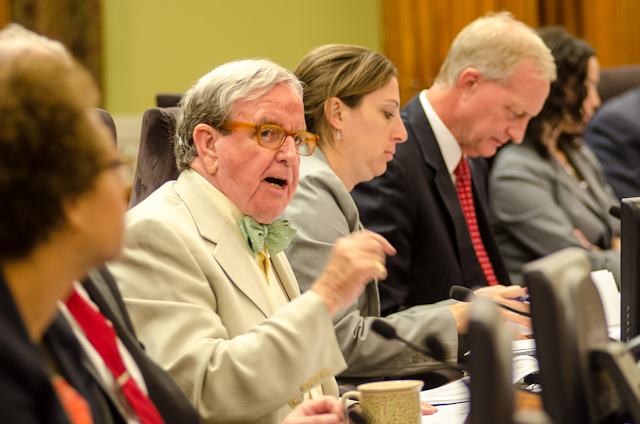
Jim Graham (D, Ward 1) at today’s hearing. Photo by Pablo Maurer
The D.C. Council got its first chance on Thursday morning to hear testimony from the public on the city’s proposal to help finance portions of D.C. United’s plan to build a new stadium at Buzzard Point in Southwest.
The basic details of the stadium deal have been known for some time: the District would handle the “horizontal” work — land acquisition and development of the infrastructure around the stadium site — while the team would handle the construction of the stadium itself. United would also benefit from some $40 million in tax incentives.
The most oft-discussed portion of the deal is a “land swap” between the city and real estate developer Akridge. The District plans to exchange the Frank D. Reeves Center, a government complex at 14th and U streets NW, for much of the land needed to construct the stadium.
Among the first to testify was city administrator Allen Lew, who over the past year and a half has negotiated the details of the arrangement. On Thursday, Lew laid out the specifics of the deal for the first time, allowing those in attendance to examine the deal’s complexities.
“It is clear and has been for some time,” said Lew, “that D.C. United needs a new home. Without a new home, D.C. United will be forced to leave the District. We will be losing thousands of new jobs and millions of dollars in new revenue.”
Just how far-reaching the city’s commitment in the deal is perhaps best demonstrated in a graph provided by John Ross, an official with the office of the Chief Financial Officer:

Lew and other city officials have suggested the stadium has the potential to create $2.3 billion of economic activity over 30 years as well as hundreds of full-time jobs and thousands of construction-related positions.
The Council heard testimony from dozens of witnesses. Some expressed fervent support for the agreement and took a seat at the witness table sporting the black and red colors of the team they’d come to support. Others expressed reservations about the deal, raising a handful of questions about its mechanics. And still others expressed their disdain for the deal as a whole.
United themselves were officially represented by head coach Ben Olsen and co-owner Jason Levien. Levien hammered home the perceived financial positives of the deal, while Olsen, a 16-year D.C. resident, gave a more personal appeal, focusing on his connection to the District and soccer’s recent explosion in popularity.
“At Buzzard Point, a soccer stadium will play a defining role for the next generation of District residents, a group that includes my children,” said Olsen. “I want them to have the chance to see and be a part of a legacy on and off the field. I want them to have a place to see a sport that is unifying, inclusive and reflective of the District. “
The Councilmembers in attendance expressed varying degrees of support for the arrangement, unanimous in their desire to keep United in the District. A few, however, expressed their concerns, chief among them the perceived undervaluation of the Reeves Center itself, which has been appraised at multiple points in the past few years at anywhere from $55 million to $186 million. The lower of those figures is the one being used in the deal as it stands.
Councilmember Jim Graham (D-Ward 1) was quick to suggest that the land swap be scrapped in its entirety, suggesting that the city would be better served by putting the property on the open market. “There would be international interest in the Reeves Center which would push the price far above what’s on the table,” Graham suggested.
Detractors of the deal offered a wide range of criticisms, often agreeing with Graham’s assertion while also raising questions about the environmental and financial impacts of the plan. Others expressed concern with the type of structure that will replace the Reeves structure at 14th and U, insisting that low-income housing or down floor retail be part of the building, concerns which Lew suggested would be taken into account.
Lew also suggested that the land swap itself is a necessary evil, a way to avoid potentially violating a cap on borrowing or struggling to come up with the cash in the city’s budget.
Though the Council chamber was packed during the opening stages of the hearing, it emptied out quickly once the USA’s World Cup encounter with Germany got underway around noon. At one point, Councilmember Jack Evans called out nearly 20 names in a row before finding a witness who was actually present.
Many of those people were likely in a downstairs hearing room, where the city had set up an impromptu viewing area for citizens who’d expressed their concerns about missing the match. Among them was Mayor Vincent Gray, who at halftime unexpectedly took to the podium to give a bit of a pep talk.
“Look at these guys,” Gray exclaimed, referring to the national team. “They’re gonna advance! And so are we, we’re going to get this stadium deal done!”
The U.S. held up their end of the bargain. Whether the second half of that statement holds true still remains to be seen.
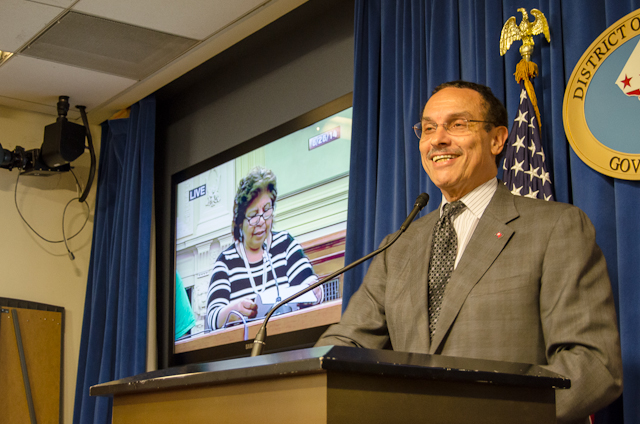
Mayor Gray addresses those who gathered to watch the US team in the hearing room.