 Photo by Matt Cohen.
The days of foam containers in the District are officially numbered.
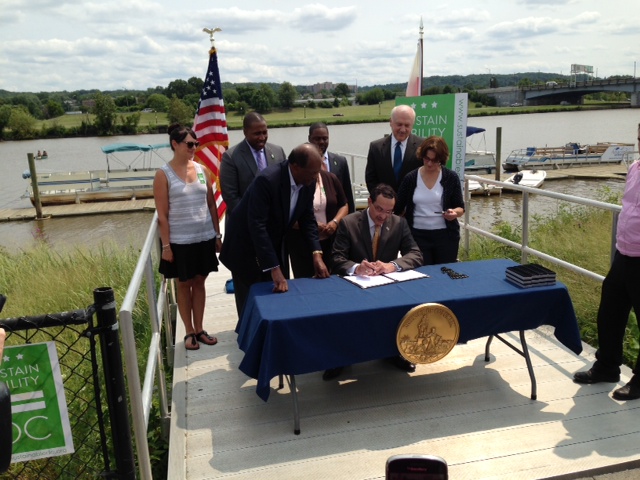
Earlier this afternoon, Mayor Vince Gray—joined by Councilmembers Anita Bonds (D-At Large), Marion Barry (D-Ward 8), and Mary Cheh (D-Ward 3) — signed the Sustainable D.C. Omnibus Act of 2014 into law, which includes a provision to ban the use of foam containers and products by 2016.
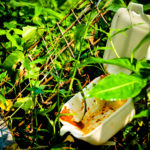
The ban on polystyrene-made foam containers follows suit with similar legislation passed in several West Coast cities, including Portland, San Francisco, and Seattle. The legislation is based off of recent scientific data that’s proved that foam containers made from polystyrene are very harmful to the environment. Under the new law, the penalty for using polystyrene would be a fine. Instead of the traditional foam containers, businesses will have to use compostable and recyclable ones.
“I’m here to sign this bill to help make D.C. the most livable and green place in the U.S.,” Gray said before the signing at the Anacostia Community Boathouse. The legislation, which was submitted to the Council by Gray—with help from Councilmembers Bonds and Barry—passed a Council vote a couple weeks ago. The bill is part of Gray’s commitment to make D.C. a more environmentally friendly city and also includes measures to improve building performance reporting, expand transit subsidies, increase the District’s urban tree canopy, and even one to increase urban beekeeping in D.C.
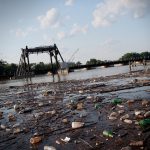
But the bill Gray signed today is just one part in a larger effort to make D.C. a more environmentally sound place, a big part of which includes cleaning up the Anacostia River. “This is the largest population we’ve had in D.C. in 30 years,” Gray said, “and we want to help make the river a swimmable and fishable place.”
The District Department of the Environment started field sampling the river earlier this month, which marks the first phase of the “Anacostia River Sediment Project.” While the project aims to clean up the Anacostia River, the first phase, United for a Healthy Anacostia River says, involves “taking core samples of river sediment, water, and microorganisms to determine the extent of contamination and assess the risk posed to human health and ecology.”
Before signing the bill into law, Gray announced the formation of a leadership council tasked with leading the effort into cleaning up the Anacostia River. “This is the first time in history the District government is taking the lead in researching and cleaning up the Anacostia River,” Gray said.
“I’m looking forward to the day I can fish in the Anacostia,” Barry joked, “but more importantly, the day I can eat the fish that I catch.”