There’s no question that D.C. is a museum town. Situated just off the National Mall, dozens of free Smithsonian Museums—such as the National Air & Space Museum, the Museum of Natural History, and others—attract millions of visitors to D.C. every year. Those museums are great, but the truth is, there’s so much more beyond the confines of the National Mall. Below, DCist writers highlight their favorite museums in D.C. that aren’t on the National Mall.
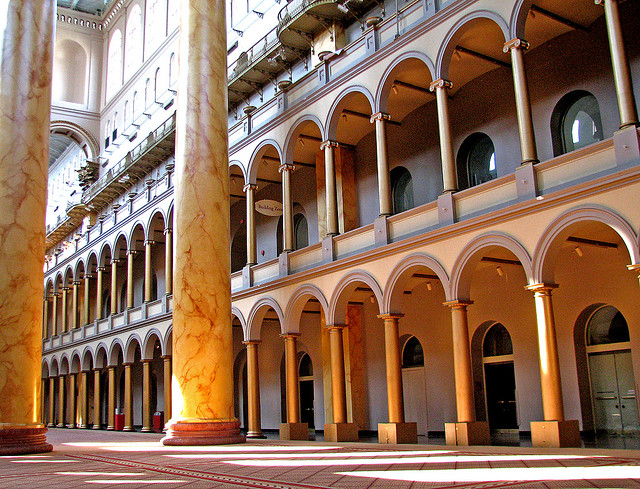 Photo by T.D. Ford.
AFRICAN AMERICAN CIVIL WAR MUSEUM AND MEMORIAL: You’ve undoubtedly seen the African American Civil War Memorial situated right outside the 10th Street NW exit of the U Street Metro stop, but have you been to the museum? Did you even know there was a museum right across the street? Didn’t think so. Easily one of D.C.’s most hidden treasures, the African American Civil War Museum is small, but contains fascinating artifacts, pictures, clothing, and other tidbits about the role African Americans played in the Civil War. It’s a small museum, but nonetheless important. — Matt Cohen
The African American Civil War Museum and Memorial is located at 1925 Vermont Avenue NW.
DUMBARTON OAKS: People tend to visit Dumbarton Oaks for the gardens, which are particularly stunning during cherry blossom season. However, the first time I visited I never made it out of the museum, a fact I do not regret for one moment. The stately mansion in Georgetown contains a gorgeous collection of rare books, gilded Byzantine art, and treasures from the Maya, Inca, and Aztec civilizations. For anyone with an interest in ancient cultures and artifacts, this is unquestionably the place to be. While it lacks the vastness of a Smithsonian collection, Dumbarton more than makes up for it with the depth of its collections. The building itself is also worth a visit for for it’s architecture—one wing of the museum was designed by renowned architect Phillip Johnson, while another portion is decorated in marbles and frescos from the Italian Renaissance. Located pretty far off the beaten path, the Dumbarton Oaks museum also has the added benefit of being blissfully quiet and empty. You can peacefully wander the beautifully appointed rooms at your leisure without being disturbed by hordes of tourists and baby strollers. In my opinion, it’s the most interesting, pleasant, and civilized museum in the entire city. — Alicia Mazzara
Dumbarton Oaks is located at 1703 32nd Street NW.
INTERNATIONAL SPY MUSEUM: It would really be a mistake to walk into the Spy Museum with the expectation to learn an awful lot about real spy craft. But that’s an illusion I doubt many tourists have. Sure, there’s an impressive collection on display of real spy artifacts—a cyanide-dispensing umbrella gun, in particular, would fit right in as something cooked up in Q’s lab—but for the most part, the real draw of the visit is the chance to play Bond. The rather vanilla exhibit invites visitors to crawl around through air ducts (which Mythbusters has deemed possibly the least sneaky way to enter a building), and the current Bond villains exhibition expands on that with simulation shark tanks and a chance to try to hang on to a steel girder for longer than Pierce Brosnan did in Tomorrow Never Dies. In reality, your standard spy kit probably isn’t much more exciting than Ryan Fogle’s wig and goofy sunglasses. Reality is boring. As long as you’re going to pay to play spy (and let’s face it, that’s why everyone goes), your best bet is to skip the museum proper; instead, head out on one of the cheaper and much less crowded espionage escapism missions hosted by the museum. “Spy in the City” is a machine-guided walking tour of the Gallery Place neighborhood, where the city comes alive with hidden messages and puzzles. “Operation Spy” takes place in a series of sets built into the heart of the museum, with plenty of safes to crack and drawers of secret plans and letters to furtively search through. Give up on the pretense that you’ll learn something—the really cool stuff is probably all classified anyway. — Riley Croghan
THE U.S. HOLOCAUST MEMORIAL MUSEUM: The Holocaust Memorial Museum bills itself as a “living memorial to the Holocaust,” and it’s just that. While it may seem undesirable to visit a museum dedicated to one of the most atrocious genocides in human history, the museum does a fantastic job of not only showcasing artifacts from the Holocaust, but paying tribute to the millions of victims and the families of the victims. It serves not only as a sobering reminder of a shameful period in the world’s past, but also as a reminder to never let something like that happen again. — Matt Cohen
The U.S. Holocaust Memorial Museum is located at 100 Raoul Wallenberg Place SW.
The International Spy Museum is located at 800 F Street NW.
THE PHILLIPS COLLECTION: The Phillips Collection at 21st and Q Streets NW bills itself as America’s first museum of modern art. Opened in 1921, the museum grew out of art collector Duncan Phillips’ personal collection of modern and contemporary (to him) art and includes names like Renoir (particularly his “Luncheon of the Boating Party,”), Mark Rothko, half of Jacob Lawrence’s “Migration Series,” plus works by Klee, Matisse, O’Keefe, Van Gogh, and a few older artists that reminded Phillips of modern art. The museum is situated in the beautiful Phillips family mansion, which has been modified, with new wings added over the years. The building also hosts traveling shows and the ever-popular “Phillips After Five” events the first Thursday of every month, which combines a pseudo-happy hour with lectures or performances. — Andrew Wiseman
The Phillips Collection is located at 1600 21st Street NW.
NATIONAL BONSAI & PENJING MUSEUM Located inside the magnificent National Arboretum is the National Bonsai & Penjing Museum, which boasts a spectacular collection of the trees and potted landscapes. The best part of the museum, which is mainly outdoors but also features an indoor pavilion, are the knowledgable volunteers, who will explain the history of each bonsai. Do not miss the nearly 400-year-old Japanese White Pine. — Sarah Anne Hughes
The National Bonsai & Penjing Museum is located inside the National Arboretum (3501 New York Avenue NE).
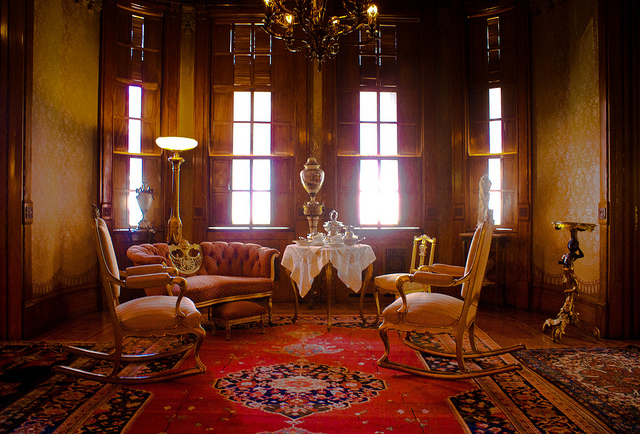 Inside the Heurich House Museum. Photo by Caroline Angelo.
HEURICH HOUSE MUSEUM: You‘ve walked past it dozens, if not hundreds of times. but most Washingtonians have never set foot in the distinguished Victorian mansion that stands like an elegant appendage on New Hampshire Avenue, just southwest of Dupont Circle. Also known as the Brewmaster’s Castle, the house was built near the end of the 19th century by a German emigrant who had $200 to his name when he came to America. It grew to be Washington’s largest private employer with the Christian Heurich Brewing Company. Heurich’s brewery supplied Washington beer lovers from what is now the site of the Kennedy Center. The factory shut down in 1955 and was demolished seven years later, but local beer drinkers may recall a brew by the name of Old Heurich. Grandson Gary F. Heurich tried to revive the brand, but this venture went flat in 2006. Christian Heurich died in 1945, and his widow deeded the house to the Washington Historical Society, who took up shop there in 1956. Preservation standards of 50 years ago were not what they are now, and some amount of cleanup was necessary to undo the previous tenant’s misguided paint jobs. But thanks to that tenant, many of the Heurich’s original late-Victorian furnishings and decorations are intact, including: a Tiffany chandelier; massive, intricately hand-carved furniture and mantles; a room modeled after a German bierstube (though Heurich’s temperance-minded third wife converted to a breakfast room); and the lasting results of enthusiastic fireproofing. — Pat Padua, from a previous article about the Heurich House Museum,
The Heurich House Museum is located at 1307 New Hampshire Avenue NW.
NEWSEUM: When it’s not wrapped in silly exhibits like a recent one promoting a certain satirical film about broadcast journalists in the ’80s, the Newseum is actually a fascinating snapshot of the history of journalism (OK, it’s more than a snapshot, as you can get lost for hours perusing through its collection of old newspapers). From exhibits documenting the first newspapers and printing presses, to artifacts from major world events like the Berlin Wall being torn down and 9/11, the museum is quite a remarkable and robust tribute to journalism in all its forms—from print to radio to broadcast to, yes, web journalism. I just wish they’d focus more on real exhibits rather than promoting a movie. — Matt Cohen
The Newseum is located at 555 Pennsylvania Avenue NW.
NATIONAL PORTRAIT GALLERY AND AMERICAN ART MUSEUM: Although it’s a Smithsonian Museum, I’m including it on this list for two reasons: A) it stands apart from the cluster of National Mall museums, and B) It’s quietly one of the best curated art museums in D.C. While the permanent exhibits in both the Portrait Gallery wing and the American Art Museum wing are stunning significant in their own right, the exhibitions that come and go are quite exquisite. The “Art of Video Games” exhibit a couple years ago was a breathtakingly fascinating look at an art form that’s often overlooked, while the recent “American Cool” portrait series provided an intelligent and fascinating discourse for the influential cultural figures in the past century. With relatively less traffic than its sister museums, the National Portrait Gallery and American Art Museum is easily one of the most underrated in D.C. — Matt Cohen
The National Portrait Gallery and American Art Museum is located at 8th and F Streets NW.
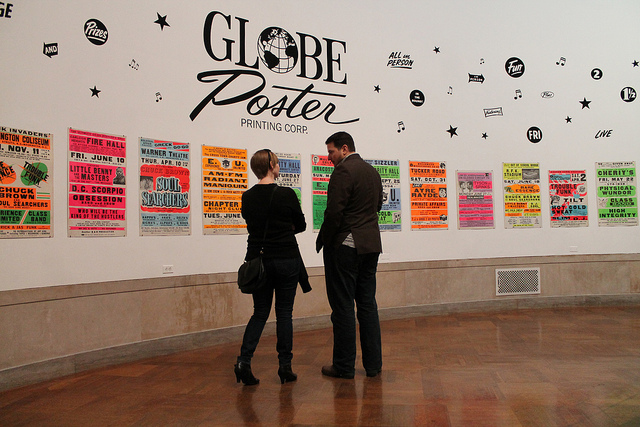 Old Globe Posters on display during the “Pump Me Up” exhibit at the Corcoran. Photo by Elvert Barnes.
THE CORCORAN GALLERY OF ART: While the days of the Corcoran Gallery of Art currently are numbered—due to longtime financial trouble, an agreement was inked for the National Gallery of Art to inherit its collection, and George Washington University to manage the college—let’s take a moment to reflect on how great the Corcoran is now. The expansive collection of classic and contemporary art—as well as sculptures and photography—are wonderful, but the occasional special exhibit, like last year’s “Pump Me Up: D.C. Subculture of the 1980s,” was a sobering and soulful reminder of just how much of a local institution the Corcoran is. Long live the Corcoran. — Matt Cohen
NATIONAL BUILDING MUSEUM: Upon entering the National Building Museum, you’ll see a vast openness, filled with, well, nothing. “This is it?” You might think to yourself. Well, yes and no. While the museum itself has many small exhibits—all interesting in their own right—the true marvel of the museum is the building itself, which is an architectural gem, and one with a fascinating history. But the National Building Museums special exhibits—like the recent one in which a labyrinth-like maze was constructed inside the atrium, or the “Overdrive: L.A. Modern” exhibition—are always a treat. — Matt Cohen
The National Building Museum is located at 401 F Street NW.
NATIONAL POSTAL MUSEUM: Located next to Union Station, the National Postal Museum doesn’t get quite as much attention as the other Smithsonian Museums in D.C. While the history of the United States Postal Service may not be quite as exciting as space travel or dinosaurs, the museum’s exhibits do a great job of explaining everything mail from the Pony Express to stamps. Seriously, so many stamps! There are also planes, a mail truck and a railcar in the lobby, if you need something a bit flashier to look at. While I couldn’t and wouldn’t pick a favorite Smithsonian museum, this is the best for a quiet afternoon off the beaten path. — Sarah Anne Hughes
The Postal Museum is located at 2 Massachusetts Avenue NE.