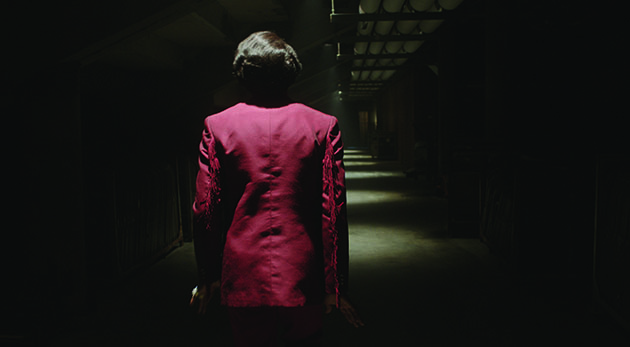
 Chadwick Boseman (Universal)
Early in their careers, before either was well known, James Brown and Little Richard shared the same manager. According to R.J. Smith’s Brown biography, The One, Richard took a sudden leave of absence from one early tour, and when emcees along the deep South circuit announced Little Richard, James Brown appeared on stage. Some audiences whispered uncertainly, but one Alabama audience who knew Brown was not who they paid to see grew restless. Brown responded by doing ever harder backflips, jumping off the piano and landing in a trademark split. He met resistance to who he was by being even more himself and won over the audience.
This anecdote, which seems like it cannot possibly be true, is not in director Tate Taylor’s biopic, Get on Up, but it gives you an idea of what made Brown, a flawed human being by any account, such a magnetic performer. Much like Brown found his funky voice by abandoning conventional blues chord progressions for a modal approach, Taylor and screenwriters Jez Butterworth and John-Henry Butterworth depart from conventional narrative structure to tell an impressionistic story of a man who changed the rhythm of pop music.The movie doesn’t find a consistent rhythm, and eventually falls into ordinary biopic tropes, but it gets one essential thing right: the music.
The movie begins in 1988. Brown, dressed in a garish green tracksuit, is annoyed to learn that an unauthorized party has used his personal office restroom. Brown shoots out a meeting held in his office building and sends the police on a high-speed chase. This early scene comes dangerously close to cartoon, its structure and ’80s feel a vague mix of Pulp Fiction and an SNL skit. But it’s a good starting point for Boseman’s spot-on Brown impersonation. From Brown’s peculiar swagger, holding his open palms to the ground as if balancing himself, to a voice that was not always easy to understand, the actor gets the mannerisms right, and builds a volatile character who’s opportunistic, frightening and vulnerable, like a funky Klaus Kinski.
Scenes freely jump back and forth in the chronology of Brown’s life, as if assembling a non-linear mix-tape of James Brown’s life moments. The opening car chase cuts to Brown as a young boy alone in the woods. His mother (Viola Davis) soon comes into the frame, chasing him playfully, but the sight of Brown by himself foreshadows a life of neglect. His mother abandoned him, his father was abusive, and the young James Brown was left to fend for himself — “I Don’t Want Nobody to Give Me Nothing (Open up the Door I’ll Get It Myself)” was one of his typically defiant ’70s titles.
Get on Up is an inconsistent portrait of a complex, volcanic personality who was one of the most influential figures in pop music. This kind of biopic has to get the music right, but, as with Clint Eastwood’s Jersey Boys, this is not something you can count on Hollywood to handle. With the help of co-producer and musical consultant Mick Jagger, the movie completely sells Brown’s music, using his original recordings for most of the film, seamlessly mixed with newly recorded music (I couldn’t tell where). Throughout the episodic portrayal of Brown’s life, the music and its development comes through: from the rhythmic variations Brown gets out of one word in his first hit “Please, Please, Please,” which an early producer makes clear was a strange record at the time; to a band rehearsal for “Cold Sweat” in which he reminds each musician that every instrument is a drum. It may be hard to hear Brown’s genius in oldies radio staples, but his rhythms changed pop music in a way that has been assimilated into the mainstream so well that you can even hear it in the slap bass of the musical transitions on Seinfeld, that least funky of sit-coms. (Read a fascinating article on James Brown and Miles Davis’ influence on film music here. )
This biopic takes poetic license as biopics do. Brown met longtime bandmate Bobby Byrd (played here by Nelsan Ellis) on the baseball diamond, not in prison. The movie does not shy from Brown’s history of domestic violence, but doesn’t focus on this. Its title, after all, for all its suggestion of political defiance and personal resilience, comes from “Sex Machine.” That would have been the title of a very different biopic indeed. Get on Up is a watchable biopic with an essential soundtrack.
—
Get on Up
Directed by Tate Taylor
Written by Jez Butterworth and John-Henry Butterworth
With Chadwick Boseman, Nelsan Ellis, Dan Aykroyd, Viola Davis.
Rated PG-13 for sexual content, drug use, some strong language, and violent situations.
Running time 138 minutes
Opens today at AMC Georgetown, AMC Mazza Gallerie, Regal Gallery Place, Angelika Mosaic, and other area multiplexes.