Of the many positives parents will find in the changes to school boundaries and feeder patterns accepted last week by Mayor Vincent Gray, there’s at least one some may object to.
Students in certain areas of the city will now attend matter-of-right schools with lower test scores. If the changes were implemented during the 2013-14 school year, 17 percent of elementary students citywide would be assigned to one boundary, as opposed to multiple, while 15 percent would be reassigned to a new boundary. Those numbers are nine percent and 40 percent, respectively, for middle school students, and 11 percent and 26 percent, respectively, for high school students.
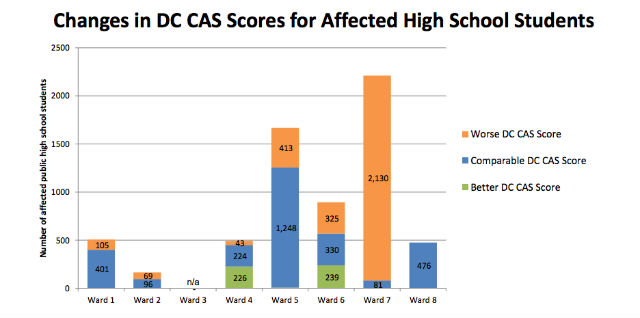
In Ward 7, the matter-of-right school for 2,130 of the 2,211 high school students affected by a boundary changes would switch to one with lower CAS scores. As the City Paper pointed out, that’s because many students would move from Eastern High School in Ward 6 to H.D. Woodson in Ward 7.
David Catania, the chair of Council’s education committee and a mayoral hopeful, said in a statement he will “delay implementation of the recommendations until at least school year 2016-2017” if elected, partially, because of this.
“I have maintained all along that I cannot support a plan that moves students from higher performing schools to lower performing ones. Yet the final recommendations do just that,” Catania said. “In addition, the recommendations are silent as to how we intend to improve those lower performing schools. Asking parents and guardians to take this leap of faith without more is asking too much.”
“It didn’t appear that the boundary committee really looked into the Ward 7 residents,” Yvette Alexander, the Councilmember who represents that Ward, told DCist last week. “That was one request: That Eastern High School could remain a choice for Ward 7 students, including those who moved from Spingarn [which closed last year.] … They should be given that choice, and they shouldn’t be out-of-boundary.”
Eboni-Rose Thompson, a program specialist for Save the Children US and Advisory Committee on Student Assignment member from Ward 7, said the final recommendations reflect a balance of input from residents and an overall “thoughtful” plan.
A native Washingtonian whose mother went to Eastern, Thompson said parents wanted feeder schools to line up with boundaries.
“That was one the most immediate things that needed to be addressed,” Thompson said of H.D. Woodson not having enough feeder middle schools. “That’s really a result of consolidations, not necessarily the amount of children in Ward 7.”
“If [H.D.] Wilson was going to continue to be a viable high school, it needed to have a feeder pattern,” she said. Because the new citywide policy puts an emphasis on neighborhood schools by limiting feeders to geographic boundaries, students who before crossed the Anacostia River to attend Eastern no longer have that option.
That’s what people asked for, said Thompson, who serves as chair of the Ward 7 Education Council and is a Advisory Neighborhood Commissioner. “If people understood what the consequences of that would be, that’s something different.”
Thompson said she encouraged many people to attend focus and working groups, and she spoke to her constituents — whose children were reassigned from Eastern to Anacostia High School.
“Did it have to be that Eastern’s boundary didn’t cross the [Anacostia] River anymore? I would say, ‘No, that didn’t have to be,'” she said. “But if we were gonna stay true to the policy set forth for the rest of the city, yes, this is the logical consequence of that.”
Thompson also points out that more students are affected in Ward 7 rather than say Ward 2 because there are more students in Ward 7. There’s also the “large number of school closures,” she said, leaving “boundaries and … feeder patterns decimated.”
“We did our best to make thoughtful decision,” Thompson said, adding that, while much of the feedback was good, some of it was conflicting. For example, some parents wanted both neighborhood schools and choice or diversity.
When asked what the next step should be, Alexander said “parents should always remain vigilant and active in their student’s lives.
“A lot of students are going to be on the out-of-boundary. They will look for other options for their children, or they’re going to hopefully, with a new administration coming in. That would be No. 1 on the new agenda with the new mayor,” Alexander continued. “I don’t know who will be mayor in January, but that is a priority.”
Alexander said if students “are being forced to go to a school in their neighborhood, then that should should be equivalent” to the best schools across the city.
“Whatever programs are at Eastern High School, we expect them to be at H.D. Woodson High School,” she said. “And that’s the bottom line. We want equity across the board for education.”
“People wanted this process to address quality,” Thompson said. “I think it’s completely reasonable to demand quality education for all children. I think that the way to address that, though, is not just to draw lines. Because when we really talk about students moving from a school with higher test scores to a school with lower test scores — although they’re not locked in; we still have substantial choice in D.C. — it’s the students that take the tests. It’s not the seats in that school. It’s not the teachers in that schools. It’s their test scores that make it a high-performing school.”
Thompson said the committee looked at “population and need” — “where students are, where students can get to” — “rather than just how many students are there now.”
“I think it’s incomplete to say that, because this is one of the consequences, it wasn’t thoughtfully considered,” Thompson said. “It was.”
To actually improve lower performing schools, Thompson said that has to be done through programing, resources and instruction.
“We don’t address that through drawing lines,” she said. “What we were able to do with this process is to start to create some of the conditions that could lead to an increase in equality system-wide.”