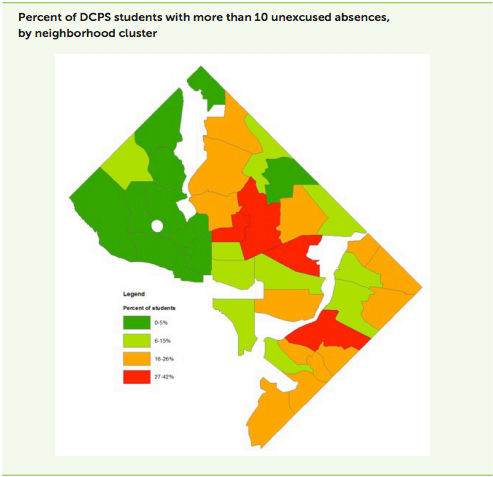
 Via DC Kids Count.
As another school year begins in D.C., officials will once again try to tackle the city’s pervasive absenteeism problem. To see how truancy negatively affects students, one only needs to look at test scores.
The non-profit Attendance Works recently analyzed results from the 2013 National Assessment for Educational Progress to see the impact of missed school days on students. For D.C. reading scores, a 14-point difference is seen between eighth graders who missed zero days during the month before testing and those who missed three or more days. That gap is 12 points for math.
The difference is even greater for fourth graders, with a 20-point gap between these two groups of students for reading and a 17-point gap for math.
As D.C. Kids Count reported in April, one in five students, both at charter and public schools, had more than ten unexcused absences during the 2012-2013 year. That’s more than 9,000 kids enrolled through D.C. Public School and 6,000 at D.C. charter schools. Ten percent of DCPS students had more than 20 unexcused absences during that period, while six percent were “highly truant” at charter schools. Those numbers of much higher when one looks at just high school students. Thirty percent of DCPS high school students were highly truant, while 14 percent missed more than 20 days without an excuse at charter schools.
Truant students — those who missed more than 10 days — are supposed to be referred to the D.C. Child and Family Services Agency, but DCPS has struggled to do so, as the Post reported.
“The extent of absenteeism that the NAEP analysis and others studies document from kindergarten through high school, along with its direct connection to student achievement, demands that school districts and state education agencies take action to staunch the loss of valuable instructional time,” the report from Attendance Works states. “This is important for educators and policymakers investing in early education to ensure students have a strong start in school.” Recommendations in the report include parent engagement and making absence data publicly available.