 Photo by Matt Cohen.
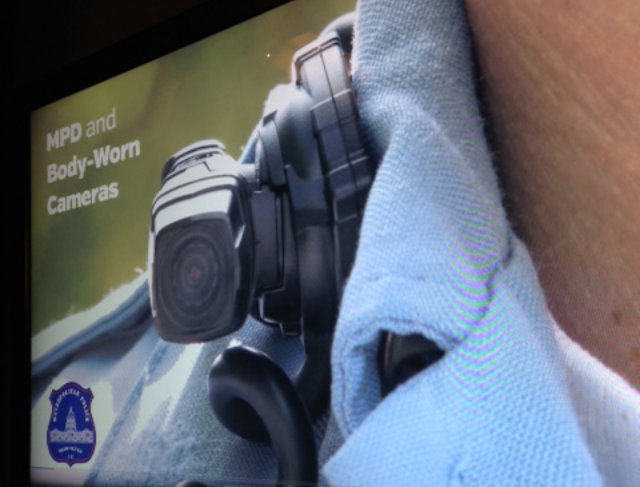
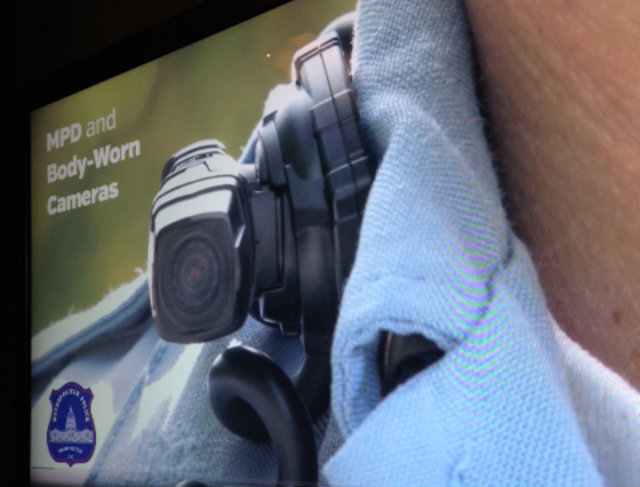
Beginning October 1, 165 D.C. police officers will be equipped with a new piece of equipment: a body-worn camera.
Earlier today, Mayor Vince Gray and Metropolitan Police Department chief Cathy Lanier announced a new pilot program to require MPD officers to wear body cameras on their person at all times.”Testing body cameras on officers is a way to foster transparency in law enforcement and improve police services and community relations,” Gray said during at press conference. “We believe that the body-worn cameras will improve police activity as the city’s population grows.”
After the police shooting of Michael Brown in Ferguson, Mo., many are calling for reform and more transparency in police procedures and practice throughout the nation, but D.C.’s body camera program isn’t a direct response to the Brown shooting. Gray says plans for this program have been in the works for more than a year, with funding for the pilot program allocated and approved in the FYF14 budget.
“People ask me if the police shooting of Michael Brown in Ferguson was the impetus for this,” Gray said. “Let me make it clear that we believe this program will prevent things like this from happening and we’ve been working on it far before the shooting.”
For the pilot program, Lanier says the 165 officers will be testing out five different kinds of body cameras, which will be worn either on an officer’s torso, or attached to glasses. She says they spent “almost 18 months” researching cameras and narrowed it down to 5 final models. During the trial period, they’ll evaluate each model to see what’s “most comfortable for officers,” what model “captures video that’s advantageous” to MPD, and what model has the best storage capabilities.
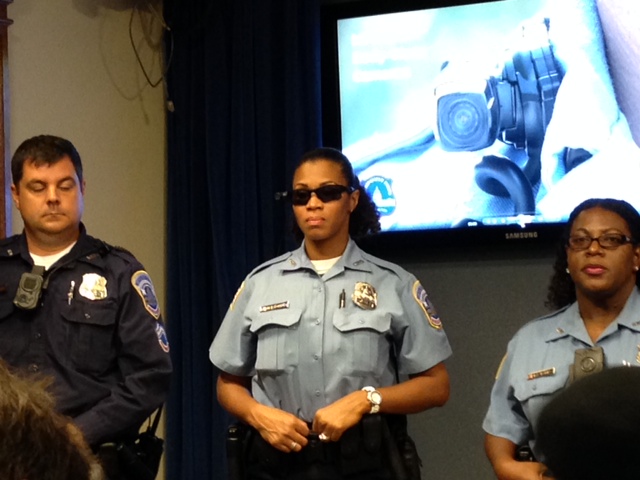 Photo by Matt Cohen.
The impetus of this program comes after a number of complaints alleging police misconduct. In May, the Police Complaints Board issued a report suggesting that the MPD implement this program, writing that body-worn cameras “can be used to resolve many of these types of citizen complaints and to train officers on proper police procedures.” The program also received support from the NAACP, who initially sent a petition to Gray asking that officers be required to wear body cameras, but withdrew the petition after they learned that a program was in the works.
Under this program, participating MPD officers will wear an body-worn camera at all times, but only turn it at the beginning of every interaction. The footage will be saved for 90 days before being erased, unless it’s being used as evidence. “People’s opinions on a scene often vary….now we’ll have video,” Lanier said. “This gives us an unbiased witnessed.”
There are some exceptions as to when a camera will be turned on, Lanier says, such as if an officer is in a place of privacy, “like a locker room.” Lanier also says a victim can request for a camera to be turned off, if the circumstances don’t make them feel comfortable, such as if a sexual assault victim being interviewed by police doesn’t want a camera in their face. However, that request may not always be granted, depending on the situation.
But one part of the program MPD is still trying to figure out is the best way to make footage available for those that request it via the Freedom of Information Act. Lanier says some footage used as evidence might have to be redacted—to blur victim’s faces and protect names—before they can be made available via FOIA, and that process can “take a long time,” she says.
After the sixth month trial period, Lanier says MPD will evaluate the effectiveness of the program and figure out the best way to move forward in requiring all officers to wear body cameras. “We are looking at the best practices for implementing these devices,” Lanier said. “We are in an age where this type of technology is becoming more common, and we want to capitalize on that. The presence of cameras will benefit the community and MPD members by improving police services, increasing accountability, and enhancing public safety.”