

 If you’ve been questioning your ability to change the world, Nicholas Kristof is coming to set you straight. Politics and Prose and Sixth & I Historic Synagogue co-host his appearance this Monday, September 29th at Sixth & I, where he will talk about his new book A Path Appears: Transforming Lives, Creating Opportunity (Knopf, $28).
The New York Times writer again teamed up with wife and colleague Sheryl WuDunn to write A Path Appears. The book is an overview of charitable giving in the United States, a how-to guide for personally making a difference, and a source of inspiration to show that it’s indeed possible.
In an NPR interview, the authors cited progress we’ve already seen in some international epidemics. “When I first traveled around in Africa,” Kristof said, “I was really struck by the blindness everywhere. River blindness, trachoma, so many middle-age people who were unproductive and could not help. In these days, because of the work of Jimmy Carter and so many others, middle-age, young people are not going blind anymore.” WuDunn added, “I mean, for centuries, we’ve had extreme poverty. But now, it is at the point where 20 percent of the world’s population is in extreme poverty and, actually, eradication of poverty is within sight.”
But if you’re not a doctor-scientist, social entrepreneur, or Bill Gates, you can’t do anything to help people. Just kidding! Kristof and WuDunn prove that enacting change is ridiculously doable for the average person. With pictures, brief bios, and website information, A Path Appears reads kind of like a Facebook of generosity. The givers are of all ages and backgrounds with various levels of resources.
The book repeatedly encourages readers to think on small scales, releasing that paralytic feeling in the face of global problems. When you focus on doing something for one person or family, “changing the world” suddenly feels attainable and satisfying.
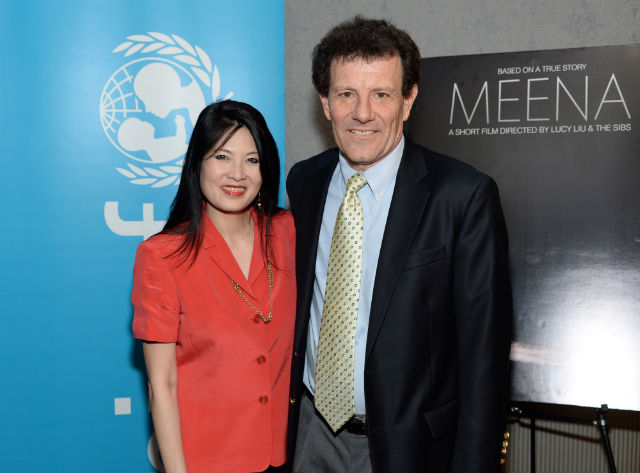 Authors Sheryl WuDunn and Nicholas Kristof. (Photo by Dimitrios Kambouris/Getty Images for UNICEF)
Kristof and WuDunn note the importance of “intervening early” in someone’s life. A domino effect often ensues. For example, clubfoot is one of the most common birth defects that leaves a child unable to walk, go to school, or eventually work. The corrective procedure is simple and inexpensive, so it is frequently administered in countries like the United States. Not so in poorer countries. But donating a couple hundred dollars through American aid group FirstStep will pay for one of these kid’s procedures. One person can certainly change the world for one person.
In addition to the anecdotes, A Path Appears offers an instruction manual for aspiring world-changers. First, figure out what cause you’re passionate about as soon as possible. Then, you can take one or several next steps. Donate to a charity; in some places, very little goes a long way. Arrange a monthly happy hour with friends as an informal “giving circle” that discusses things you can do. Volunteer with effective organizations. Make a donations page for easy fundraising. Become an organ donor.
The authors also acknowledge that not all charities are totally upstanding. They give advice on how to identify and avoid the sketchy ones. The back of the book also has a comprehensive directory for many specific organizations and charitable opportunities.
Kristof and WuDunn have now written four books together, including bestseller Half The Sky, which addressed global struggles faced by women and children. They both won Pulitzer prizes for their New York Times coverage of China, and Kristof won a separate Pulitzer for his op-ed column in the newspaper. The couple lives in New York City with their three children.
A book and ticket to the event can be purchased online for $35. A signing will follow the talk. Doors open at 6 p.m.



